- Zelensky on strike deep in Russia: “Su-24M” and four devices destroyed
- Germany sends a clear signal to Russia: nearly 12 billion euro missile arsenal being prepared
- Strikes shook Russia overnight: flames engulfed an oil plant and the “Ozon” logistics center
- New shot in the trade war with Russia: Armenia took unplanned actions
You can find the latest news about Russia’s invasion of Ukraine HERE.
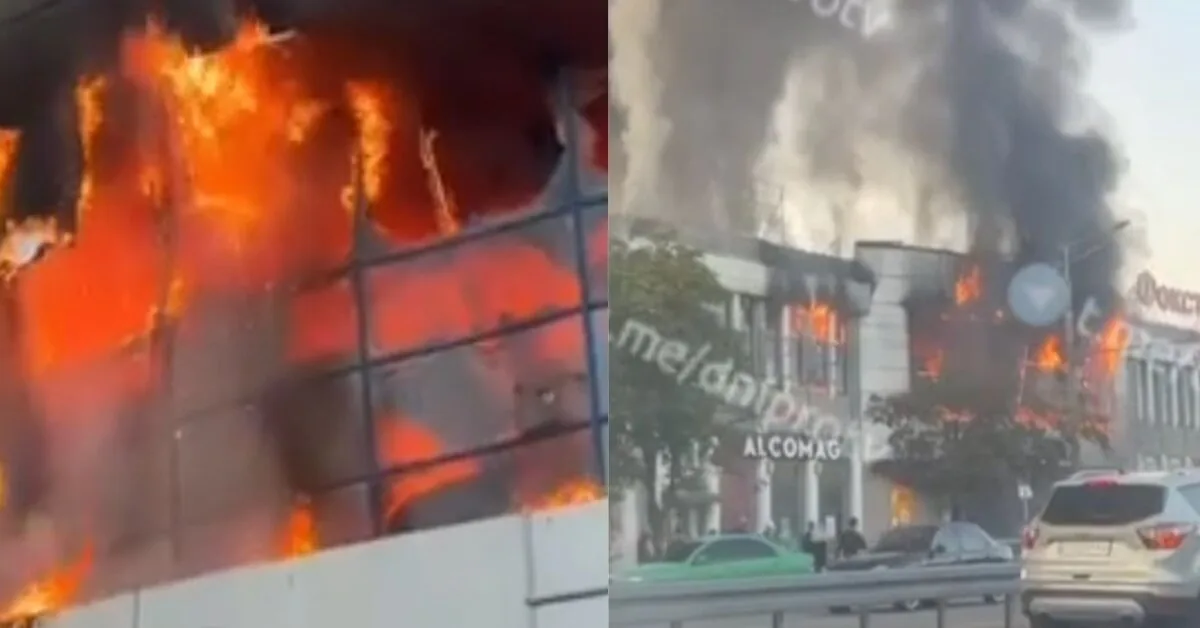
Drones attacked Russia’s largest “Ozon” warehouse in Orenburg
08:53

Drones attacked the largest logistics warehouse belonging to the online trading platform “Ozon” in Orenburg, Russia. Videos and photos of the attack have been posted online, showing a rising column of smoke.
Read more Sunday «Group»: can you group 16 words into 4 categories?
The attack was also confirmed by local authorities. Orenburg mayor Albert Jumadilov stated that several drones were shot down in an area with industrial facilities, and their debris fell within the “Ozon” logistics complex territory.
“Ozon” also confirmed that the company’s warehouse was damaged. It is reported that about 300 employees were evacuated, and goods stored in this facility were temporarily removed from the trading platform’s offer. Acceptance of new goods deliveries at the Orenburg warehouse has also been suspended.
Videos and photos posted by witnesses from the scene show that the fire has been contained. However, the extent of the damage is currently unknown.
The “Ozon” logistics complex in Orenburg covers more than 200 thousand square meters. It is located in the Orenburg special economic zone.
This is the second “Ozon” warehouse attacked by Ukrainian drones within two days. On the night of August 22, the Ukrainian armed forces struck the “Ozon” logistics center in Chapayevsk, Samara region, Russia. A huge fire broke out there after the strike.
Fires in Russia
UNIAN previously reported that a huge warehouse complex caught fire near Saint Petersburg in an area where important Russian heavy industry enterprises operate.
The fire broke out in the Izhora industrial zone, located in the Shushary settlement, Pushkin district. Within a few hours, the fire area grew from 22 thousand to 82 thousand square meters, and the fire was assigned the fourth level of complexity.
Huge fire near Saint Petersburg: zone with military complex enterprises burning
08:49

A huge warehouse complex caught fire near Saint Petersburg in an area where important Russian heavy industry enterprises operate. According to the Russian Ministry of Emergency Situations, the fire covered tens of thousands of square meters.
As reported by ASTRA, the fire broke out in the Izhora industrial zone, located in the Shushary settlement, Pushkin district. The burning warehouse is about 350 meters from the “Ozon” warehouse.
According to the Russian Ministry of Emergency Situations, within a few hours the fire area increased from 22 thousand to 82 thousand square meters. The fire was assigned the fourth level of complexity.
Local residents note that authorities did not issue a drone warning, nor were sounds of drones or air defense systems heard. The cause of the fire is currently unknown.
The Izhora industrial zone is an important center of Russian heavy industry – it houses metallurgy, metal processing, and heavy machinery manufacturing enterprises, as well as factories related to energy and nuclear industries.
Strikes on Russia
On the night of August 22, Ukrainian defense forces struck the online trading platform “Ozon” logistics center in Chapayevsk, Samara region, Russia, for the first time.
On August 16, drones struck the “Wildberries” logistics complex in Koledino, near Moscow. This is the company’s largest warehouse, covering more than 200 thousand square meters.
It is also recalled that drones attacked Shushary near Saint Petersburg in July – then the “Wildberries” warehouse caught fire.
Read more Firefighters received 1.8 thousand calls due to storm damage, this number continues to grow
Russia developed new tactics for effective drone use on the front
08:36

Russian forces have recently started using a new and effective tactic – using drones to monitor roads in the “gray zone” of the front line.
As Forbes writes, this tactic is based on deploying drones near key routes where they record sounds emitted by passing vehicles. Upon detecting possible military equipment, the operator can strike with the drone itself or call in artillery or other attack drones.
“Although technically this method is simple, it can have a significant impact on the battlefield, allowing Russian forces to control and restrict movement on key routes for a long time,” the publication notes.
What is the essence of this innovation?
The main advantage of this method is that, unlike visual observation, the drone does not need to see the road directly. This allows it to remain unnoticed while detecting moving vehicles.
Senior Sergeant Vitaliy Piasetsky of Ukraine’s 93rd Separate Mechanized Brigade explained that Russian forces deploy drones on tall buildings, near public transport stops, and along logistics routes to monitor vehicle movement.
When a drone detects the sound of an approaching vehicle, this information is transmitted to its operator. Upon receiving the message, the operator can check the target and decide the best way to attack it – for example, calling in artillery fire or directing an attack drone at the vehicle.
Both Russian and Ukrainian forces have previously used armed FPV drones to set ambushes on roads. However, as Forbes notes, the new Russian method allows the drone to remain unnoticed from the road. Moreover, this way the operator can detect an approaching vehicle from a greater distance than visually, giving more time to prepare a strike.
The new tactic is especially important
Most infiltration into the “gray zones” is done on foot, but roads remain crucial for military operations. Once Russian or Ukrainian forces establish positions, continuous supply is necessary, usually carried out by vehicles or ground robots using roads.

Additionally, roads play an important role for Ukrainian forces trying to eliminate Russian fortified positions.
“Ukrainian forces have recently started using mechanized tactics and use armored fighting vehicles to clear these positions. Therefore, both sides actively attack vehicles and robots moving along these routes to establish control over the ‘gray zones’,” Forbes writes.
However, especially in urban areas, the complex road network makes it difficult to monitor every route. This is particularly relevant for Russian forces, who lack experienced drone operators. The new Russian drone tactic allows monitoring more routes without operators having to constantly control drones flying over each one.
“Broadly speaking, this tactic provides Russia with a relatively inexpensive way, using existing drone technologies, to prevent the enemy from freely operating in certain areas and may complicate Ukrainian forces’ movement through the ‘gray zones’,” the article states.
Situation on the front
Earlier, a French analyst said that fortifications already installed in Donbas have become an unexpected obstacle even for the Ukrainian armed forces themselves.
Continuous lines of trenches, barbed wire, and anti-tank obstacles are an effective means against Russian infiltration tactics. However, they also hinder Ukrainian soldiers’ free movement in the front zone.
Of course, Ukrainians have left narrow passage corridors in these defense lines, and Russians try to attack Ukrainian equipment precisely in these places.
Read more After Mark Carney announced retaliatory tariffs, Donald Trump struck Canada