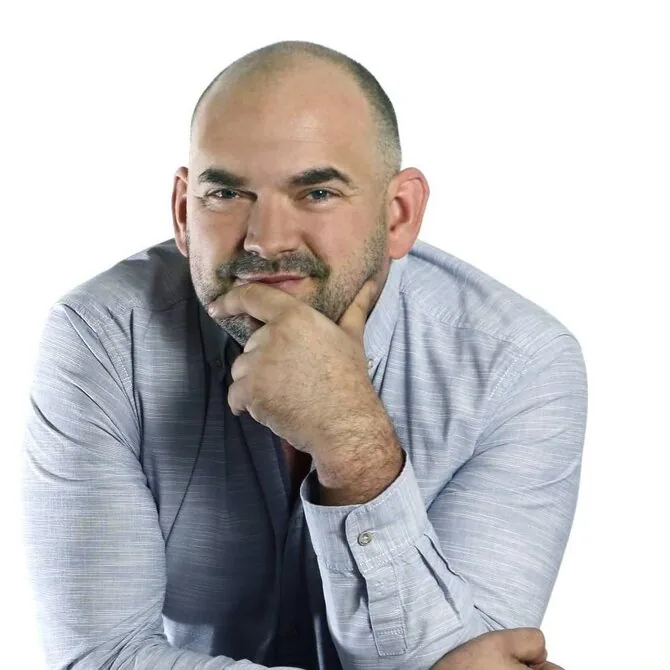
M. Pareščius encountered fake people’s profiles two decades ago when he was one of the founders and shareholders of “Draugas.lt.”
Read more Eight Muslim countries condemned Israel’s statement rejecting the US plan for the Gaza Strip
“Fake profiles were created in dating clubs, correspondence was exchanged, and money was lured from people. The problem is old, but it is spreading more and more because tools are emerging that make it easier to create content and copy people’s profiles,” the expert explains.
The material for these scammers does not even have to be searched for on one platform. For example, they can take a person’s personal photos from Instagram and create a fake profile in their name on Facebook or another social network.
A large number of followers is not a decisive factor here, according to M. Pareščius. The target can also be a person who hardly posts anything on social networks.
“Scammers can take a person’s photo from the press or internet portals and put it into a newly created profile similar to a real person’s profile,” he says.
From a loan request to a “guaranteed” income
Once a profile that looks reliable is created, another part of the scam begins. One of the simplest scenarios is to pretend to be an acquaintance and contact their circle.
“They can ask to borrow money, tell that they have painful life problems, and ask: be kind, can you lend?” describes one of the schemes M. Pareščius.
The photos can be of a completely real person, but the name, surname, and the whole story are fabricated.
The romantic scam scheme can be prepared much longer. For example, a profile of a man in a foreigner’s or soldier’s uniform appears on a social network. The photos can be of a completely real person, but the name, surname, and the whole story are fabricated.
“The person pretends to be your future life love. To convince you that he is in love, he will regularly talk, give compliments, communicate every day and evening, ask how you are doing, what you are doing,” the expert explains.

When trust is already built, the conversation may turn to money. One of the specialist’s mentioned options is an offer to invest in cryptocurrencies or the currency market through a platform specified by the scammers.
The victim is introduced to an allegedly reliable consultant and promised that following his advice will allow earning. Some people are tempted and transfer large sums of money or cryptocurrencies to the supposed exchange.
“The person transfers funds from their cryptocurrency wallet to another exchange that does not actually exist. That’s how your money is taken,” explains M. Pareščius.
He also mentions another sign long used by scammers – when an online acquaintance suddenly asks to send money to another country, for example, Nigeria, using Western Union. The expert sees such an unexpected request as a clear signal that the person is already involved in a scam scheme.
Flirt ended in blackmail
Another scenario M. Pareščius encountered while consulting people starts in a dating app.
After meeting, for example, through Tinder, it is suggested to continue the conversation on WhatsApp or another app. Communication and flirting continue for a while until the interlocutor offers virtual intimate communication. When the person exposes themselves, the real purpose of such acquaintance becomes clear.

“The next day you receive a message: I would like you to transfer 5, 10, or 30 thousand euros in cryptocurrency to the specified account. The scammer already has a copy of your friends list and threatens that if you don’t pay, your nude videos will be sent to friends and colleagues,” the expert shares real cases of his clients.
In such situations, his first advice is categorical – do not pay: “If you pay scammers, there is no guarantee that they will not still publish your video or photos. I have had clients who paid several thousand euros just for their peace of mind.”
One person who turned to M. Pareščius was a soldier. He was afraid that publishing intimate material could harm his service.
The expert advised him not to try to buy off the scammers but to inform the management and his circle about what happened. If necessary, warn that fake or AI-generated content may be distributed in his name or using his image.
One fake profile can trigger a whole chain
The problem does not end with the person whose name the profile was created. After taking over a real account or creating its copy, scammers can start targeting their friends.
Read more People «behind the wall»: the historian who studied the old Vilnius beggar told about their life
The fake profile sends invitations, messages, or links. Clicking on them by at least some people may attempt to extract their data, phone number, take over the account, or ask for money.
“This way, friends’ accounts are hacked, and the scammers’ circle keeps spinning. The person can still create a new profile and warn close friends, but if they have a thousand or more followers, you can’t reach everyone so easily,” draws attention M. Pareščius.
That is why he urges to react even when the person has not yet lost money. If accounts are already being created in their name, messages or links sent, the risk extends to their circle as well.
Scammers will create both face and document
Artificial intelligence, according to the speaker, has made it even harder to understand whether the person seen online is really who they claim to be. Today, a scammer does not have to limit themselves to just a stolen photo.
The times have come when you cannot trust anything.
“They can create any face, even a fake profile of our president. They can make a copy of a document and any person’s photo. The times have come when you cannot trust anything,” warns M. Pareščius.
Therefore, a photo, video, or sent copy of a document is no longer reliable proof that the person is real. “How will you check if the person is real if you only correspond and do not meet?” the expert rhetorically asks.
According to him, scam methods existed even before artificial intelligence – photos could be manipulated long ago using, for example, Photoshop. The speed and cost have changed: today, producing such content requires much less time and resources.
Leaving social networks will not protect you
It might seem the simplest solution is not to post anything about yourself online. However, M. Pareščius says that it is impossible to completely avoid risk this way.

A person’s photo can be published in the media, in a school event photo, or on another person’s social network. Eventually, someone can just take a photo of them.
“Your photo can be added to another body or next to a crashed car and sent to friends saying you need help. You yourself will not have posted anything, but your image can still appear in the public space,” the speaker gives an example.
He compares the internet environment to real life: even on the street, a person cannot fully control what others will do or say about them.
Therefore, in M. Pareščius’s opinion, today it is worth thinking not about absolute protection, which is practically impossible to achieve, but about how to reduce risk and what to do if a problem arises.
If you notice that someone is using your name, photos, or sending messages in your name, it is important to warn your circle. If money is already being extorted, blackmailed, or other harm is done, the expert urges to contact the police.
The most painful thing is not even losing money
M. Pareščius notes that people usually turn to him when the situation is already quite advanced – large sums lost, blackmail experienced, or the person no longer knows what to do. However, the damage caused by scammers is not necessarily measured in euros.
“It can be an ordinary person earning minimum wage, but if someone uses your personal data, damages your reputation, and you feel emotionally bad because of it, that pain can be much greater than the lost money,” says the expert.
Especially painful, he says, are situations when fake or humiliating content is created about minors. He recalls a case when a girl’s classmates created false and humiliating content using her image and spread it online.
In such a case, M. Pareščius urges to contact the police. The problem is that the investigation takes time, and the images spread online may continue to circulate in the meantime. Even if the content is deleted, copies may reappear.
“But the more such cases are clarified, the fewer people will want to abuse others this way among young or older people. However, while the police investigate, photos or videos remain online. And it is very hard emotionally for the person,” he says.
The expert also knows cases when similar means are used to take revenge on former partners – humiliating content is spread, stalking elements appear, conflicts move to law enforcement or courts.
According to M. Pareščius, this is where one of the hardest-to-measure consequences of online scams and abuse is revealed – a person may not lose a single euro but suffers greatly in privacy, reputation, and emotional well-being.
Read more In Paris – Meilutytė’s incredible triumph at the European Championship