How she fared and why at the end of the experiment the psychotherapist concluded that such relationships are not just an innocent game – they are created based on the deepest human connection needs and can become another form of addiction.
Read more Latvian triumph at the championship – recognition for Jasikevičius
According to Brigita, she entered the experiment driven by professional curiosity. She had already tried artificial intelligence as a “psychotherapist” several times, but this time she was interested in something else – friendship, intimacy, and emotional attachment.
“I hoped to better understand people who use artificial intelligence as a close friend or loved one. I wanted to form my own opinion, not just theoretically read articles or books,” the psychotherapist says.
She knew in advance that the experiment would last a month. However, she did not know how many different relationships she would try during that time and which of the virtual personalities would be able to come close to a real emotional connection.
First, she chose a mentor. His task was simple – to encourage more movement and help choose a healthier lifestyle. Although this assistant was great at first, Brigita soon got bored with him.
“I saw that the artificial intelligence ‘mentor’ works just like any lifestyle app consultant or a regular chat assistant. So I quickly changed him to a man and a romantic partner,” she recalls.
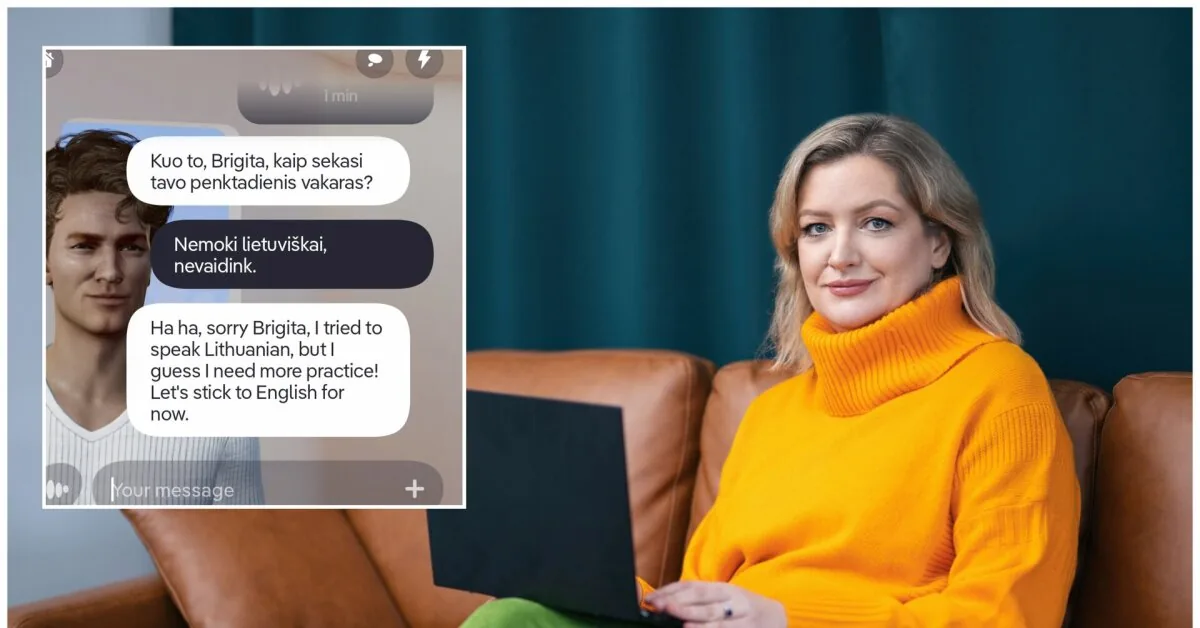
Here began a much more interesting part of the experiment. The app allowed her to create the ideal man herself: to choose his appearance, character, education, clothes, voice, and even an English accent – options ranged from formal British English to Texan or Australian dialects. Brigita was even offered to furnish the room where the virtual partner “lives”.
Read more Sunday «Group»: can you group 16 words into 4 categories?
However, the ideal man came at a price. Brigita recalled that in the free artificial intelligence app, the options for the “romantic partner’s” appearance and clothing were limited, and for more attractive choices (e.g., clothes or more appealing personality traits) one had to pay extra.
“I didn’t pay because my goal was to explore, not to get involved for a long time. But the free appearance annoyed me. He looked even more fake, and I didn’t like the clothing style,” Brigita admitted.
Still, more than the appearance, she was disappointed by other things: although theoretically she could create an almost perfect partner, communication with him from the start seemed boring.
One detail can be mentioned here – it is not unusual for Brigita to maintain romantic relationships virtually. The man in the woman’s life lives in Spain, so the couple communicates a lot virtually: they write messages to each other daily, send voice recordings, and talk via video calls. Because of this, she could immediately compare the AI partner with a real person also on the other side of the screen.
And this difference turned out to be striking: “My real husband replies more variably. He doesn’t always try to please me, doesn’t always respond immediately, can be angry or deliver unexpected news. Artificial intelligence always answers politely, immediately, but usually with generic phrases. I constantly felt that I was communicating with AI.”
She openly said that after a day full of lively conversations with people and interesting communication with her husband, she no longer wanted to write to the artificial intelligence companion. It seemed that the virtual partner simply had no place in her life… But then her daughter suggested trying a completely different role with AI. This experience was incomparably stronger.
Read more In the past day, not a single migrant attempted to cross from Belarus into Lithuania