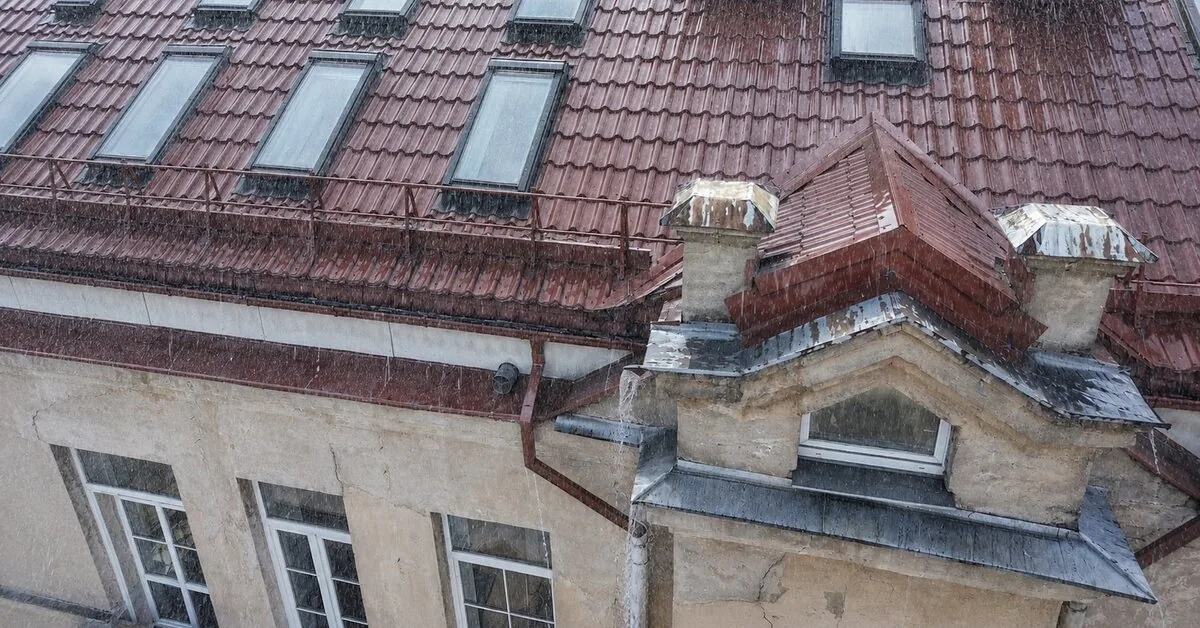
In one of the apartment buildings managed by “Civinity Namai”, roof drains clogged during a storm and could not drain water. It flooded the entire stairwell. The emergency team reacted quickly, so major damage was avoided. This case reminded us that a problem starting on the roof can reach several floors of the building and common areas in a relatively short time.
Read more Can cow’s milk increase the risk of prostate cancer: latest expert findings
“During a heavy downpour, a large amount of water can accumulate on the roof within a few minutes. The arriving team checks its entire path – from the drains and roof covering to the stairwell, basement, and rooms where electrical panels are installed. The water trace often appears further from the point where it entered the structures, so simply wiping a wet wall is not enough,” says Andrius Soikinas, “Civinity” Development Project Manager.
A damp spot can be further from the leak location
On flat roofs, rainwater is collected through drains, while from pitched roofs, it flows through gutters and downspouts. During the season, leaves, moss, small branches, sand, and other debris accumulate in these areas. They are brought onto the roof by the wind, so even a system cleaned in spring can become clogged again after a few summer storms.
When the capacity of a drain or downspout decreases, water accumulates on the roof and at structural joints. Later, it can penetrate under the roof covering, into ceilings, or engineering shafts. Moisture sometimes travels several meters through structures, so a spot appearing on the stairwell ceiling does not necessarily mark the exact location where the roof became leaky.
The first signs are quite common. A corner of the ceiling darkens in an top-floor apartment or stairwell, paint starts to peel, and dripping can be heard near a shaft. In the basement, a wall might become damp or a previously absent puddle might appear. Outside, it’s worth paying attention to water running over the edge of the gutter, a detached joint, or a constantly wet spot near the downspout.
Residents do not need to determine the cause of the fault themselves. A photo, precisely indicated location, and time when the sign was noticed are most helpful to the administrator. If moisture appeared in an apartment, it is worth noting the room and the location on the wall or ceiling. When reporting about common areas, it is important to specify the stairwell, floor, or basement room.
“Residents see the building every day, so their reports often help to notice the problem at the very beginning. A new damp spot or water appearing in the basement after rain is a sufficient reason to contact the administrator. It is much easier for the team to start an inspection when a person sends a photo and precisely writes where and when they noticed it,” states A. Soikinas.
Read more An ATM caught fire in a shopping center in Vilnius
If water approaches electrical panels, wires, or other electrical equipment, they must not be touched. The situation must be immediately reported to the emergency service and the building administrator.
Roof condition assessment is part of technical maintenance
Residents should not climb onto the roof themselves. The condition of the roof covering, drains, gutters, downspouts, and other common structures must be assessed by a specialist responsible for the building’s technical maintenance. Residents pay for this maintenance every month. The technician inspects the building, records defects, and provides a conclusion on what actions need to be taken. Cleaning or repair works are organized based on the identified problem, and their cost depends on the scope.
After several heavy downpours, it is worth asking the administrator when the roof drains and downspouts were last checked, whether an additional inspection was carried out after summer storms, and what deficiencies were found during it. A spring inspection shows the condition of the system at that time, but during the summer, wind can bring new debris, and a strong water flow can dislodge accumulated sediment in the downspouts.
As autumn approaches, rainwater drainage systems will face another load. With the onset of leaf fall, blockages in drains and gutters form faster. A deficiency noticed now can still be removed before a longer rainy period.
A small spot appearing on the ceiling itself does not show how much water has entered the building’s structures. After documenting it and providing the information to the administrator, a technician can assess whether it will be enough to clean the drain, or if the roof covering will need repair, structures dried, and nearby engineering systems checked.
Read more Zelenskis: Ukraine has handed over its plan to the US regarding the end of the war with Russia