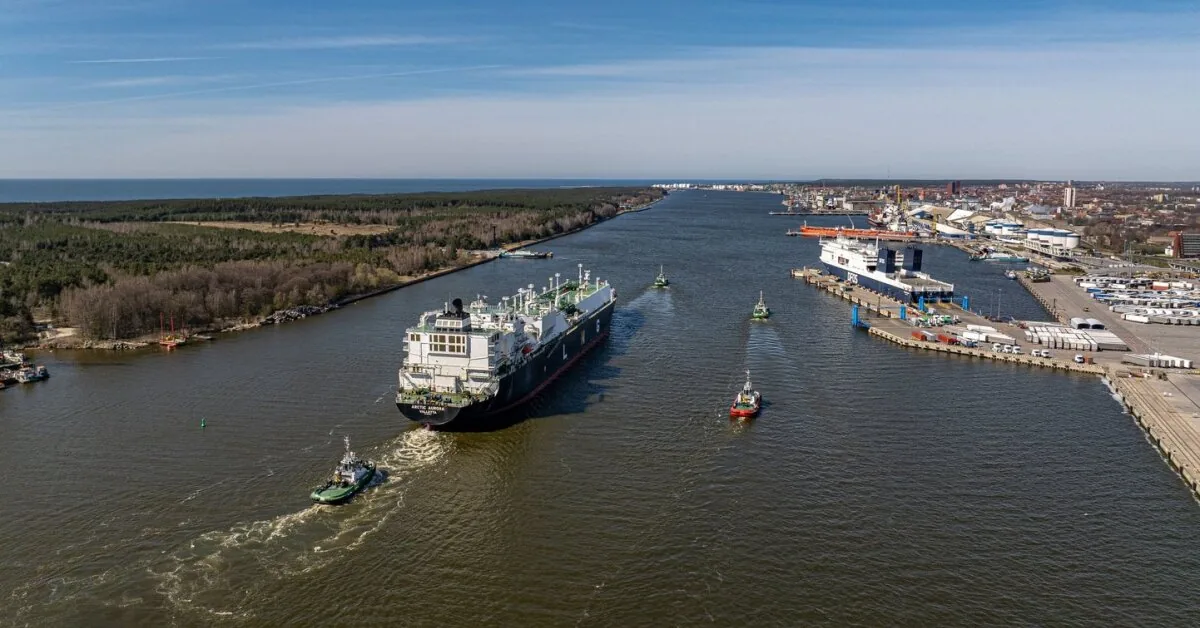
Despite geopolitical upheavals, in recent years the port has not only maintained growth but also strengthened its leadership position in the Baltic countries – it now accounts for about 44% of the Baltic states’ cargo market. The current results are due to a consistent investment policy, which was not abandoned during economic crises or periods of geopolitical uncertainty.
Read more Scientist warns: avoid this food – it is real fuel for chronic inflammation
Investments in the port are not just about new quays or a deeper shipping channel. These are decisions that determine what kinds of ships Klaipėda will be able to receive in ten or twenty years, what cargo Lithuanian business will serve, and what place the largest transport hub in Lithuania will maintain in the country’s economy. That is why, according to the Port Directorate leaders, stopping investments in the long run would mean losing competitiveness.
Competitiveness was not a coincidence
Algis Latakas, General Director of Klaipėda State Seaport Authority, says that the current position of the port is not the result of a favorable geographical location or fortunate circumstances. It was determined by a development strategy consistently implemented for more than three decades.
“Since the establishment of the Port Authority in 1991, infrastructure has been consistently invested in. Regardless of cargo results or the economic situation, port development projects were not stopped. The state invested in infrastructure, and companies operating in the port invested in the most modern technologies, equipment, warehouses, and process automation. It is precisely this consistent work that today allows Klaipėda port to remain competitive,” says A. Latakas.

According to him, cargo diversification also plays an important role. Today, Klaipėda port can serve practically all types of cargo, so the decline in some sectors is compensated by growth in others.
“Reliability and consistency are very important for business. When one type of cargo decreases, another compensates for it. Such stability is ensured not by chance, but by infrastructure developed purposefully over many years and private companies’ investments in technology and quality,” emphasizes the Port Authority head.
Starts from market needs
Martynas Armonaitis, Director of the Finance Department of Klaipėda State Seaport Authority, says that investments are not just construction or reconstruction projects. First and foremost, they are intended to ensure that Lithuanian business does not lose opportunities to compete in international markets.
“Our mission as a port is to connect Lithuania with the world. For goods to be exported and imported quickly, conveniently, and at the lowest possible cost, quality services are needed. And quality services are impossible without modern infrastructure. Therefore, the port must constantly adapt to market needs and global shipping trends,” says M. Armonaitis.
Our mission as a port is to connect Lithuania with the world.

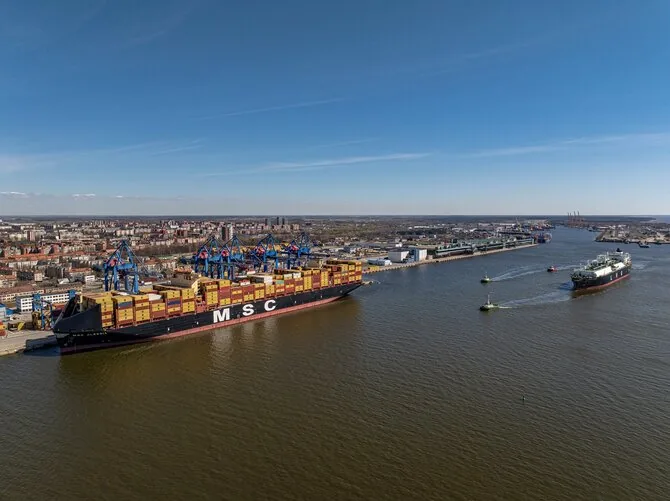
He states that ship parameters are increasing, so they require greater depth, longer quays, and more areas for cargo. If infrastructure is not developed in advance, the port will no longer be able to receive the new generation of ships and will lose part of the business.
Must be economically justified
Although investments are necessary, each project is first evaluated – its return and impact on future cargo flows are calculated.
“First, we determine what specific infrastructure is needed for a particular cargo or passenger flow. Then we assess how much the investment will cost, whether it will create additional cargo flows, and whether it will pay off. The decision to invest is made only when we see clear economic logic and long-term benefits,” explains M. Armonaitis.
According to him, the most important indicator in project evaluation is the internal rate of return (IRR), which must be at least 5%. It is also analyzed whether future revenues will allow servicing financial obligations.
“On average, investments should pay off in about 20 years. If the payback period becomes longer, it becomes much more difficult to finance such a project. Therefore, each investment is evaluated not only according to today’s needs but also according to the long-term economic effect,” says the Finance Department director.
Public investments attract private capital
The majority of the Port Authority’s projects are implemented with own funds, financed by loans from the European Investment Bank and the Nordic Investment Bank. However, public investments alone are not enough for projects to be successful – so-called suprastructure is established by private companies.
According to M. Armonaitis, this is where one of the most important competitive advantages of Klaipėda port is formed.
“Without the Port Authority’s investments, private investments would often be impossible or meaningless. Usually, private companies invest about twice as much as the Port Authority – in cargo handling equipment, warehouses, technologies, ship repair, or construction. Our investments become an incentive for even greater private capital flow, which creates a significant economic effect for the state,” he says.
Such synergy allows modernizing not only general infrastructure but the entire logistics chain – from the quay to cargo handling equipment.
Benefits the entire country
According to A. Latakas, the impact of investments is much broader than just increased cargo handling. Klaipėda port is one of the most important drivers of the country’s economy.
“Klaipėda port, together with companies operating in the port, pays about 310 million euros in taxes to the state budget annually. This is a truly significant amount, demonstrating the port’s importance to the country’s economy. Therefore, investments in infrastructure are of huge importance – they create added value for the entire country. Just as a necessary way to travel from point A to point B, infrastructure in the port is essential for efficient cargo movement,” says A. Latakas.
Klaipėda port, together with companies operating in the port, pays about 310 million euros in taxes to the state budget annually.
He states that it is precisely modern infrastructure that allows Klaipėda port to maintain growth while cargo handling in some neighboring ports is only stabilizing or declining.
The largest investment program in the port’s history
For the next four years, the Port Authority has planned an investment program of about 775 million euros. The largest part will be allocated to the development of the southern part of the port – the formation of a new approximately 100-hectare area.
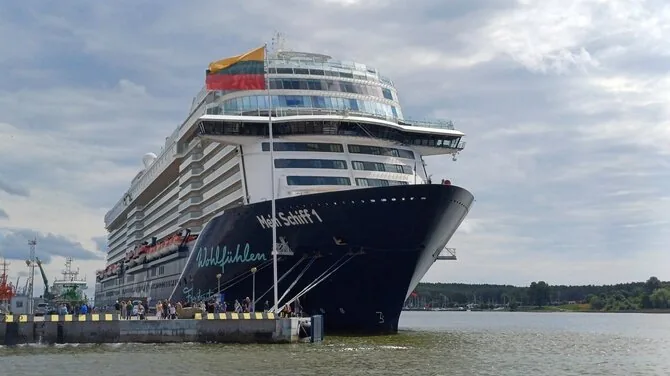
In addition to this strategic project, investments continue in a new cruise ship terminal, adaptation of the Smeltė peninsula quays for offshore wind power projects, reconstruction of existing quays, quay electrification, and more.
A large part of the investments is also allocated to sustainability projects, which in the future will reduce pollution, increase energy efficiency, and implement the European Union’s environmental requirements.
Decisions are not made for today
One of the long-term goals of Klaipėda port is to deepen the shipping channel to 17 meters. This would allow the largest ships capable of entering the Baltic Sea to be received and further reduce cargo transportation costs.
Such projects are planned for many years. According to the Port Authority leaders, investments in port infrastructure are strategic decisions whose returns are revealed only in the long term – through larger cargo flows, new business opportunities, and growing port competitiveness.
The port competes not only for today’s but also for future cargo flows. Therefore, infrastructure decisions are made considering not only current needs but also global shipping trends and market changes. It is precisely consistent investments that allow Klaipėda port to maintain competitiveness in the Baltic region, attract private investments, and create long-term economic value for the state.
Read more Fights broke out at the lifeguard station in Palanga, equipment was broken