“The potential yield is slightly above average,” BNS said Vytautas Buivydas, vice chairman of the Young Farmers and Youth Union.
Read more Russia launched a massive attack on Ukraine: drones and rockets flew, apartment buildings shelled
According to him, the average yield of winter wheat grains is 5-6 tons per hectare.
“If the land is poorer or there were some winter effects, then quantities decrease. But 6 tons of winter wheat is the optimal number. The yield of spring wheat grains is 1-1.5 tons less – if there are 4-4.5 tons, that is already very good. Oats – about 3 tons, peas – also 3–4 tons. The yield of winter rapeseed is between 2 and 3 tons – that is normal and good, but sometimes 4–5 tons are reached,” counted V. Buivydas.
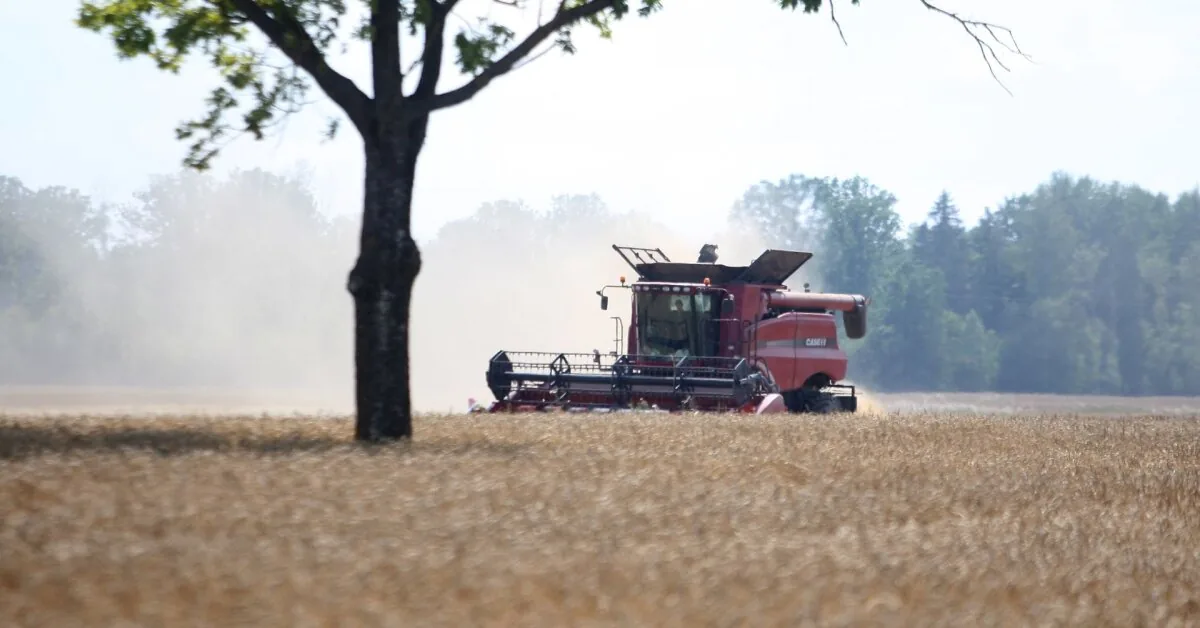
According to him, the size of the yield can be predicted by seeing the already harvested quantities, as the harvest of winter crops has already started: “Now the peak of acceleration is already here, the combines just have the opportunity to go and they go.”
V. Buivydas says that such forecasts are also made taking into account the cereals laid down by rain on the ground.
According to him, the weather this year was so changeable that some farmers, worried about the effects of drought, started pulling irrigation systems, while others decided to abandon growth regulators.
“When it rained, they saw that they probably made a mistake because many cereals lodged. That lodging is because there is enough fertilizer, they spared money for the regulator so that the stem holding the ear would not grow so tall, so after the rain the stem stretched and the cereals became more sensitive and the rain lodged them faster, because the bigger the ear of grain, the higher the risk of lodging,” the farmer said.
The start of the harvest is called the beginning of the winter barley threshing. After them, the combines turn to the fields of winter triticale, rye, and finally wheat.
“Winter crops ripen earlier, so they are harvested first, then the spring ones come,” said V. Buivydas.
Spring cereals have not yet started to be harvested: “They will have to wait another two to three weeks. In the second half of August, the first oats are harvested, spring barley may already be ripe, and then everything mixes – one day winter cereals are harvested, and the next day – spring ones.”
Drying and transportation have become more expensive
Vice chairman of the Lithuanian Agricultural Chamber Andžejus Kulevičius says that the service of transporting grain from the farm to the elevator has increased by about 20% this year. Moreover, in Lithuania, these services are more expensive than in some neighboring countries.
Read more Experts revealed what happens in the body when consuming ginger daily: you will be surprised
“Currently, grain drying costs about 7 euros per ton for each one percentage point reduction in moisture to the base 14% moisture, and for wetter harvests, additional costs can reach 10 euros per ton,” A. Kulevičius said in a statement.
According to V. Buivydas, since grain drying prices have increased, some large farmers working thousands or tens of thousands of hectares, taking on the higher costs they will incur drying the grain, get into combines and go to the fields, while smaller ones are more flexible – they can let the cereals dry in the fields for a few days.
“If farms are large and the volumes of threshing are very large, they definitely do not wait – they have the opportunity and go to the fields, even wetter ones, threshing while taking on those additional costs arising from not being able to wait until they dry. But smaller and medium, family farms have an advantage – they do not have large areas, they can wait (for favorable weather for threshing – BNS). There is such flexibility of small farms that they can still adapt a bit to weather conditions having smaller areas,” said V. Buivydas.
“When you are a bigger farm, you do not manage to harvest in time, then you do not manage to sow (winter crops – BNS). The bigger the farm, the more efficient it is on one hand, but the costs are higher,” added the farmer.
The vice chairman of the Agricultural Chamber says that this year’s harvest poses many challenges and difficulties for farmers due to natural and economic factors.
“Farmers face rising costs, while grain purchase prices remain as they were fifteen years ago. Although during that time fertilizers, plant protection products, fuel, agricultural machinery, spare parts have become more expensive, wages and taxes have increased, grain prices on international exchanges today are similar to those more than a decade ago. Such imbalance causes great concern about the competitiveness and future of farms,” said A. Kulevičius.
According to him, this year’s harvest is especially complicated by increased production costs. Harvesting requires a lot of fuel – it is needed not only for combines and other machinery but also for grain transportation and drying.
A. Kulevičius claims that farmers compete not only among themselves but also with producers from other European countries, so it is important that competitive conditions are as similar as possible.
Read more In Western Canada, 20,000 people have been evacuated due to a rapidly spreading forest fire