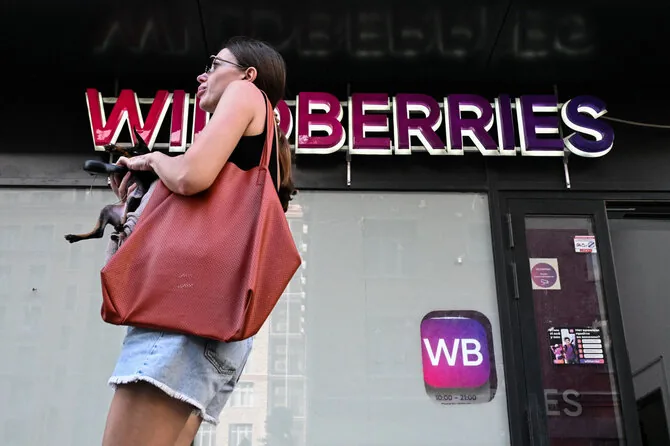
Ukrainian drone strikes on “Wildberries” warehouses in recent weeks have become one of the most intense attacks on Russia’s civilian and economic infrastructure since the start of the large-scale war.
Read more Tailored for the wealthy? There are only two such stores on the seaside
The economic impact was felt almost immediately — on July 22, a drop in the shares of “Wildberries” direct competitor was recorded on the Moscow Exchange.
Shares of the Russian online retail company “Ozon” fell more than 5% in the morning trading on the Moscow Exchange on July 22 — to 2724.5 rubles per share, reported the publication “Kommersant.”
Although analysts consider that the “Ozon” company could become another Ukrainian target, there is no confirmed data that “Ozon” warehouses have been attacked so far.
On July 31, a video circulated online showing a drone exploding near this trading platform’s logistics center in Tatarstan.
However, local media reported that the “Wildberries” logistics complex is also located in the same industrial area, so it is unclear which facility the drone was actually targeting.
High likelihood of forgery
Additional doubts about the authenticity of the photo were raised by its technical analysis.
The photo was checked using OpenAI’s artificial intelligence generated image detection tool, which detected an invisible “SynthID” watermark.

This is a special digital marker embedded in the image using artificial intelligence systems. It is invisible to the human eye, but it allows identification that the image was generated or at least significantly edited using AI tools.
The detection of such a mark is not an absolute proof that the entire photo was completely created from scratch. However, it is an important indicator that the image is not an authentic, unprocessed photograph.
In other words, it means that the image was digitally manipulated.
This allows the conclusion that it is very likely that the photo was either completely generated or at least edited using generative artificial intelligence tools.
Using reverse image search, a likely original photo was also found, which may have been the basis for the forgery.
In 2025, the deputy governor of the Nizhny Novgorod region, Yegor Polyakov, published photos of the then still under construction “Ozon” warehouse complex.
One of them shows not only the same building and surroundings but also the same cars parked in the same places as in the image circulated online. This is another sign that this photo was created by altering a previously published original.
There are also doubts about how this photo is spreading online. Despite the fact that the inscription on the roof of the huge logistics center would be easily noticeable and could attract considerable attention, essentially only the same single image from one angle is found in the public space.
No other photos or videos capturing the inscription from a different location or angle have been found.
This alone is not sufficient proof of forgery, but together with the technical analysis results and the discovered original frame, it is another sign confirming that the image circulating online is digital manipulation, not an authentically captured real-life image.
15min verdict: manipulation. The photo circulating on social networks is not an authentic image of the “Ozon” warehouse in Nizhny Novgorod. Technical analysis shows that the image was generated or significantly edited using artificial intelligence tools, and reverse image search found a likely original photo of the same object published in 2025.
Publication prepared by 15min in cooperation with Meta, aiming to stop the spread of misleading news on the social network. More about the program and its rules – here.