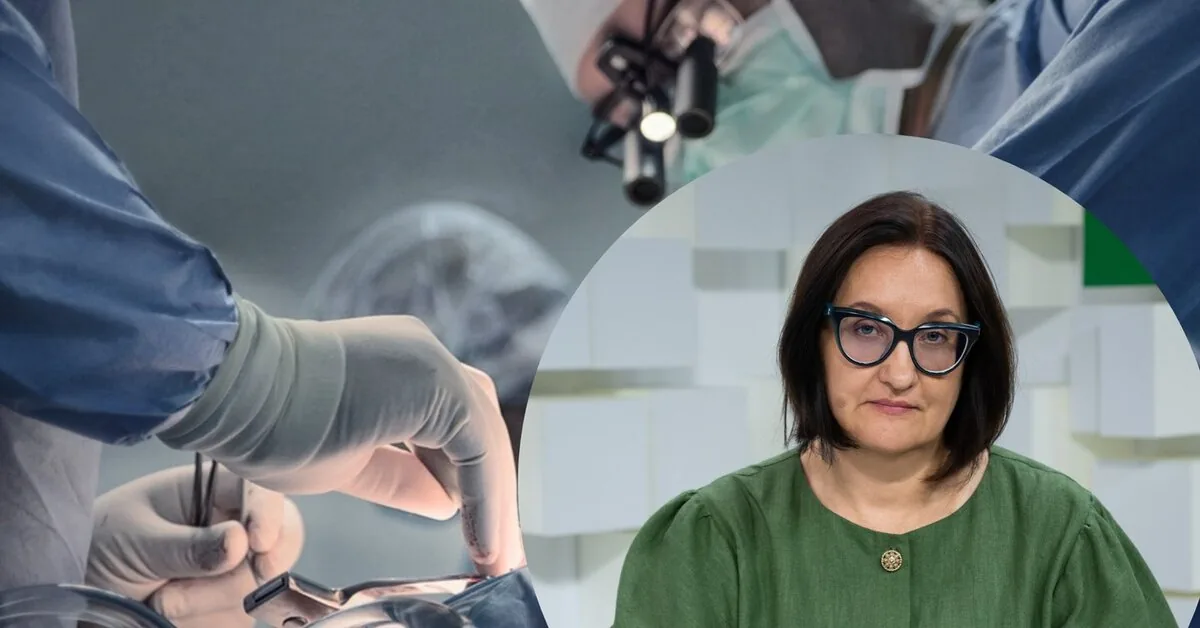
– Perhaps let’s start by celebrating your July. I understand this was truly a historic event for Lithuania – three heart transplant surgeries were performed at Santaros Clinics in one week. The intensity has somewhat eased. How do you retrospectively evaluate what happened today? In terms of preparation, coordination, medical work, etc.?
Read more In Slovakia – another heat record: temperature rises for the second day in a row
– We actually say it was July, but the intensity lasted a little less than two weeks. During that time, 21 potential donors were identified, meaning brain death was confirmed. Out of those potential donors, seven became effective. In other words, they were medically suitable, and their relatives said “yes” to donation.
During those two weeks, three hearts were transplanted at Santaros Clinics, and another one at Kaunas Clinics. Overall, in July, 24 transplants were performed in Lithuania and abroad.
Some organs, for which there were no recipients in Lithuania, were sent to Poland and Latvia.
Well, probably many factors aligned. Having seven donors in a month is not a historic event. Such cases have happened before, even nine donors at once. This case is different because the hearts were medically suitable – both donors’ and recipients’.
Four heart transplants in a month is a lot. Last year, only four heart transplants were performed throughout the entire year, and this year we already have five. Statistically, there are about eight per year, so this year will likely be a record year.
The numbers have been encouraging for the past three years. As you said, donation is a team effort. Hospitals must be very strongly united, and this has been further strengthened by the establishment of regional centers in Vilnius, Kaunas, and Klaipėda.
We can be proud to have very professional teams, the ability to redistribute tasks, and to give the green light to donation and transplantation.
The numbers are truly encouraging, but we are somewhat concerned about public approval. We would have more donors and more surgeries if the public were more actively supportive of donation. Currently, the situation is this: at the end of last year, the refusal rate by relatives was 28%, and today it is already 38%.
– And why do you think that is?
– Our observation is this: if we look at general surveys, the numbers do not change. About 80% of Lithuanians would generally support donation, but when it comes to the doors of intensive care, the situation changes – it becomes as I mentioned.
Regarding the reasons, we notice that when society is generally unbalanced, dissatisfied with life, the economy, politics, especially health reforms, it leads to coldness towards donation. A person feels bad overall, is angry, does not want to do good deeds, and wants no one to bother them.
The second observation – it is clear that today the state’s priorities are defense and armament. Because of this, the possibilities to allocate more funding for publicity, education, and everything else decrease.
– Let’s talk about trends. How many lives does donation help save annually in Lithuania?
– The numbers in Lithuania are slightly increasing. Especially kidney transplants are increasing. Previously, there were up to a hundred, and now this number is exceeded. The waiting time for a kidney has shortened over the past three years from one and a half years to ten months.
However, it is harder to get a transplant for those waiting for a repeat kidney transplant because their bodies are already sensitized.
Read more Prime Minister to top scorers: be open to the world, but remember that home is Lithuania
But actually, we now even have cases where the kidney waiting time is almost just a day – only a few hours.
But actually, we now even have cases where the kidney waiting time is almost just a day – only a few hours.
So the waiting time has really shortened a lot.
The waiting time for heart and liver donors has also shortened somewhat. Previously, a heart had to be waited for up to two years, now about a year. Livers previously had to be waited for about one and a half years on average, now also about a year.
It is also important that the chances of getting retransplantation are improving. Kidney transplant surgery has become almost routine – there are cases where a person undergoes even a fifth kidney transplant.
– Do we have such cases in Lithuania?
– Yes, we do. Several people. But we also have liver and heart retransplantations. As we say, a person lives, for example, with a third heart.
With livers, it is the same – if surgery was performed and after some time the organ stopped functioning, the person can wait again and receive a transplant. Medicine is really advancing.
– Kidney waiting time, as you said, is almost the shortest. Still, what is the most difficult? What is waited for the longest today? Is there an age difference? For example, if a child needs a transplant?
– There is a waiting list where it does not matter if you are first or tenth because the organ goes to the one for whom it is medically best suited.
It is evaluated by height, weight, blood type, and many other medical indicators. The hardest, of course, is to get a heart. For children, it is generally difficult because the margin for height and weight can be up to 20%.
Imagine if it is a one-year-old child, a donor heart may fit a child up to about six years old. I am talking about the heart because this criterion is not relevant for kidneys – the most important are immunological matches, cross-reactions, to prevent rejection. So the hardest is to get a heart for a child.
But we are very proud that children’s heart transplants are performed in Lithuania at all.
Yes, there are very few child donors in Lithuania per year – one or two. But our neighbors help us. For example, if a donor appears in Latvia. They do not perform heart transplants for children – unfortunately, their little patients are treated as much as possible and then go abroad for treatment.
So there is an agreement: if your country lacks recipients or does not perform a certain type of transplant, organs are offered to the nearest neighboring countries. It so happens that very often our children receive a guardian angel’s gift from Latvia.
In Lithuania, liver transplants are not performed for children, but they are sent to Germany or Poland, usually with a living donor – mother or father. The transplant is performed there, fully compensated by the state.
Read more Madeira’s guide did not return money to affected tourists – those helping them receive threats