









Today, cultural organizations compete not only for the sold ticket. They compete for a person’s time and attention. And attention becomes one of the most valuable resources.
Read more Donald Trump’s nominee for US Attorney General said he reached an agreement with senators
The audience has changed
Less than a decade ago, people more often sought information themselves and spent more time comparing different offers. Today, the amount of information has increased so much that the first impression is often determined by just a few seconds. That is why communication must not only inform but also quickly explain why the event is worth a person’s attention.
“Today we live in an attention economy. Every day we receive thousands of informational messages, so we can no longer expect to attract an audience just by announcing a concert. People evaluate information much faster; they expect clarity, consistency, and professionalism. Therefore, today it is no longer enough to have a strong artistic program – you need to be able to present it clearly and attractively,” says Tadas Grabys, director of Klaipėda Concert Hall.
According to Dovilė Padegimaitė, head of the integrated marketing agency “Paperplanes Agency,” these changes are not unique to the cultural sector – they equally affect all brands. Today, the audience is looking not only for information. They expect clarity, authenticity, and a consistent experience across all channels. Communication becomes not only a means of conveying information but also of building relationships.

The function of identity has changed
Visual identity is no longer just a logo or a poster. Today it helps the organization to be recognizable, builds trust, and allows the audience to navigate the flow of information more easily.
“Good content remains the most important strength of a cultural organization, but today it can no longer operate separately from communication. If a person does not understand what makes the event special, does not notice it in the flow of information, or does not recognize the organization itself, a strong program simply does not reach its audience. Therefore, visual identity today is no longer an aesthetic solution – it is a strategic system that helps the organization to be recognizable,” says D. Padegimaitė.
Example of Klaipėda Concert Hall
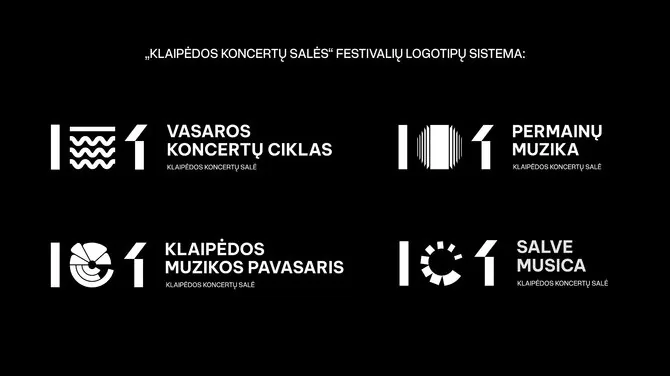
This principle was exactly how the visual system of Klaipėda Concert Hall’s festivals was updated. The goal was to create not just new logos but a coherent identity system that would help all festivals speak one language while maintaining their individuality.
“We saw that the different festivals we organize were communicated inconsistently, so over time it became harder to create clear recognition. We wanted not just to change logos or colors but to create coherence that would allow each festival to maintain its character while clearly showing that they are part of one organization – Klaipėda Concert Hall. This helps the audience recognize the content we create faster and ensures more consistent communication,” says T. Grabys.
Read more Swedbank lends 26.8 million euros for the development of Lithuanian airport infrastructure
The agency head D. Padegimaitė agrees. According to her, the greatest value is created not by individual visual solutions but by their system.
“Often organizations create communication in stages – one event, one campaign, one visual. Each decision may seem logical, but over time the organization starts speaking different languages. It becomes harder for the audience to recognize what connects all the projects. That is why long-term value is created not by individual solutions but by a clear and consistent system.”
Content and communication are not competitors
There is still an attitude that a good artistic program speaks for itself. However, today even the strongest content can go unnoticed.
“Communication cannot be more important than content, but it is a necessary condition for that content to reach people. You can create the best concert or festival, but if the audience does not learn about it or does not understand why it is worth attending, the cultural value remains unrevealed,” says T. Grabys.
According to D. Padegimaitė, this logic has long been self-evident in business, but it is still making its way in the cultural sector.
“Communication is not about how the organization looks. It is about whether the organization is understandable, recognizable, and ultimately chosen. When communication is consistent, each new campaign does not start from scratch – it builds on the trust already created with the audience.”
Today, a modern cultural organization creates not only an artistic program. It cares about the entire visitor experience – from the first contact on social media or advertising to the impression a person leaves the event with. Therefore, communication today is not an auxiliary function but an important part of the organization’s strategy. Investing in communication is an investment in the relevance and place of culture itself in today’s society.
Read more A mortar mine was found in Vilkaviškis district, the «Shield» plan was implemented