










After the performance, A. Grigorian (Carmen) together with the impressive ensemble – Jonathan Tetelman (Don José), Kristina Mkhitaryan (Micaëla) and Davide Luciano (Escamillo) – basked in the sound of long-lasting ovations, reported the Swiss daily “Blue News”. The audience did not spare shouts of “Bravo!”, which were also directed at the Greek conductor Theodor Currentzis and his masterfully playing orchestra “Utopia”.
A Different Carmen: Free and Master of Her Fate
This Asmik Grigorian performance is truly exceptional not only because of the fact itself but also because of the role interpretation. Her created Carmen is incredibly compelling. Moving away from the traditional male-destroyer (“femme fatale”) stereotype, Asmik embodied a very self-confident woman who controls her own fate. Moments before her cruel death, her Carmen proudly tells her killer Don José that she was born free and will die free.
Argentine and Italian-born director Gabriela Carrizo emphasized that today this opera created in 1875 inevitably makes one reflect on the problem of femicide (the killing of women because of their gender). “For example, in my native Argentina, a woman is killed every 35 hours,” the director told “Blue News”, aiming to reveal the characters as comprehensively and deeply as possible.
Innovative Solutions and Unexpected Transformations
This production is not lacking in visual and psychological innovations. G. Carrizo, co-founder of Belgium’s dance theatre “Peeping Tom”, used unique effects: dancers reflect the inner, emotional states of the main characters with acrobatic movements. At first glance simple, the scenography by Christof Hetzer, made of concrete ramps and planes, becomes a highly atmospheric and dramatic background thanks to the masterfully created lighting by Tom Visser.
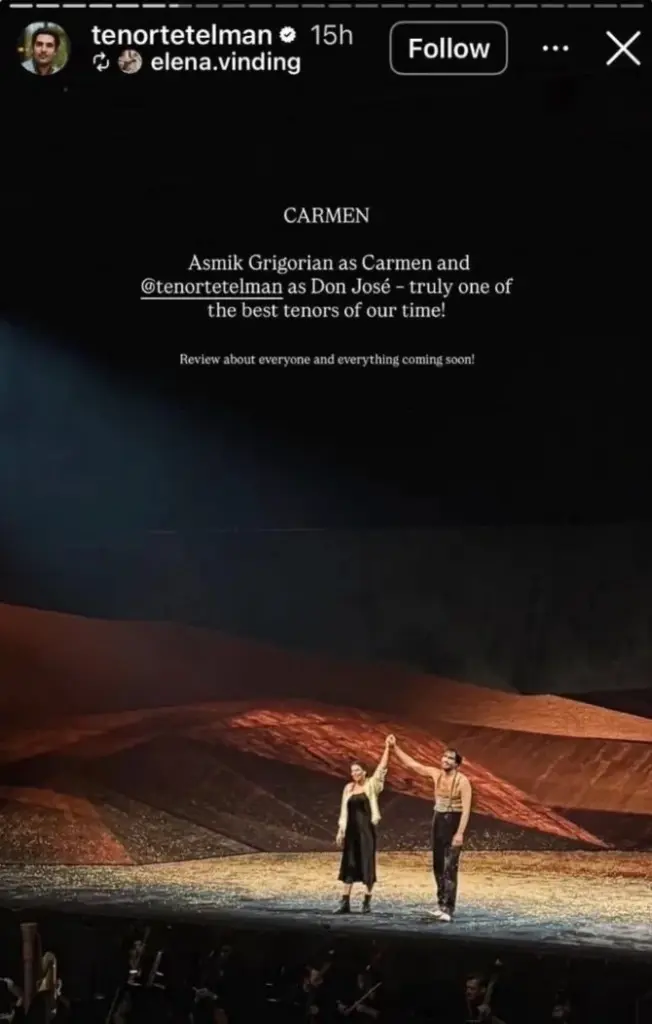
The character of Don José, embodied by Chile-born and currently one of the most sought-after tenors in the world J. Tetelman, was newly revealed. In this interpretation, he is portrayed not as a primitive macho, but as a man shaped by social pressure and violence, who has not lost sensitivity. His deeply felt “Flower Aria”, in which Don José confesses his love for Carmen, provoked spontaneous ovations from the audience – the same was repeatedly received by A. Grigorian and other soloists. J. Tetelman powerfully and convincingly conveyed the transformation from a loving man to a person blinded by jealousy and unable to control his emotions.
Read more The 35th anniversary of the Medininkai massacre is commemorated in Lithuania