









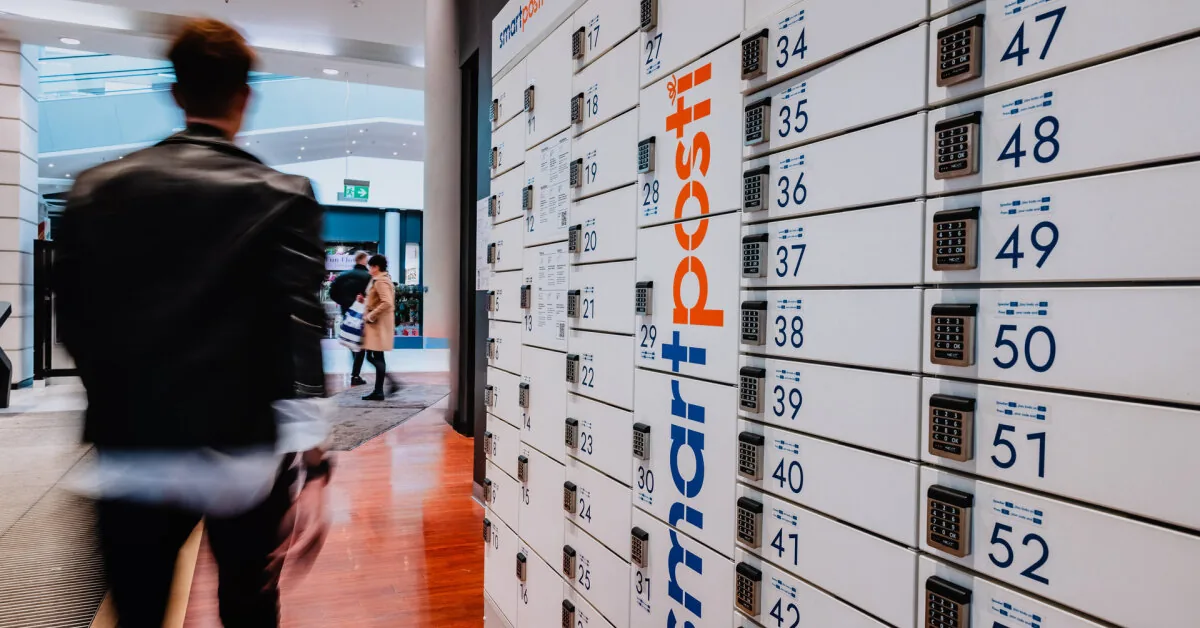
Justas Januškevičius, Sales Manager for the Baltic States of “SmartPosti,” one of the largest parcel delivery networks managed by the company “Posti Group,” says that robots and drones can complement the parcel delivery chain, but at least in the near future, they will remain niche solutions. Parcel lockers are already the standard for parcel delivery today, a significance confirmed by both consumer habits and market investments in infrastructure.
Read more Russia launched 22 missiles directly at Lviv: «After all, they are barbarians»
According to the Communications Regulatory Authority (RRT), parcel lockers continue to be the most popular parcel pickup channel in Lithuania – in 2025, more than 65% of all parcels were picked up via parcel lockers.
As J. Januškevičius states, the parcel locker network is also expanding – according to RRT data, by the end of 2025, there were 2,194 parcel lockers operating in Lithuania, compared to 2,070 in 2024, and postal service providers’ investments grew by almost 36% to 10.7 million euros over the year.
“This shows that the market is investing not in a short-term solution but in long-term logistics infrastructure. Parcel lockers today are no longer an alternative but an important part of the urban logistics ecosystem, allowing businesses to organize deliveries more efficiently and residents to manage parcel receipt and sending more flexibly according to individual needs,” says J. Januškevičius.
How technology is changing parcels
According to the “SmartPosti” representative, technological progress does not necessarily mean that traditional parcel delivery will be taken over by robots or drones. On the contrary – it can strengthen already existing solutions.
For example, “SmartPosti” emphasizes in its 2026 logistics trends report that AI can evaluate millions of data points in real time – delivery time, cost, emissions, energy consumption, and customer needs. This allows for more precise management of routes, parcel flows, and parcel locker occupancy so that parcels are directed to where it is most convenient for people to pick them up.
Meanwhile, robotization in the logistics sector is not yet widespread. A study conducted in the Baltic countries, Finland, and Sweden showed that only about 3–5% of companies currently use robots. 86% of respondents currently do not plan to implement them, while 14% intend to do so within the next 3–5 years. The greatest interest is seen in Lithuania – where 19% of companies plan to implement robots, in Sweden – 16%, Finland – 15%, Latvia – 9%, Estonia – 8%.
However, this does not necessarily mean that parcels will be delivered by drones or robots. Robots are already used in warehouses and sorting centers. For small companies with 2–10 employees, such investments remain more challenging – 62% of them do not plan to implement robots at all.
Drones for parcels: not as simple as it seems
According to the Sales Manager for the Baltic States at “SmartPosti,” although drones are not new and it might seem that their application for parcel delivery should already be simple, in reality, it is not. The European Union Aviation Safety Agency emphasized in 2025 that additional infrastructure and clear rules are needed: where drones can fly, land, how to manage noise, safety, and liability.
“Drone delivery is not just ‘take off and fly.’ Even in the United States, where such projects are actively developed, certification, permits, informing local residents, and clearly defined operating zones are required. In other words, it is not a simple alternative to a courier,” notes J. Januškevičius.
Read more The historic Lauksargiai railway station was handed over to the Tauragė district municipality
He points out that drone operations in Lithuania are also subject to many restrictions. Before each flight, it is necessary to check whether flying is allowed in the chosen location, whether additional permits are required, or whether there are restrictions on the area, which often apply near airports, military facilities, hospitals, city centers, residential areas, events, and other sensitive places.
Another important limitation for drones is weather conditions, distance, and payload.
“Moreover, even the most advanced drones used for parcel delivery abroad face technological limitations. For example, the operational range of the Amazon Prime Air MK30 drone is about 12 km, and the weight of the parcels carried usually cannot exceed 2.3 kg. Therefore, at least for now, drone delivery cannot match parcel lockers in terms of stability and reliability. The latter are not affected by adverse weather conditions or limited operational range, thus ensuring consistently accessible parcel receipt and sending services,” emphasizes the “SmartPosti” representative.
Robot delivery: an advanced idea but not applicable everywhere
A similar situation exists with delivery robots. According to J. Januškevičius, their operation depends heavily on the environment: the width and condition of sidewalks, curbs, slopes, pedestrian flows, charging infrastructure, and weather.
“If the sidewalk is narrow, uneven, obstructed by poles or other obstacles, it becomes more difficult for the robot to move. It needs to safely cross pedestrian crossings, yield to pedestrians, respond to human flows, and stop if necessary. This means that a parcel may be delayed not because of the robot itself but due to difficult conditions,” the specialist lists.
He adds that the development of delivery robots requires clear separate regulation and a consistent operational plan. For example, in Washington, such robots can only move on sidewalks, crossings, or alleys, must yield to pedestrians, cannot exceed about 16 km/h speed, and in case of malfunction, the operator must ensure that the device is quickly repaired or removed from public space.
“Research in 2025 on robots moving on sidewalks shows that their travel time can be harder to predict. Therefore, robots can become a valuable supplement to parcel delivery, but in the near future, they are unlikely to replace the parcel locker network. As with drones, their capabilities are limited by movement speed, operational area, and the weight of the cargo carried, so only parcels meeting certain technical requirements can be delivered by robots,” summarizes J. Januškevičius.
The market chooses reliable and assured solutions
Although more innovative delivery methods such as drones and robots are emerging in the market, their capabilities are still limited by technical and environmental factors. Meanwhile, parcel lockers stand out for their scale, accessibility, and reliability, so they will remain a key part of parcel delivery infrastructure in the near future.
“Drones and robots seem like the future, but parcel lockers are already the future that works now. They do not require ideal weather conditions, special airspace permits, perfect sidewalks, or the recipient to be at home. The parcel locker network allows many parcels to be delivered in one stop, reduces the need for repeated courier visits, and gives people the freedom to pick up their parcel when it is convenient for them,” emphasizes the Sales Manager for the Baltic States at “SmartPosti.”