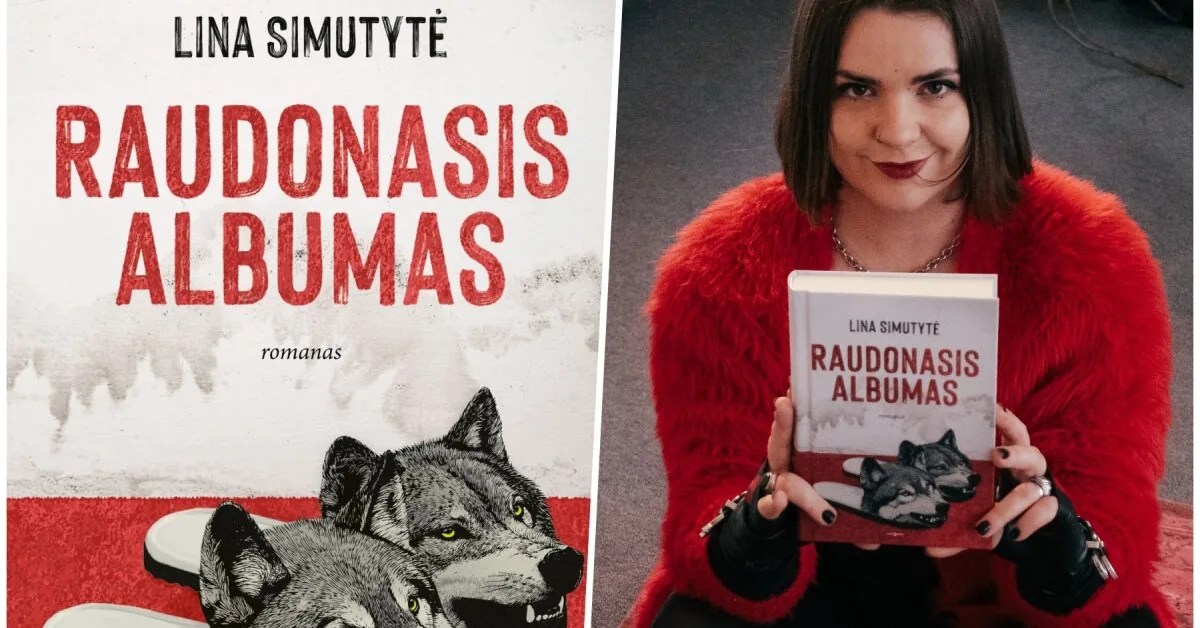
The novel “The Red Album” continues and expands on the themes touched upon in the author’s debut book. Lina Simutytė creates a new variant of the Bildungsroman – a prose of becoming, maturing, self-care, and self-destruction.
Read more Lithuanian U18s suffered their second defeat in the European Championships
Through the characters of Elena and others, their actions and choices, we see the diad of life and death instincts – the effort to find one’s own sources of vitality, explore sexuality, experience and actively create the living world, and at the same time endure pain, losses, darkness, destruction (the scene of sexual violence). It is interesting to note that the process of the Bildungsroman created by Lina, the maturation process of the protagonist and other characters, is strongly influenced by the environment.
Of course, I think that the inner development of almost all people is influenced by the living world, but there are periods, especially turn-of-the-century times, marked by cataclysms and disasters, that affect the maturing youth even more strongly. That is why the motivation, originality, and additional values of the characters’ actions give the author’s book the color of the described era. The generation born in the early years of Independence matures, experiencing the social, political, and cultural transformation of the 2000s. L. Simutytė accurately and (horrifyingly) precisely captures the atmosphere of the turn of the century and vividly reveals one of the most important collective changes in our country’s history.
L. Simutytė accurately and (horrifyingly) precisely captures the atmosphere of the turn of the century and vividly reveals one of the most important collective changes in our country’s history.
Special attention, as already mentioned, in the book is given to the “wild nineties” and the few decades after the declaration of Independence. All the poverty, dirt, the Soviet “scheming” turning into not always successful businesses, (the breath of interwar Lithuania, trying to restore what flourished then) in L. Simutytė’s novel blend well with personal experiences. Collective traumas here merge with personal, almost archetypal experiences, which are little dependent on historical circumstances. Still, maturing and growing up in borderline, transformative times has additional challenges – which the author of “The Red Album” skillfully captures, explains, and interprets with a vivid, cinematic narrative…
And although it cannot be absolutized, the general background was the effort of the elders, parents, and grandparents to get rich, escape poverty, “scheme” to have a material basis. Reading Lina’s book, I recognized a lot, identified with many things – from earlier times, the Soviet era, when my grandfather stole meat from his workplace in a meat processing plant and carried it home stuffed down his pants at the waist, to later times described in “The Red Album” – my mother went to Poland and brought cheap clothes from there.
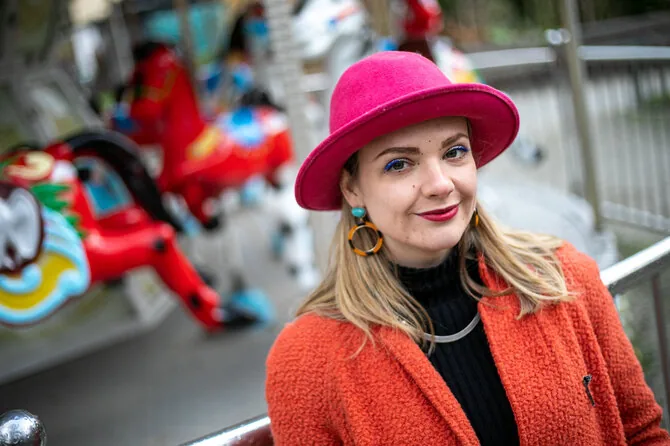
Therefore, the world Lina creates in the book seems very accurate, vivid, and authentic to me. Alongside the parents’ attempt to survive, their children discovered the already legal global culture – here a special role was played by the popular genre – MTV music, the “Akropolis” shopping center, entertainment and niche TV programs. Also, the author’s portrayal of mostly unintentional neglect resonates with me – when it was necessary to take care of livelihood, adults expressed love mostly through having material things – (again) a generation grew up with a key around their neck, which had to discover many things on its own. The “Sick Building Syndrome” described in the novel seems very important to me: “The air in rooms exhibiting Sick Building Syndrome is sometimes more polluted than outdoors. These are poorly ventilated, inadequately heated buildings where mold and dust mites breed, and health-threatening moisture accumulates. Sick Building Syndrome is caused by poor-quality building materials, various chemicals, cigarette smoke, etc. People living in such homes may experience various symptoms caused by the syndrome.”
In Lina’s novel, the sick building testifies not only to the peculiarities of the physical environment but also to the state of mental and spiritual health (I also lived in such a building because my uncle smoked in the rooms, cigarettes “Prima” and “Astra,” which were unfiltered). Therefore, this motif also seems very interesting, original, and, most importantly, accurate to me.
Read more Exclusive report: how turtles return to the Dzūkija ponds
The title of the novel “The Red Album” connotes both relics of the Soviet era (the red color of the Soviet Union) and a more distant history stretching back to the post-war and diaspora (the history of Elena’s grandparents’ generation). In the book, red color marks both objects (lipstick, funeral photo album) and elements (fire, fire connotations – here I also find connections with the first Lina’s book story “City Festival”).
A great advantage of Lina Simutytė’s writing style is the tribute to detail and the offering to metaphor. To be honest, (I try not to overpraise), the author’s writing style has no analogues in contemporary Lithuanian prose. Since “City Festival,” one can see the special and very valuable dichotomies of L. Simutytė’s authorial style: elements of popular culture in her work blend perfectly with high registers – deep meanings are threaded onto the everyday straws, built on the foundations of X Files series and Maxima.
It seems very real to me, and brave – not to turn away from the discourse of banality but to peel it off, build vibrant worlds where everything that makes up our living spacetime intertwines. Another dichotomy of the author’s prose is the blend of historicity (a kind of historical realism – recognizable details of the era) and magical realism, dreamlike narratives. Such a choice testifies to a wonderful distortion of reality – because true reality, it seems to me, is always also a dream, strangeness, that which is unsolvable and inexplicable by facts alone. L. Simutytė organically and integrally intertwines both worlds – and here I recall my teacher’s phrase stating that good literature makes things incomprehensible that are clear in everyday life and routine. I myself believe that good literature is dual – it both explains and transforms at the same time. Such is L. Simutytė’s prose to me.
Reading “The Red Album,” I felt grapefruit juice dripping from my fingers, touched photos, rough and smooth surfaces of objects.
Another important feature of L. Simutytė’s prose is the special attention to language, which is used to create a very dense and rich narrative. Reading “The Red Album,” I felt grapefruit juice dripping from my fingers, touched photos, rough and smooth surfaces of objects, enjoyed the taste of homemade jelly cake, felt phantom limb pain, a severed finger, saw the flickering of hanging Christmas garland lights. The author creates both a gloomy and impressive world, wandering through which is uncomfortable but almost vitally necessary.
L. Simutytė forms a very aesthetic (even if sometimes it is the aesthetics of ugliness) microcosm of the work – this feature, alongside the mastery of language mentioned above, makes her one of the most prominent contemporary Lithuanian prose writers.
Read more This snack will immediately lower your cholesterol: you can eat it even before bed