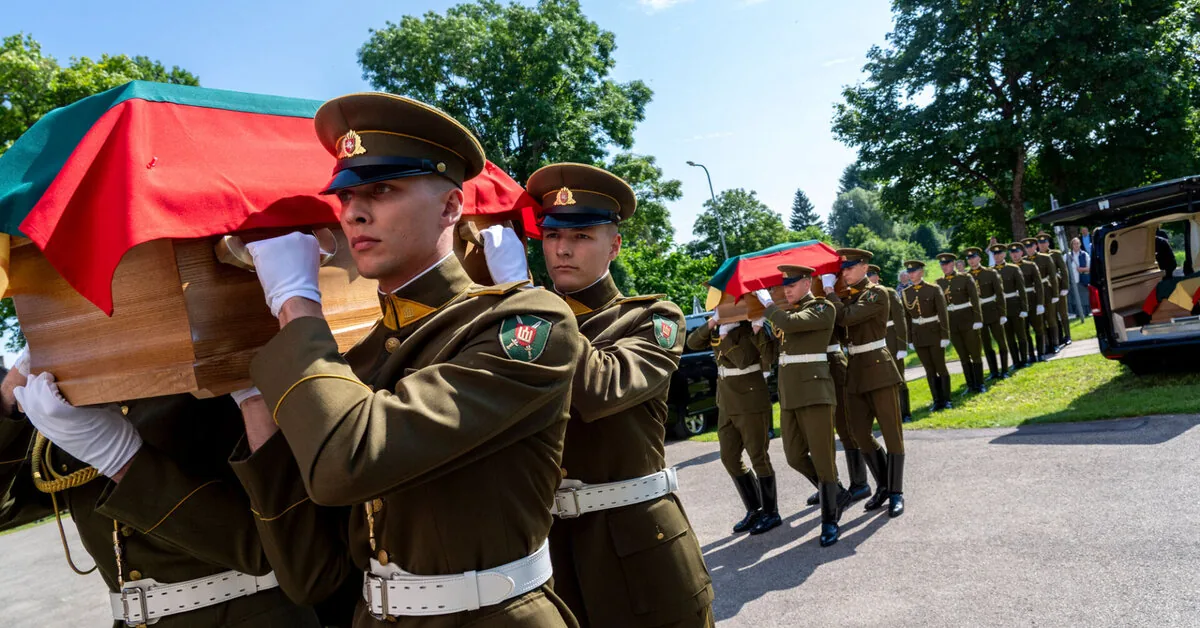
The deceased were bid farewell in Jūžintai St. Michael the Archangel Church, their remains buried in state and family graves, accompanied by three salvos of honor and remembrance, and the flags of the Republic of Lithuania were handed over to their relatives as a symbol of the state for which Lithuanian partisans fought and died, the Lithuanian army announced.
Read more Famous Member of Seimas celebrates wedding anniversary: can you recognize?
“Lithuanian partisans – during the occupation, acted as an organized Lithuanian army and the only legitimate government in occupied Lithuania. By contributing to the search for partisan remains, the current Lithuanian army honors its own predecessors, because Lithuanian partisans are our soldiers,” said Col. Darius Vaicikauskas, Deputy Commander of the Army’s Land Forces, in the statement.
BNS wrote that, according to data from the Lithuanian Genocide and Resistance Research Centre, 12 remains were found last year near the old Jūžintai cemetery, next to the former NKVD (KGB) headquarters, in pits intended for storing potatoes. This year, three more remains were discovered there.
Nine remains found last year have been identified; the identification process for the remains found this year is still ongoing.
In one pit, the remains of four partisans from Tranas’ squad, who died on August 23, 1945, in Dauliūnai forest, were exhumed: 35-year-old squad leader Edvardas Tranas, his wife’s 22-year-old brother Vytautas Dičius, and two as yet unidentified partisans. It is believed that one of them might be Jonas Tijūnėlis, but due to the lack of closer relatives, this could not be proven by DNA tests.
Read more Bordeaux mayor: city is ready for any scenario due to fire threat
In another pit, five remains were found: four partisans who were hiding in a bunker on the shore of Lake Vazajus – 16-year-old Leonas and his 23-year-old brother Bronius Pajedai, 19-year-old Napalis Kušlys, and 23-year-old Albinas Kilas, as well as 19-year-old Stanislovas Vanagas from Pūškoniai village. All five of them died on the morning of June 26, 1945.
In the third pit, the remains of two students from Norkūnai village were discovered. They were killed on July 10, 1945, because they were hiding from forced conscription into the occupying army. It was determined that these were 18-year-old Jonas Matuzonis and 21-year-old Pranas Staškevičius.
The four remains found in other pits have not yet been identified; their DNA is stored in a database.
The partisan war against the Soviet Union’s occupation in Lithuania took place from 1944 to 1953. No fewer than 50,000 people participated in it, and about 100,000 Lithuanian residents participated in the entire resistance movement as members of underground organizations and supporters. Over 20,000 partisans and their supporters died in this war.
Read more Victoras Wembanyama took a break from basketball on the football field