However, as reported by the Financial Times (FT), after Ukrainian forces struck five of the company’s warehouses last week, Wildberries became not an ambitious project, but another vulnerable spot in the Russian president’s “war chest.”
Read more Per 15 minučių Kaune – dviejų motociklų avarijos: vairuotojai pristatyti į ligoninę
These attacks are part of a new Ukrainian campaign, largely leveraging advances in long-range drone technology, to bring the consequences of war to the homes of ordinary Russians.
Ukrainian strikes have damaged Russian oil refineries in the heart of Moscow and even in a remote part of Siberia, forcing one of the world’s largest energy producers to introduce fuel rationing at petrol stations and import fuel.
Now, attacks on Russia’s e-commerce sector threaten one of the country’s largest companies, which had a turnover of 6.1 trillion rubles last year and offered Putin a bold global expansion plan for 2024, writes the FT.
Wildberries is a huge platform focused on Putin’s core electorate: low-income Russians living outside Moscow and St. Petersburg. Its network of pickup points extends into small towns and villages, where they have become important centers of local life.
These strikes reportedly destroyed billions of dollars worth of inventory.
Alexander Kolyandris, director at Eurasia Group, noted that the economic damage would exceed the lost inventory.
“The loss of goods will ruin thousands of merchants, leading to unpaid taxes, loan defaults, and the like,” he stated, adding that the attacks would deprive the state of tens of billions of rubles in taxes from major taxpayers.
Ukraine justified the attacks as retaliation for Russian strikes on the warehouses of Ukraine’s private postal service, Nova Poshta.
Ukrainian President Volodymyr Zelenskyy stated that Wildberries’ logistics network was used to supply the Russian army with “drone components, navigation equipment, and other means.”
Although Putin’s press secretary Dmitry Peskov denied this, sellers on the Wildberries platform offer products that could be used for manufacturing combat drones or as essential supplies for soldiers at the front, such as bulletproof vests and helmets.
These goods, many of which are imported from China and fall under Western dual-use goods regulations, are popular among ordinary war supporters who raise funds to arm the Russian military and build primitive drones as part of a “people’s military-industrial complex.”
Read more Democrats call for prioritizing an agreement on the demographic crisis in the 2027 budget
The vast majority of products sold on Wildberries, which has earned a reputation as an online clothing store for women, have no military application.
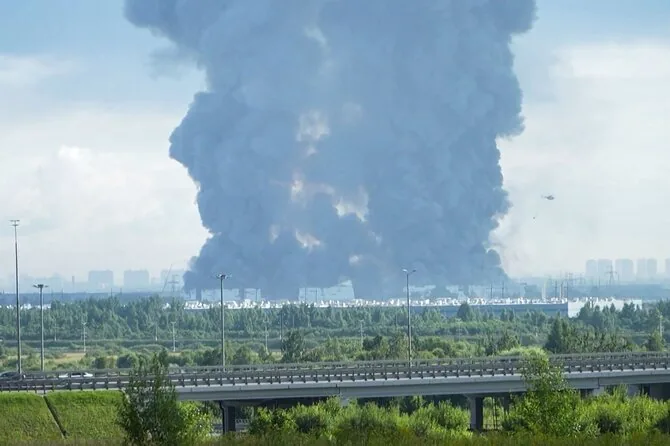
The first four strikes destroyed approximately 444,000 square meters, or 8 percent, of Wildberries’ storage space, according to Russian media. Rebuilding the warehouses could cost the company about 36 billion rubles. Many small businesses trading through Wildberries, which controls almost half of Russia’s e-commerce market, lost their inventory due to the strikes.
Wildberries sellers posted emotional videos on Instagram, explaining that their businesses were destroyed overnight.
“Currently, 4,000 of my fur coats, worth over 20 million rubles, are burning in the warehouse. What can I do to help myself? Nothing,” reads the caption of a video showing a seller standing by the roadside with a plume of smoke rising behind her.
The founder of a cosmetics brand said she lost 1 million rubles due to the attacks: “I can’t calm down. I’m in shock. Every entrepreneur is in shock. I’m exhausted. We only learned from the news that if someone blows up a warehouse, we won’t get any compensation.”
And this is indeed true, as less than two weeks before the first strikes, Wildberries changed its terms, classifying drone attacks as force majeure and waiving any obligations to compensate merchants for lost goods.
As public outrage grew, Tatyana Kim, co-founder and CEO of Wildberries, stated that insurers were unwilling to cover damages from drone attacks, but promised to compensate 88,000 sellers, whom she described as “the smallest and least protected” Wildberries sellers.
According to Kim, within the framework of the program, sellers will be paid as if the destroyed goods continued to be sold at the same rate and price as before the drone attacks.
However, sellers complained in Telegram group chats that the payouts amounted to only a fraction of the value of their destroyed inventory. One seller wrote that Wildberries paid him only 37,000 rubles after he lost goods worth 1.5 million rubles in a fire in Elektrostal.