The possible impact of the future lock on the natural and residential environment, electricity production, transport infrastructure, and other related areas has been examined.
Read more 180 injured: India’s «Tarakon» movement promises to protest until the end
Revived historical idea
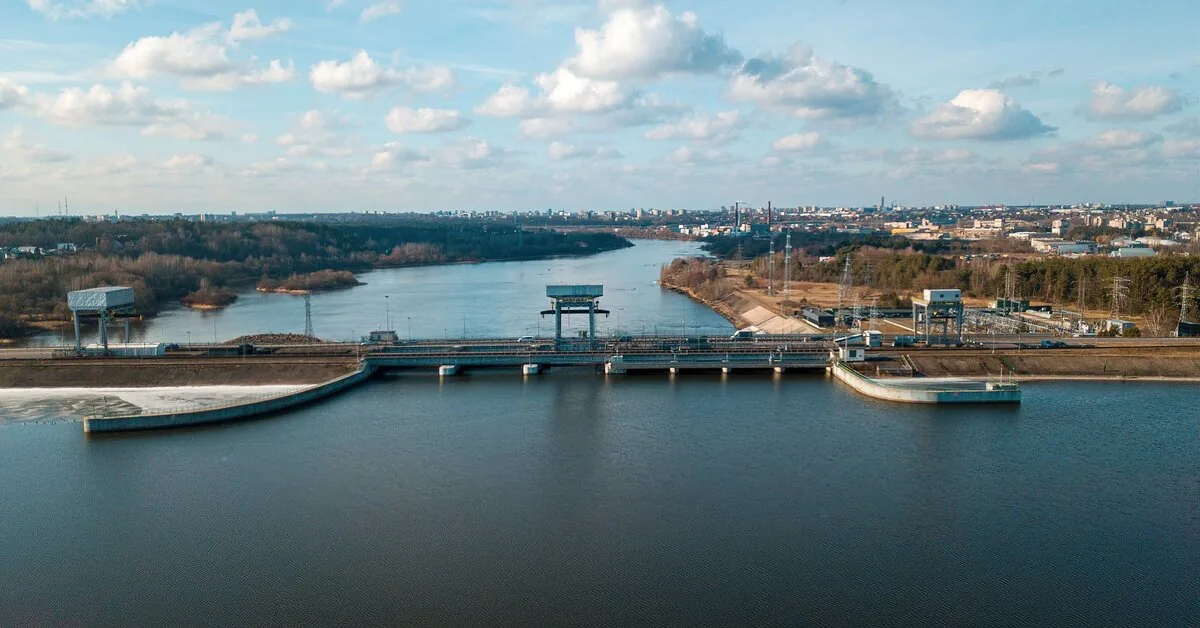
In October 2021, a memorandum signed in the Kaunas Lagoon initiated negotiations with the responsible national institutions and companies. Thus, Kaunas initiated a new phase in the lock construction project through the hydroelectric power plant (HPP).
A few years ago, the Kaunas City Municipality and the Inland Waterways Directorate (IWD) signed an agreement to finance the environmental impact assessment of the lock and the preparation of project proposal documentation. The Kaunas City Municipality allocated funds for preparatory work, and the IWD organized the preparation of the project documentation.
The EIA conclusions will be one of the bases for further preparation of project proposals and assessment of possible technical solutions. Once implemented, the project could create conditions to connect the upper and lower Nemunas water routes, develop recreational, passenger, and, with the necessary infrastructure, cargo shipping in the future.
“The lock was ‘drawn’ when building the Kaunas hydroelectric power plant, but like many projects, it was later shelved. We revived this idea and are now carrying it on our shoulders step by step. We would like everything to happen much faster, but this is a grand project that requires coordination among various institutions,” says Kaunas Mayor Visvaldas Matijošaitis.
Environmental impact assessment
According to the Inland Waterways Directorate’s Shipping Director Aurelijus Rimas, the EIA program was approved last year. When preparing the assessment, it was first necessary to define possible structure parameters and technical solution alternatives, as the environmental impact and integration possibilities into existing infrastructure depend on them.
The documentation preparation process was coordinated with the EIA entities stipulated in legal acts and other interested institutions and companies, including AB “Ignitis gamyba.”
“It should be noted that such a facility would be unique in Lithuania – both in terms of water transport and hydraulic engineering. All processes are coordinated not only with the hydroelectric power plant owners but also with the Ministry of National Defence.
During the EIA, the possible impact on biodiversity, fish resources, noise levels, air quality, public health, residential environment, and electricity production was assessed. The assessment results show that, applying the planned impact reduction and management measures, no significant negative environmental impact should occur,” says A. Rimas.
One of the largest in Europe
The main goal of the lock through the Kaunas HPP would be to connect the upper Nemunas with the lower Nemunas, thus ensuring a continuous and uninterrupted state waterway from Druskininkai to the Curonian Lagoon.
Read more Russia – another blow from China, followed by 3 more countries
Looking to the future and the potential of the lock, it is planned to build a structure with maximum dimensions – 17 meters wide. It would accommodate vessels up to 16 meters wide. This would be one of the largest river locks in Europe. According to the EIA, special gates with depths of 10 and 20 meters would be installed on the Kaunas Lagoon side. The materiality of the lock structures will be clarified during the preparation of project proposals and the technical project.
“It is important to understand that this would be a structure of national importance. Such a facility is built once – no reconstructions would be possible later. In this case, we are talking about precisely accurate numbers and solutions, so everything must be thoroughly considered,” emphasizes A. Rimas.
The environmental impact assessment foresees that the installation of the ship lock would stimulate recreational and passenger shipping. The country’s economy could benefit from the emergence of a cargo shipping route Alytus–Kaunas–Klaipėda, thus relieving some heavy transport from the main roads.
Possibility to install a fish pass
During the EIA, the possibility of installing a fish pass was also considered in parallel. Such responsibility and deadlines are set in the Republic of Lithuania’s Water Law, so these procedures must be carried out by the Kaunas HPP owner. For this reason, the fish pass installation at the Kaunas HPP should be a separate project.
“Where and what kind of fish migration solution would be appropriate must be answered by detailed scientific and technical studies. When designing the lock, it is important not to block the possibility of implementing other environmental solutions nearby in the future. At the same time, it is necessary to assess not only the possible benefits for fish migration but also the spread of invasive species and other ecological risks. These issues require a joint assessment by scientists, environmental authorities, and infrastructure managers,” added IWD Shipping Director A. Rimas.
The environmental impact assessment report is available to the public from July 20 to August 25 (inclusive) on working days during working hours at UAB “Ardynas” premises (Gedimino St. 47), as well as in the Petrašiūnai–Gričiupis (T. Masiulis St. 10) and Panemunė-Šančiai elderates (Vaidotas St. 115).
The public will be able to familiarize themselves with the prepared EIA document on August 26 at 3 p.m. at the Panemunė–Šančiai elderate. An online broadcast of the meeting is also planned.
The EIA document is expected to be finally approved and project proposals to begin preparation next year.
Read more New drugs increased Novartis sales in the second quarter