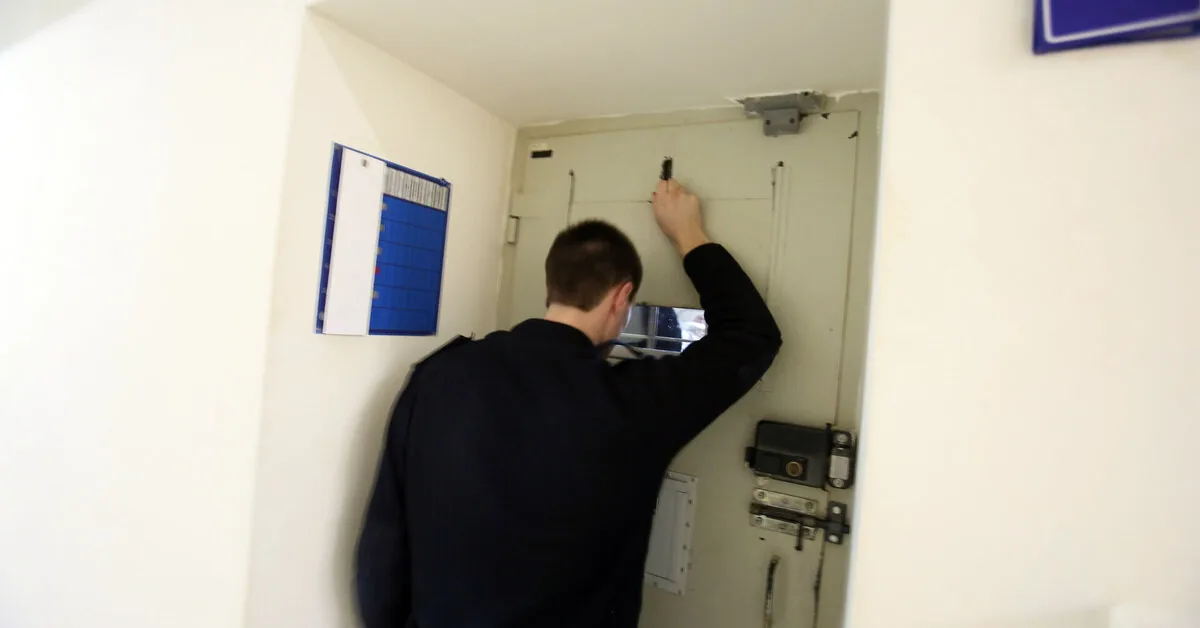
As reported by LTPF last week, amid a shortage of hundreds of officers in the penal system, LKT is abolishing the positions of specialists in the Security Management Department of Kaunas Prison.
Read more JAV Secretary of State Marco Rubio met with the President of Lebanon in Washington
According to the federation, officers in the department have been given warnings about the abolition of their positions, informing them that specialist positions in the Resocialization Department are planned to be established in their place, and those who refuse the proposed new positions will be dismissed.
LTPF calls this “wasting employees” and warns that the restructuring could cause a security crisis.
“Currently, the shortage of officers in prisons reaches up to 40%, and in some places the vacancy rate is even higher. In such a tragic situation, undertaking reforms that will further harm prison security is a complete destruction of the system,” said LTPF chairwoman Loreta Soščekienė.
LKT director M. Kairys stated in a comment to BNS this week that the number of employees at Kaunas Prison is increasing, and the Resocialization Department is not being expanded at the expense of the Security Management Department.
According to M. Kairys, from January 2025 to July 2026, the number of employees at Kaunas Prison increased from 207 to 214. During this period, 46 new employees were hired, including 27 officers, and 39 were dismissed, including 20 officers.
“More new officers were hired than left, so turnover is fully controlled. (…) The number of officers in the Security Management Department remained stable – it decreased by only three, while the Resocialization Department increased by as many as ten officers, from 26 to 36,” said the LKT head.
He emphasized that security at Kaunas Prison “will only strengthen after these minor work organization changes.”
“The dynamic security model, which is implemented by transferring good Norwegian practices, focuses on preventing risks at an early stage through closer communication between officers and inmates, rather than just mechanical supervision. Staff redistribution allows for more efficient use of available resources where they are most needed,” noted M. Kairys.
However, LTPF deputy chair Darius Čekavičius criticizes the argument that the changes are being made according to the mentioned model.
“The dynamic security model is not solely the responsibility of resocialization officers. The Norwegian experts themselves, whose recommendations the system is based on, emphasize that all officers who interact daily with inmates must work according to this model,” said D. Čekavičius.
According to him, the positions being abolished are those whose officers work directly with inmates, which risks weakening the work of the guard shifts and, consequently, the overall security of the institutions.
Leader: employees informed about changes, conditions will not worsen
M. Kairys emphasized that employees and trade unions were informed in advance about the structural change, and consultations took place in several stages.
“Since the summer of 2025, employees have been talked to about this change. Several meetings and consultations were organized on this issue to provide as much information as possible and minimize the negative impact on employees,” said the LKT head.
He indicated that on April 7, the information was presented at a meeting at Kaunas Prison, consultations with social partners, including LTPF, began on May 18, additional answers to trade union questions were provided on June 5, and consultations were concluded by mutual agreement.
Read more In the elite karate tournament in Japan – the hosts dethroned and Lithuanian bronze
According to L. Soščekienė, officers are not given the option to decide whether to work in the Resocialization Department or their current position, and the lack of choice may lead to officers leaving.
She also urged LKT to seek new employee recruitment opportunities, improve working conditions, thereby strengthening employee motivation and institutional security.
“This is not a discussion about funding or privileges. We are talking about the safety of prisons and the people working in them. If such decisions are made, protest actions will have to be taken,” said the trade union chairwoman in a statement.
The LKT head noted that other positions are offered to employees of the restructured departments, and those who do not agree are given warnings according to the legal procedure and continue to be offered vacant positions.
“All restructuring actions are carried out strictly in accordance with the Internal Service Statute and the Labor Code. (…) Employees are even offered increased pay when transferring to the Resocialization Department, so employees are motivated to work in the Lithuanian Prison Service and conditions are in no way worsened,” said M. Kairys.
He stressed that two unified Security Management and Resocialization departments operate at Kaunas Prison, not divided according to the prison units on A. Mickevičius and Technikos streets.
“In 2025, such a change was implemented in the Kaunas Prison unit at 11 A. Mickevičius Street. (…) Since this work organization proved successful at A. Mickevičius Street, the same model is being implemented this year at Technikos Street,” said the LKT head.
Officer shortage
M. Kairys confirmed to BNS that the service has the same officer shortage he mentioned in October 2024. At that time, the director said LKT lacked about 400 officers.
“There is a shortage, and a recalculation of positions is currently underway according to clear criteria. Employees, managers, and social partners are involved in the process, discussions are held according to the established procedure, and no decisions have been made yet,” M. Kairys said this week.
According to him, the service constantly analyzes reasons for employee dismissals, which show normal labor market processes, where most of those who left chose other workplaces in the private or public sector.
According to M. Kairys, several officers were dismissed after receiving a negative conclusion from the Central Medical Expertise Commission, in isolated cases employees were dismissed due to disciplinary actions or failure to pass the probation period.
“LKT constantly pays attention to improving working conditions and increasing officer motivation to retain experienced specialists and attract new ones. The case of Kaunas Prison precisely reflects these trends,” said the service head.
He noted that the restructuring at Kaunas Prison directly implements LKT’s long-term strategic goals, which are enshrined in the Resocialization concept, the 2030 strategic guidelines, and the indicators set by the Ministry of Justice for the service.
One of LKT’s strategic goals by 2030 is to achieve that 50% of the staff work with inmate resocialization. This year, such employees should make up 24%, and next year – a quarter.
Read more „Mitjet“ race in Palanga: Lithuania’s Monaco has never seen this before