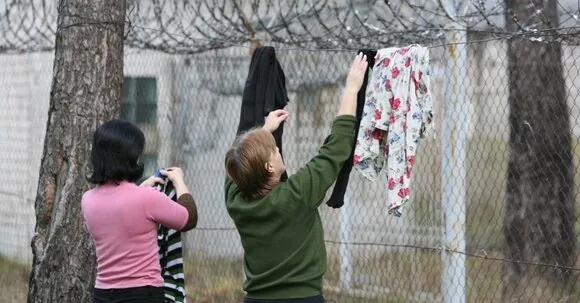
As indicated by the institution, it manages three main temporary accommodation centers in Vilnius, Rukla, and Pabradė, which can accommodate up to 1,000 foreigners in total. As of July 13, 628 foreigners from various countries of origin were living in these centers.
Read more At Katažina’s concert – an unexpected incident: captured what the performer was doing
“At the moment, it would be too early to talk about a specific number. The decision on additional accommodation places would not be made based on a single numerical limit, but by assessing the overall situation – occupancy of existing places, the intensity of the incoming flow of persons, and forecasts,” said the agency’s representative Lina Gediminė in a comment provided to BNS this week.
According to her data, there are still free places in the reception centers managed by the institution, so there is no need to activate additional infrastructure, but the situation is constantly being evaluated with the Ministry of the Interior.
“It is important to emphasize that secondary migration flows are dynamic – they depend on many external factors, so today it would be difficult to predict a specific date when additional capacities might be needed,” said L. Gediminė.
As the agency’s representative noted, the installation of container towns would be a complex project requiring not only the residential modules themselves but also electricity, water supply, sewage, heating, security systems, furniture, household appliances, as well as additional public procurement procedures.
“Besides physical infrastructure, it would be necessary to ensure all reception conditions – catering, healthcare, social services, legal assistance, translations, and involvement of other institutions. The exact timing would depend on the chosen solution, funding, and procedures,” said L. Gediminė.
“This is not a solution that could be implemented within a few days, but institutions are ready to act promptly if such a need arises,” added the PIIA representative.
By next Tuesday, Latvia will accept 58 migrants
The State Border Guard Service (VSAT) indicated that the occupancy of its premises used for detaining foreigners is about 50%, so there is currently no additional need.
As VSAT representative Giedrius Mišutis said in a comment to BNS, border guards are responsible for holding migrants detained by court decision.
“There is currently no need for additional premises for such foreigners for the border guards, as only about 50% of the available premises are currently occupied,” said G. Mišutis.
He noted that secondary migration from Latvia is a dynamic process, and its intensity is uneven.
Read more Zelenskys became hostages of their decision: tension between Fedorov and Syrsky caused an earthquake
“For example, from July 6 to 12, the number of accommodated persons decreased by 42, while in June it increased by about fifty. Currently, it has been agreed with Latvian officials that from today until next Tuesday they will accept 58 migrants,” said the VSAT representative.
When asked what weekly or monthly rate of illegal migrant returns would satisfy VSAT, according to G. Mišutis, the optimal situation would be that the processes of detention, accommodation, and return to Latvia do not cause tension in the work of the service and other institutions.
“On these issues, VSAT is actively communicating and cooperating with both Latvian and Polish colleagues, of course, also with the responsible Lithuanian institutions,” noted the border guards’ representative.
PIIA is looking for additional staff
According to L. Gediminė, the biggest challenge for the Reception and Integration Agency is the ability to flexibly adapt to rapidly changing migrant flows.
“The more incoming persons, the greater the need for accommodation places, social workers, lawyers, translators, healthcare services, security, and employment activities,” said the agency’s representative.
“Considering the increasing flows, we are already strengthening our capacities – conducting additional staff searches and assembling teams to ensure quality reception and continuity of services if needed. Currently, the situation is managed, we monitor it daily, and decisions would be made immediately if necessary,” said L. Gediminė.
As BNS wrote, this year over six months, compared to last year’s situation, the so-called secondary migration flow from Latvia increased from just over 300 to more than 1,200 foreigners.
Interior Minister Martynas Katelynas mentioned to BNS last week that if necessary, the state has the ability to mobilize additional resources by building container towns.
M. Katelynas also did not rule out the possibility of temporarily restoring control at the border with Latvia, but President Gitanas Nausėda was skeptical about such considerations.
According to the State Border Guard Service, this year over 8,000 migrants tried to enter Latvia, were detained, and returned to Belarus or deterred by Latvian border guards still on the Belarusian side. This is almost nine times more than the attempts to enter Lithuania from Belarus.