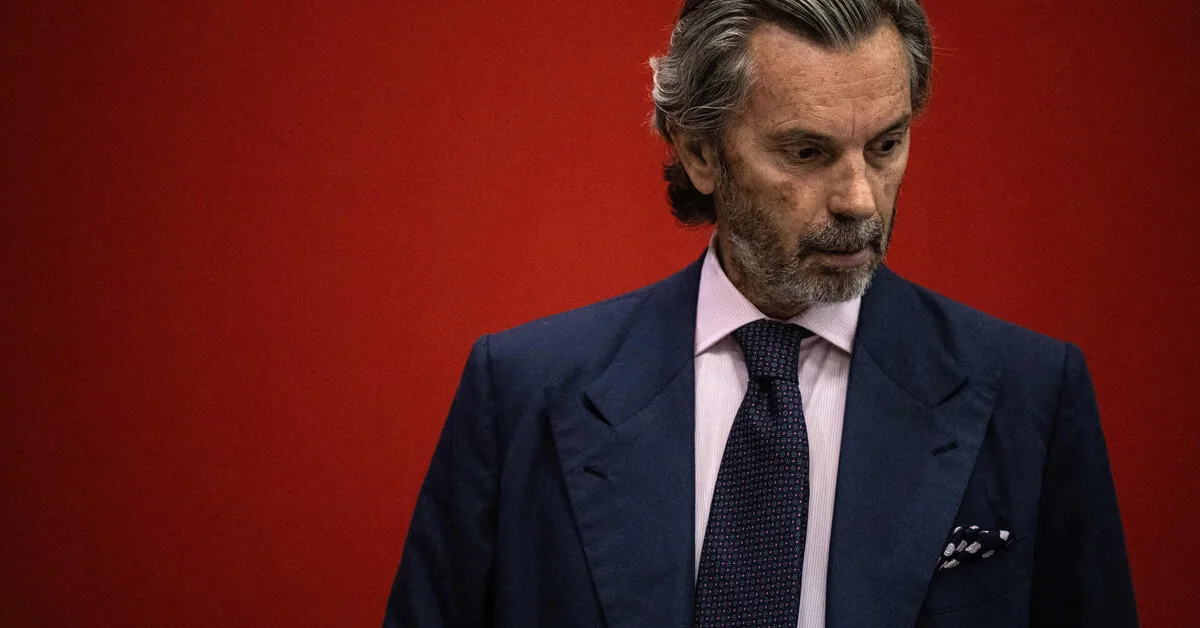
Giovanni Castellucci was found guilty of negligent homicide and negligence related to the collapse of a bridge in Genoa, which killed 43 people. It was one of the country’s biggest infrastructure disasters.
Read more The first victim in the «Aurum 1006 km race»: Porsche engine replacement
The courtroom was full of people who lost loved ones in the disaster on August 14, 2018, when the Morandi bridge, part of an important highway connecting France and Italy, collapsed during a storm.
Thursday’s verdict was announced after a four-year trial in which 57 defendants were tried for involuntary manslaughter, endangering transport safety, and falsifying official documents.
In total, the court found 32 defendants guilty on Thursday.
The prosecution requested prison sentences totaling more than 400 years, including an 18-year sentence for G. Castellucci.
Egle Possetti lost her sister, nephew, niece, and brother-in-law in the bridge collapse.
The verdict will not bring them back, she told the AFP news agency before the court decision.
“But it is clear that for the victims, the most important thing is that the truth has finally come out,” the woman said.
According to E. Possetti, during the years-long trial “not a single person said: ‘I take part of the responsibility.’ It was difficult.”
“Today we can say that there are those responsible for the murder of our loved ones,” said Michele Matti Altadonna, whose brother was among the dead.
“We are here for our loved ones, in their memory,” he told AFP.
Some defendants’ lawyers said they would appeal the verdict.
But M. M. Altadonna said, “For the four children my brother left behind (…) we will not give up, we will not give up until the Supreme Court.”
Under Italian law, judges must publish their reasoning within six months.
Victims’ lawyer Raffaele Caruso said the Morandi bridge collapse was not accidental.
“This collapse, as we and, above all, the prosecution have always said, could have been avoided,” he said.
Read more This mistake can kill lavender: 5 steps for longer blooming
Italy’s Deputy Minister of Transport Edoardo Rixi said in a statement that Thursday’s decision is “an important step on the path of truth and justice.”
“The collapse was not a fatal accident, but the result of serious mistakes and negligence by those who were supposed to ensure safety. It is right that responsibility has finally been established,” wrote E. Rixi.
“A ticking bomb”
The magistrates’ investigation findings were ruthless: “From the bridge’s opening in 1967 until the collapse, i.e., after 51 years, not even minimal maintenance work was carried out to reinforce the cables of the 9th support.”
Work was done on two other supports, the 10th and 11th, and was planned for the 9th, which collapsed during the morning traffic peak.
Prosecutor Walter Cotugno called the bridge “a ticking bomb.”
Most of the defendants were executives and technical staff of “Autostrade per l’Italia” (ASPI), which manages almost half of the country’s highway network, and the engineering company “Spea,” responsible for maintenance.
Besides G. Castellucci, among them was former “Spea” head Antonino Galata, as well as officials from the Ministry of Infrastructure.
ASPI head responsible for maintenance Michele Mitelli was sentenced to 11 years in prison, and the group’s second-in-command Paolo Berti to five years and six months.
G. Castellucci was accused of delaying work on the 9th support. He is already serving a sentence for his role in a 2013 accident when a bus broke through viaduct barriers and 40 people died.
The main defense argument was that the bridge had a hidden construction defect, cable corrosion, and that this, not lack of maintenance, caused the collapse.
“Autostrade” and “Spea” reached an agreement with the prosecution to pay the state 29 million euros.
At the time of the tragedy, “Autostrade” belonged to the “Atlantia” group, controlled by the wealthy Benetton family, but following public outrage, the family later transferred their shares to the state.
Read more «Kauno Žalgiris» newcomer from Croatia: «I don’t like to lose»