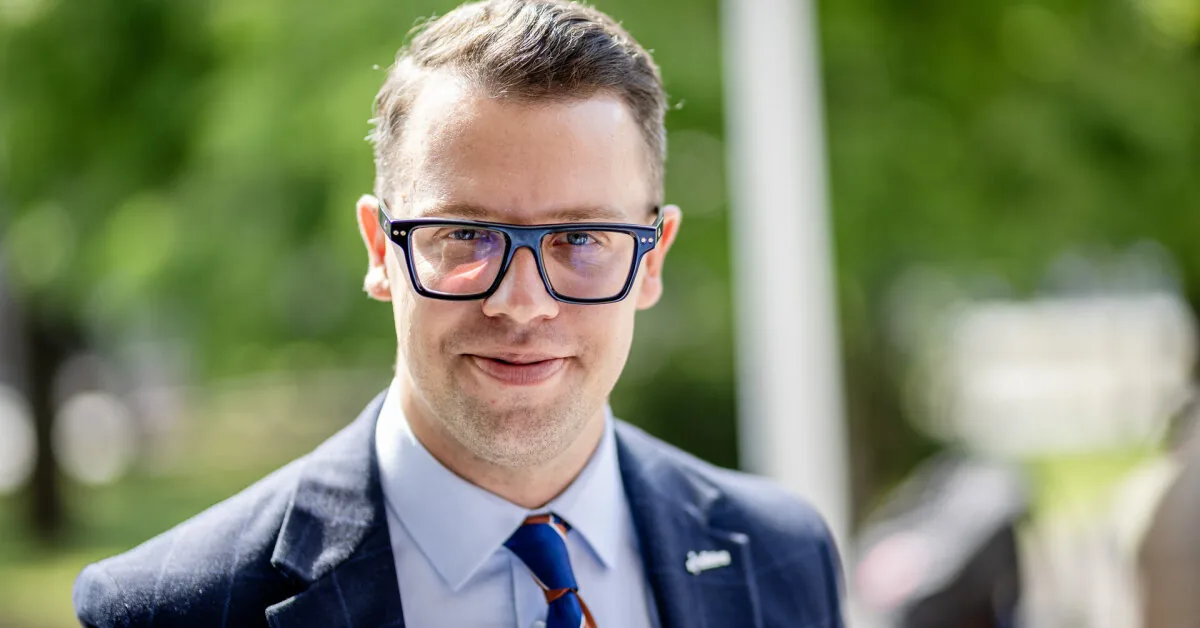
In an interview with L. Alsys, we discussed how he sees the ministry’s relationship with the cultural and media communities against the backdrop of recent protests, the pressure from local politicians on culture, budget formation, the Government’s cultural program, and accusations of academic dishonesty in preparing his doctoral dissertation.
Read more Lithuanian startup made it onto the world map: it was acquired by a US healthcare platform
Does the Ministry of Culture have anything to apologize for?
– Before becoming minister, you worked as the chancellor of the Ministry of Culture. The Ministry of Culture named significant attention to dialogue with the cultural community as one of the most important tasks of the 20th Government. Do you agree with this? Was there significant dialogue, considering the protests by the cultural community and protests for free speech since last autumn? I must declare that I myself participated in the initiative group of the Cultural Assembly.
– There can never be too much attention and dialogue. Probably this is one of the ministries that simply cannot operate without dialogue. I declared that all decisions I want to make will arise from dialogue with the community. Was there enough of it in the previous leadership? I think they really made great efforts to ensure that everyone who wanted to be heard was – whether an individual representative of the cultural community, an association, or an institution. The previous leadership devoted quite a lot of their time to conversations, discussions, and visits. That attention was definitely shown.
The protests initiated by the Cultural Assembly arose after the appointment of the minister, which probably caused the greatest division. I think it was a good incentive for society to understand that we are already in a different period and our mindset should change – we should no longer have to prove that culture is a value. And probably that dialogue became a necessity. The sector itself best identifies the problems and expectations it raises to society. Also to the Ministry of Culture.
I probably participated for pragmatic reasons: to see how many people, what they talk about, what they discuss.
– In previous interviews, you mentioned that you participated in protests. Which ones and for what purpose?
– I participated in protests for free speech. I probably participated for pragmatic reasons: to see how many people, what they talk about, what they discuss. For me personally, the most beautiful thing was that many young people participated. It showed that even young people care about what is happening in our country. Another important takeaway I had as a good lesson was that in the current geopolitical situation, we can basically feel calm because our society is truly civic-minded. It understands the values of our state, the price of our freedom.
– Was your letter to LRT regarding the circumstances of Rita Miliūtė’s employment prepared after you personally participated in the protest where her speech was heard?
– I don’t remember the exact dates when the letter was sent, but I think it was during that period. Various inquiries definitely came to the Ministry of Culture. We discussed how the minister could have an argument about whether Rita Miliūtė works at LRT or not. And we chose, in our opinion, the safest form: to send an official inquiry from the ministry with a simple question. We received a response from LRT and, in my opinion, that was the end of the matter.
– Do you not see a contradiction between this letter and your declared support for the protesting community and civil society?
– Essentially, I do not see a contradiction. I am for us, being in one position or another, not playing or speculating with the information we have or do not have. I am for the answer we provide to be as measured and as accurate as possible to prevent any further speculation.
– Although you mentioned that there was dialogue with the cultural community, the cultural community itself urged the then minister to take political leadership and defend both the cultural and media communities from disinformation campaigns organized by the then coalition partners, sometimes with the involvement of social democrats. However, this was not done. There was no apology either. In your view, does the Ministry of Culture have anything to apologize for to the cultural and media communities?
– You know, it’s hard for me to evaluate the minister with whom I worked in the team. To respond critically to her decisions or chosen communication… Maybe I’m not the one who should judge. Or maintaining collegiality, I might refrain from some comments.
Should the Ministry of Culture and I personally have anything to apologize for? I probably said that on the first day my name appeared in the media as a potential candidate for Minister of Culture. I said that if there really is such a need from the cultural community, if it needs to be done, I will do it.
– At this moment, is it unclear to you whether such a need exists?
– It is clear to me that there are still great tensions in the sector. It is clear to me that there is great division in some cases due to value positions. And that is the price of democracy, that we can have different opinions. Was it a good situation that society had to take to the streets and declare a position? I think it can always be done more calmly. But apparently, the situation was so tense and emotionally sharp that it was the only choice. And for me as a person with my own values and opinion, it is certainly not difficult to apologize.
– But you have not apologized?
– I apologize if there is such a need. I think we can work and cooperate. If my apology is a condition, a new step, a new page, and moving forward, then I sincerely apologize to the whole sector and I think it can be a beautiful step forward.
Cultural budget, cooperation with other ministries, and sector autonomy
– At this time, the problems of cultural and media autonomy have become even more apparent in some municipalities where the principle of respectful distance is not observed, and local politicians can exert pressure. Does the Ministry of Culture have the tools and will to change this?
– The Ministry of Culture probably has the position to express its opinion. We have the Media Support Fund as a tool, which is the main institution that can support and contribute to strengthening regional media. The Ministry of Culture advocates for free media, quality content, independence from political storms. There is a principle of division of powers between local government and the national level. We as a ministry monitor the situation. We receive all information, various inquiries. The ministry states that politicians should not influence the media.
– You say you receive information and inquiries. How do you assess the current situation of cultural and media autonomy in Lithuanian municipalities?
– I think in most municipalities there really is no desire to control culture or exert some influence. Maybe one or two isolated cases happen, which we can probably also discuss and evaluate. But I think the main goal is that culture, as befits a European state, would be at arm’s length from politicians.
In the area of the Ministry of Culture’s governance, we can control only one aspect – the fight against disinformation. In all other cases, we should talk about the independence of culture and media.
– Budget formation is probably the most pressing issue for the cultural sector. What specific goal do you set for yourself?
– I set a specific goal that the cultural budget – or the budget allocated to the Ministry of Culture – does not decrease.
– Compared to this year?
– No, compared to previous years. In 2026, the Ministry of Culture’s budget was already reduced due to savings and state security. We probably all agree that security is one of the most important concerns today. But culture is a tool of nationality, civic-mindedness, and resilience. There are those beautiful sayings: what will we defend if culture disappears? I would like those words not to be just catchy phrases. I am a pragmatic person. We can talk about big plans and attention to culture, but all this will be shown by the budget.
We have already submitted the Ministry of Culture’s needs. In 2027, an additional at least 66.5 million euros is needed. In 2028, an additional not too little, not too much – 173 million, and in 2029 – 159 million. The decrease between 2028 and 2029 happens only because the National Hall construction – a huge investment project – ends in 2028.
The numbers are really not small and not modest. But this is our assessment of what is needed for the cultural sector to stand steadily and we can talk not about an optimal but a completely optimistic scenario.
I also understand the structure of the state budget, the tensions arising from the needs of other areas. Therefore, I emphasize that my goal is that the budget at least does not decrease. I have also told the Prime Minister the hottest points for the Ministry of Culture – priority areas on which we cannot save or reduce.
– And what are these?
– These are three quite large areas. Increasing the salaries of cultural workers – this is a government commitment to bring the salaries of cultural workers closer to the country’s average wage. Increasing the funding of the Lithuanian Council for Culture, increasing the funding of heritage management programs, digital content creation, priority investment projects. And other institutions such as the Media Support Fund, Lithuanian Culture Institute, Film Center, where there are large commitments to local artists, communities, institutions, and also foreign partners.
– Looking at the further activities of the Government, with which other ministries, in your view, would it be most important for the Ministry of Culture to strengthen synergy and on what issues?
Read more Taiwan chip manufacturer TSMC announced record quarterly profit
– In my view, culture is not exclusively the prerogative of the Ministry of Culture. I declared that I will seek horizontal cooperation with all other ministries.
But if I had to single out the most specific ones, it is definitely the Ministry of Education, Science and Sports. The cultural community has been saying for many years that it would like equal cooperation with the education sector. From the very first days when our little ones go to educational institutions – so that culture is not remembered later or perceived as an additional activity. We have a really good relationship with the Ministry of Education and Science. We have joint projects. The Culture Passport – a well-functioning mechanism that opens up considerable opportunities to experience culture. Also the Millennium Schools project, in which culture was given considerable attention.
Another ministry with which we will need a lot of cooperation is the Ministry of National Defense. It already has joint projects with the Media Support Fund. When we talk about the fight against disinformation, resilience, this is probably one of the key collaborations.
The Ministry of Social Security and Labor is and will be a close partner. We have a downtime mechanism for people with artist status. We want to review this system once again and better calibrate it to meet today’s expectations and needs. We should have many discussions with the Ministry of Economy and Innovation because it concerns the creative industries sector, cinema, tourism sectors.
Government program: 64 points and strengthening nationality
– Let’s discuss the Government program. Most of the 21st Government’s cultural program is inherited from previous – 20th and 19th governments’ – programs. Although some points were abandoned, some combined, the cultural part remains very broad – it includes 64 points, two more than were planned in the 19th Government program when the social democrats formed the first coalition. But only two years remain. Isn’t such a program scope simply too broad?
– In my opinion, those 64 points are not too broad. Most of the points are connected to each other. Another part is horizontal, which overlaps with other ministries – maybe that’s why the number is bigger. Yes, I have said more than once that two years is not a long time. We have talked with the forming cabinet that if we work systematically, rhythmically, cooperating with the sector – those tasks can be done. After all, quite a large part of them has already started and in some cases only the final touches remain.
– One of the few completely new program points sounds like this: “We will strengthen the dissemination of Lithuanian culture, Lithuanistics, historical memory, documentaries, historical films, educational projects, ethnoculture, intangible cultural heritage, folk art, and civic-mindedness.” Under one umbrella, very different things are gathered – from entire cultural fields to types of those fields, activities, and even values. On what basis was this combined into one? And what will strengthening the dissemination of all of them mean in practice?
– Probably it was combined by the binding – strengthening nationality and civic-mindedness. This is probably a statement coming from the sector that the mentioned areas are those that reflect our nationality, civic-mindedness, encourage historical memory. Probably each point will have a separate measure in the action plan on how it can be done.
And dissemination can be understood very simply. We commit to strengthening these areas through the measures we already have. We have the Lithuanian Council for Culture, Lithuanian Film Center, Lithuanian National Culture Center, as such, we can call them umbrella organizations that must cooperate with the sector in forming dissemination, strengthening identity, nationality, civic-mindedness.
If we say that we are already fighting an information war, we are in it, then civic-mindedness and national identity are the most important components. Because what does the enemy do? It tries to diminish our national identity. Saying that we will strengthen civic-mindedness, we do not have the right to choose to save on dissemination. We must put all efforts to resist disinformation, informational attacks against us. Only when we can clearly say that we know who we are, know our history and the price of freedom – no one else will affect us.
– If we single out civic-mindedness and nationality as a priority, how will it be ensured that this does not turn into thematic or representational regulation of creativity from the state side and culture – for example, documentaries or historical cinema mentioned in the Government program – instrumentalization?
– I think control in this place is impossible. The Ministry of Culture will certainly not issue any priorities that now we only talk about national art, civic-mindedness, and nothing else. For example, regional cultural councils. Experts approve priorities according to which art and cultural projects are funded. As a state, we can only be glad if those projects are directed at our national, historical memory, but I think this happens completely naturally. There will definitely be no greater encouragement or urging from the ministry. It will be systematically monitored that it happens as it does now.
– On some issues, the Government program becomes more vague. If earlier it was stated that a separate department would be established in the ministry to implement the NGO cultural policy strategy, now there is no specific commitment – it talks about “review of human resources” and “due attention.” Why? And what role will NGO issues have in your ministry?
– Yes, maybe a bit more vague. I have mentioned that a process of certain structural changes in the ministry itself has started, which I initiated when I was still chancellor. Attention to the NGO sector will definitely not disappear. We now have people in various departments and groups. I would like to concentrate the NGO sector expertise into a specific department or person. That commitment remains. When forming the political cabinet, I paid a lot of attention to NGO issues – with one of the future deputy ministers we have talked that the NGO sector will be one of the main areas under supervision.
About accusations of academic dishonesty and team formation
– On LRT Classic, news came about possible academic dishonesty on your part in preparing your dissertation. How do you assess this situation yourself? Do you think it can affect your reputation in the eyes of the cultural and academic community?
– In April, there was a departmental evaluation of my doctoral dissertation. Reviewers made comments, then at the department meeting we had a discussion of my draft. Mistakes were identified. I agreed with most of them, with some reviewer comments I might still want to academically argue. Colleagues at the department meeting decided that I should be given the work back to correct. And the protocol states that after correcting the shortcomings, I can continue the defense process.
Since September, according to all documents, I am no longer a student at Vytautas Magnus University. I have finished that stage, now I have the opportunity to complete this process non-residentially, whenever I find time or want to.
Still, this is a draft. If we talked about a finished work, it would probably be a completely different situation. And will it cause some reputational damage? Of course, it will not add a plus. But I assess it quite calmly. It is a natural process. There is a draft, criticism was expressed for the draft, I accept the criticism, I am fixing the work, and when it is fixed, it will return to the department and the same process will start again.
– But criticism is not equal to criticism. Still, the accusation of academic dishonesty is important in the academic community. Do you accept it? Do you think there is a basis for it?
– Yes, I agree that it was stated that there is improper citation. Or primary sources are mixed with secondary ones. Yes, that exists. And I agree with some elements. We talked a lot with colleagues that there could have been haste and cases of inaccurate citation. But that is the stage, the draft stage, when you correct mistakes. There are those mistakes and we will fix them.
– On Tuesday, it was announced that Viktoras Denisenko and Matas Drukteinis will no longer hold deputy minister positions. Did you not see them in your team? Why?
– As is known, I received quite a lot of expectations from the cultural community, both from the position and opposition colleagues. I was of the opinion that if the head changes, the team must also change. Because saying that one person changed and some changes will come is probably difficult. I am really on good terms with all the colleagues we worked with.
I assess this change pragmatically. Probably every leader wants to form their own team. There will be some continuity. Two people remain from the previous team. According to the coalition agreement, Deputy Minister Renata Kurmin remains, who will continue to oversee her areas. Perhaps there will be a portfolio review among all colleagues. And other people are new, but they are neither newcomers to ministries nor people unfamiliar with the sector. I made considerable efforts to ensure that these are respected, valued personalities in the sector and people who want not a position but to make a change.
– How much final say do you have in team formation issues, and how much is decided by the party?
– The team I have formed at this moment, I believe I had one hundred percent say.
– When will your team be revealed?
– I really hope that the formal verification processes will take place in these days. I set myself the task that at least 80 percent of the team would start working next Monday. So far, that is the signal I have.
Discussions are still ongoing with several people who should give their final thoughts and expectations to me this week. Which, by the way, was important to me in the team. I said, evaluate well and think because in this team I do not want a single yes-man. I want it to be a collegial circle of discussions, to have value conversations and clear positions. That expectation was expressed to both advisors and future deputy ministers. As soon as I can officially present the team, I will present it.
Read more Cruel teenage violence in Marijampolė shocked Stano – published an appeal
– Is it true that Tomas Juočys will work in the team?
– I cannot confirm or deny.