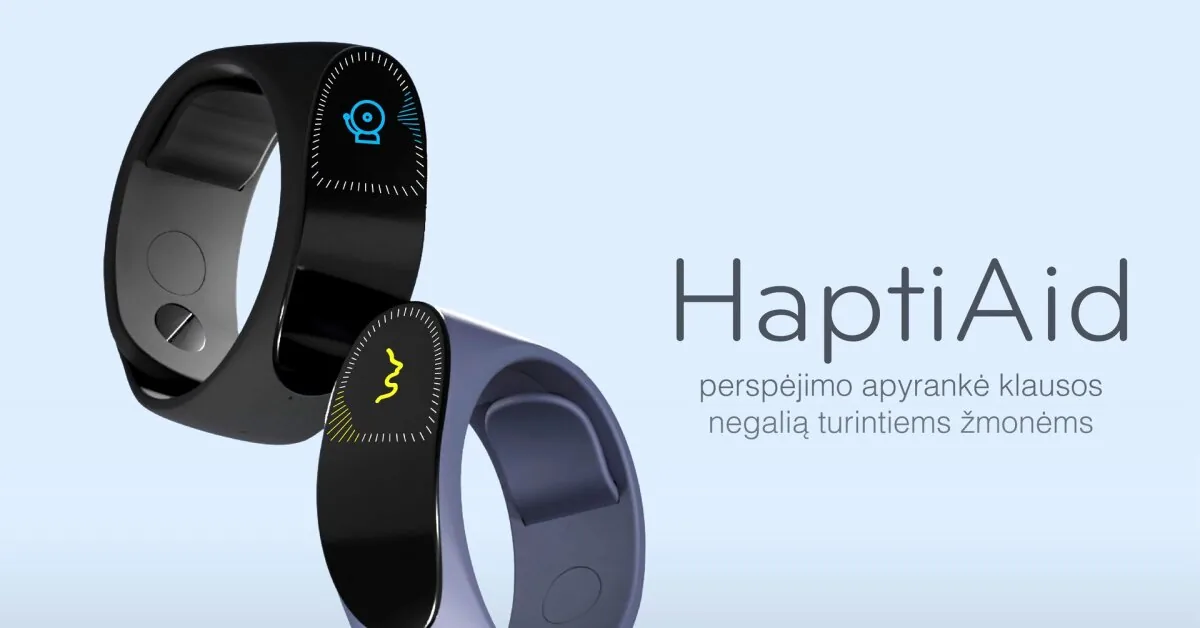
To help address this issue, Lukas Gedvila, a student of Industrial Design Engineering at the Faculty of Mechanical Engineering and Design of Kaunas University of Technology (KTU MIDF), created a concept for a haptic bracelet designed for people with hearing impairments in his final thesis.
Read more After raids in lakes and lagoons – dozens of violations and a warning to vacationers
Before creating the bracelet concept, the student evaluated existing assistive solutions for people with hearing impairments on the market. The analysis showed that while there are individual solutions available, there is still a niche for a compact, aesthetic, and multifunctional device that would be comfortable for everyday wear.

Based on the analysis results, a bracelet concept was developed focusing on ergonomics, clear information presentation, and long-term comfort.
Turning sounds into vibrations
The operating principle of the developing bracelet is based on an additional sensory channel. The device integrates a microphone system that captures ambient sounds, and an artificial intelligence algorithm running on a specialized processor analyzes and recognizes them.
When a significant sound is recognized, the user is informed in two ways – by vibration and brief visual information on the screen. This allows the person to understand more quickly what is happening around them, even without hearing the sound.
While developing the project, the student paid great attention not only to technological solutions but also to the ergonomics and comfortable long-term wear of the future product. The bracelet’s construction and design were created to ensure structural integrity, wrist fit, and resistance to environmental effects, including shocks, moisture, sweat, and dust. An integrated battery with wireless charging capability was also planned.
Selected energy-saving components
In developing the device, much attention was given to material and electronics solutions. FKM elastomer (a highly resistant synthetic rubber used in products resistant to environmental effects and temperature fluctuations) was chosen for the case production, and PMMA plastic (also known as acrylic glass) for the screen.
The electronics part integrates energy-saving components such as the ESP32 microcontroller (a small programmable computer module controlling device functions), the Syntiant NDP101 processor (a specialized AI chip for sound recognition), and Knowles microphones (high-sensitivity microphones used in portable electronic devices). These components were selected considering their size, power consumption, and ability to analyze sounds in real time.
Different solutions were planned for the production stage: 3D printing was used for the prototype, and injection molding (a manufacturing process where melted material is injected into a mold and solidifies) for serial production. A two-part packaging was also designed: a presentation box made from recycled cardboard and a transport box made from bamboo fiber to protect the product during logistics.
Created for real use
The final project result is a technically grounded warning bracelet concept integrating engineering, construction, and design principles.
The created bracelet weighs 96.47 g, withstands a drop from one meter onto a hard surface, and its material cost is 51.04 Eur.
According to the author, such a device could be used not only in everyday environments but also in public spaces, during sports, at home, and in other situations where timely awareness of events happening around is important.
Read more Scientists have identified the exact number: just one hour less sleep increases weight