„This is one of the largest infrastructure projects in Lithuania in recent decades. If we want to grow, strengthen competitiveness, and accommodate the largest ships in the region, the port must expand. The development of the southern part of the port will fundamentally change Lithuania’s capabilities and prospects as a maritime state. It is important to us that along with the new port area, the city’s transport infrastructure is also developed, creating benefits for both Klaipėda residents and businesses. I believe that close cooperation between the state, the port, and the municipality will allow this project to be implemented smoothly,“ says Minister of Transport Juras Taminskas.
Read more Idyllic vacation in Spain turned into a horrific accident: a stone fatally injured a young child
The development of the southern part of the port will fundamentally change Lithuania’s capabilities and prospects as a maritime state.
The new southern part of the port will be able to handle up to 30 million tons of cargo per year. Over 25 years, the economic benefit could reach about 7 billion euros, and the long-term port revenues about 1.2 billion euros over a 50-year period.
„The development of the modern Klaipėda port has always been based on consistent investments, planning, and a forward-looking vision. The port’s results show that such a strategy pays off and yields returns. The development of the southern part of the port, enabled by the adopted law, will give the Port Authority the opportunity to purposefully create the future Klaipėda port – developing infrastructure that will ensure the port’s growth, competitiveness, and significance to Lithuania in the long term,“ says Algis Latakas, General Director of the Klaipėda State Seaport Authority.
„The expansion of the Klaipėda State Seaport is important not only for the city but for the entire country. However, a growing port must be accompanied by no less investment in strategically important transport infrastructure. For decades, we have consistently talked about the necessity of the southern bypass. This is a project that would redirect heavy traffic flows away from residential areas, reduce noise, air pollution, and congestion, improve people’s daily lives, and strengthen the country’s military mobility. But the bypass alone is not enough. It is also necessary to complete the reconstruction of the Jakai roundabout and modernize the road towards Šilutė to four lanes. Only by implementing all these solutions will we create an integrated transport system that ensures smooth port operations, convenient resident transport, and long-term competitiveness of the entire region. I thank the current Minister of Transport Juras Taminskas, thanks to whom these projects have moved towards real work after several decades,“ says Klaipėda Mayor Arvydas Vaitkus.
This is a project that would redirect heavy traffic flows away from residential areas, reduce noise, air pollution, and congestion, improve people’s daily lives, and strengthen the country’s military mobility.
Deputy Minister of Transport Dovilė Sujetaitė adds that at this stage, not only the port but also road infrastructure important to the city of Klaipėda will be developed.
„We are actively working on the entire port city logistics hub – starting with the Klaipėda southern bypass and the modernization of the Jakai roundabout and ending with the reconstruction of regional road No. 141 Kaunas–Jurbarkas–Šilutė–Klaipėda. They will become strategically important connections for both the port and the city. Creating infrastructure of this scale is a long-term process, so we plan all actions so that the transport infrastructure around the port grows together, not lagging behind,“ says D. Sujetaitė.
A stronger port – benefits for Lithuania’s economy and national security
The project is considered of strategic importance for both national security and Lithuania’s economy, so the law will allow for the efficient organization of port infrastructure development, ensure project coordination at the state level, and establish a transparent procedure for the competitive lease of the targeted port area.
Read more «Žalgiris» player – about the shock in Vilnius and disappointment over the World Championship
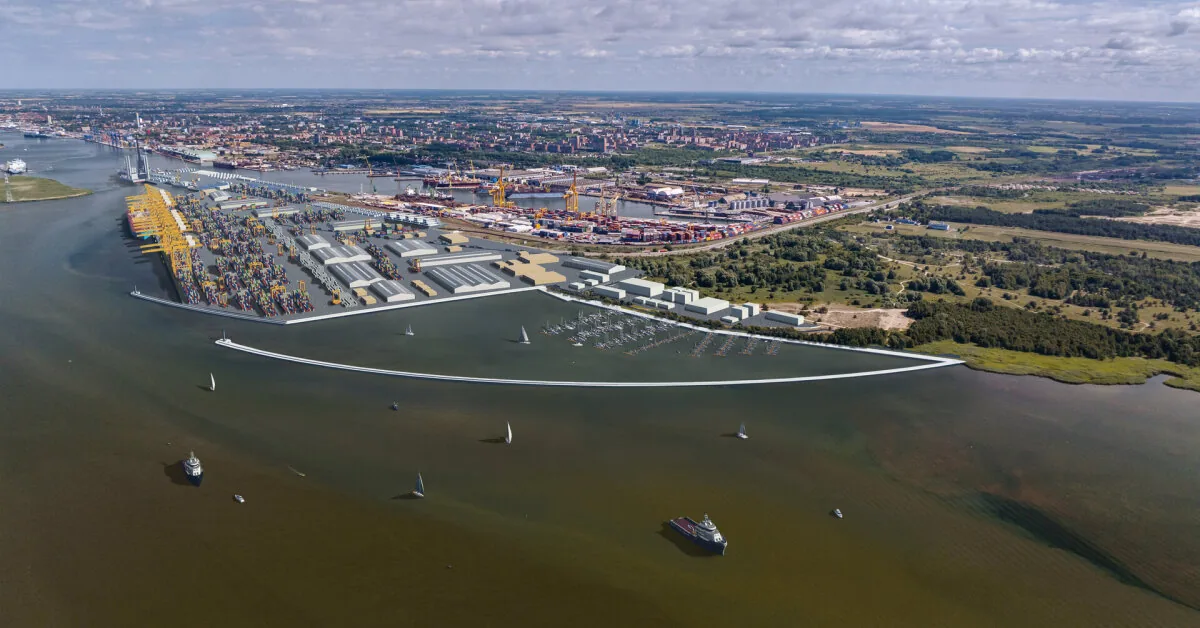
About 100 hectares of new territory are planned to be formed in the Klaipėda port water area, adapted for cargo handling, logistics, industry, green energy activities, and military mobility needs. Deep-water quays will be built, with a total length of about 1.3 kilometers, and southern port gates will be installed. The newly formed land area within the port territory and the created port infrastructure will be state-owned.
The southern marina is also planned – it will be intended for small shipping and marine tourism development, with about 500 berths for boats. This project will create modern recreational infrastructure, complementing the commercial port activities and strengthening the port’s integration with the city.
Private investors are sought for port expansion
A mixed financing model is planned for the development of the southern part of the port, combining private capital investments, port operator funds, and other sources. It is preliminarily estimated that about 600 million euros of investment will be needed to form the new port territory and create port infrastructure, of which at least 300 million euros will be the investor’s initial contribution. Such an investment model will allow private capital to be attracted at an early stage – investors will contribute to the formation of the new land area in the port territory and the financing of infrastructure creation through the mentioned initial contribution.
About 600 million euros of investment will be needed to form the new port territory and create port infrastructure, of which at least 300 million euros will be the investor’s initial contribution.
Another part of the project will be financed by the port operator’s own and borrowed funds and other sources. Additionally, about 800 million euros of private investments could be attracted for the development of port superstructure (buildings, facilities, and other equipment necessary for operations), the volume of which will depend on the specific business decisions of investors. In total, this would be about 1.4 billion euros of public and private investments.
The adopted law will provide a legal basis for the Port Authority to announce a competition for an operator who will contribute to infrastructure financing through advance payment and lease the future land area. The government will still have to approve the public competition procedure for leasing the targeted port area.
The contractor for the construction of the southern port gates has already been selected – the Port Authority signed a contract with the company “Tilsta,” which won the competition. Work is expected to begin this fall. By the end of 2028, a new land area should be formed in the port territory and the necessary infrastructure installed, and operations in the new territory are planned to start in 2029. The project implementation progress will be supervised by a commission established by the government.
Read more Study of 700-year-old remains revealed an unexpected fact about early Vilnius