
We constantly update the interview code
The new Government’s oath in the Seimas is scheduled for Tuesday.
However, Egidijus Kūris says that if everything goes according to the current plan, the Constitutional Court will probably declare in the future that Mindaugas Sinkevičius’s Cabinet of Ministers started working without authorization.
Read more EK leader calls to restrict access to social networks based on users’ age
The fundamental violation is that the appointed prime minister Mindaugas Sinkevičius presented the Government program before the Government was approved.
– The prime minister is appointed, the cabinet of ministers is approved, the Government program is presented to the Seimas. So what kind of start is Mindaugas Sinkevičius’s Government having?
– You already mentioned the word false start in the show’s announcement. This is a word that, as I understand, linguists consider a foreign and inadmissible word, so my request to the State Commission of the Lithuanian Language is to come up with a good, catchy, accurate, precise, short, strong term. Generally, when sports commentators say the word false start, we all understand what it means – when a runner starts too early on the track, when a swimmer jumps into the water too early.
So this Government’s start is truly a false start. And I can explain more from a legal perspective.
Now many talk about specific ministers, many say that one or another minister was pulled from somewhere and no one knows them, which is quite true. But very little is said about the Government formation procedure.
This Government’s start is truly a false start
This procedure is very clearly defined in the Constitution. For example, Article 92 of the Constitution states that the prime minister must present to the Seimas the Government he has formed and that has been approved by the President of the Republic no later than 15 days after his appointment and submit its program for consideration.
So now we are arranging how everything happened chronologically by dates.
First, the Seimas was approached regarding Mindaugas Sinkevičius’s candidacy, approval was obtained, the President of the Republic issued a decree appointing M. Sinkevičius as prime minister. His status officially becomes the appointed prime minister on that day.
Now the clock starts ticking, the 15-day term is set. Within those 15 days, everything must be done – the Government composition must be formed. The appointed prime minister submits this composition to the president, the president evaluates, makes a selection, as we are used to, sometimes strict, sometimes less strict, then the president issues a decree and approves the Government composition.
The future or appointed Government must submit, more precisely – its head, the appointed prime minister, must submit its program to the Seimas. But I see that on July 3 there were reports that the future head of the Government submitted the Government he formed to the president and asked for approval. Then there was a comment from the president’s advisor F. Jansonas that the president will evaluate those candidates for a few days and make a decision, which is completely normal.
And on the same July 3, a draft resolution on the approval of the Government program was registered in the Seimas. It is assumed that the program was attached to it.
So here are a few things. First – there was no Government, the president’s decree approving the Government is dated July 7. Therefore, the term false start can be used. Because in this case, the appointed prime minister rushed.
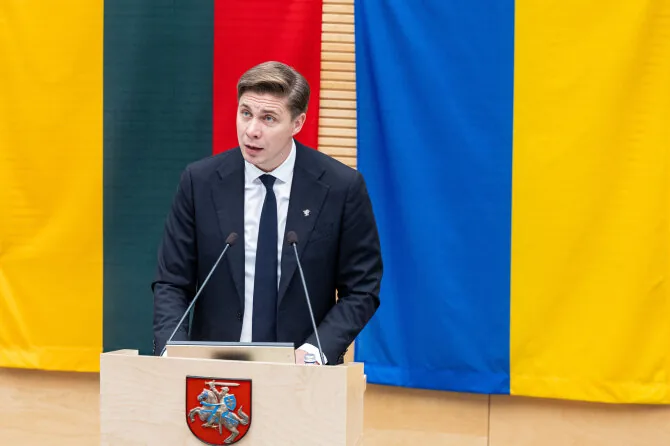
Now in the Seimas, he presented the program later, after the president signed the decree, the appointed ministers sat there and answered questions. Formally everything is fine. But what is being considered in the Seimas? A draft resolution is being considered. If you open the Seimas session agenda, the first probably question is the draft resolution on the approval of the Government program.
But such a resolution does not exist because it was submitted by a subject who could not have done so under such circumstances. The appointed prime minister simply could not submit this Seimas resolution on that day.
This is exactly the same as if you or I, being reasonable people, decide that Lithuania needs some law. We sit down with a hundred other reasonable people, write the best law, and submit it to the Seimas for consideration. Can the Seimas consider it? No, because we are not members of the Seimas, not the president, the Government, or 50,000 citizens. The subject is not the right one.
In other words, what happened in the Seimas is a process that arose from a null basis. This submission of the Government program is null. There was no Government on July 3. MP Jurgis Razma asked this question to the prime minister, but the genre was such: a member of the Seimas asks, the one answering replies, but the discussion does not continue. The question was very apt, but no one else developed the matter, and in fact, the prime minister should have admitted – yes, today I am here for no reason because what I am submitting is just paper and we are all pretending to consider a draft resolution of the Seimas.
The draft resolution, legally speaking, was simply not submitted. So this is such a false start that there has never been such a false start in the history of forming the Government of the Republic of Lithuania. This is – I dare say – complete constitutional, legal illiteracy, complete illiteracy, and complete disregard for procedures. Procedures in law and constitutional law are very important, so this threatens very serious legal consequences.
– What kind?
– We know that there have already been similar cases. About allegedly illegally operating governments or not allegedly.
One case, which everyone has long forgotten, was examined by the Constitutional Court in April 1999. Then there was Gediminas Vagnorius’s Government, and some ministers changed. Then the opposition, Česlovas Juršėnas and others, received the first Government resolution, which was adopted after a certain number of ministers changed, and they appealed that resolution, which was completely unremarkable, to the Constitutional Court, which examined the appeal.
Read more The youth confrontations between Lithuania and Poland have been going on for half a century
In that case, the CC recognized that the Government acted legally because those who initiated the case miscounted the ministerial changes. They imagined, roughly speaking, that seats should be counted, but heads should be counted. And if two ministers swap places, for example, the heads of the Ministry of Agriculture and the Ministry of Environment swap places, the number of formally changed ministers does not change. Because formally the Government acts as one body and is jointly responsible for everything. Therefore, ministers must have a broader outlook and understand other areas of Government activity.
That was the first case. But then there was another case – about Saulius Skvernelis’s government, when its program was approved by a protocol resolution. The CC then waited a long time but examined the case in 2020 and decided that the Government did not receive authorization in the Seimas as established by the Constitution because it receives authorization if the Seimas approves the program, and then there was no full program consideration.
But the official announcement of that CC decision was postponed for a long time, several months, during which parliamentary elections took place, and a new Government was formed. But S. Skvernelis’s situation, if anyone had been inflating that bubble, was very unenviable – he knows that his Government operated illegally, but he does not even have a formal legal basis to come to the Seimas and ask again, which would be a very peculiar thing a few months before the elections if he came again to the Seimas and asked to properly approve the program.
It did not go that far, the term expired, new elections came, and the CC decision was announced. But from it, you can see the significance of the Government program.
There is another precedent that shows that if now, as the so-called (I say in quotes) Government program is presented, the Seimas adopts such a resolution, and this is planned for tomorrow, the opposition or anyone who wants can challenge that Seimas resolution in the CC. This can come not only from the opposition but also from courts if someone litigates regarding the application of any resolution of this Government.
If I were in the Seimas opposition, I would say that we will immediately initiate an appeal to the CC and challenge this Seimas resolution approving the Government program. This is very easy. Our MPs often write inaccurate requests to the CC, then the CC has the opportunity, especially if the case is very political, to reject the request. But let’s allow ourselves to dream that MPs write a quality request, then the CC will have no choice but to recognize that this M. Sinkevičius Government operates without authorization.
Because there is a precedent. It comes from 2014. Remember that in 2013 there was an attempt to adopt a constitutional amendment regarding a person who was removed from the Seimas or presidency or other offices by impeachment and the consequences of such removal. It was considered for how long he cannot hold certain offices. Much later it was set to ten years. But at that time – autumn 2013 – the question arose, which I raised when journalists asked what I thought about the amendments, I asked why no one thinks about procedures. I said that the constitutional amendment was submitted by the Seimas Committee on Legal Affairs and Legal Enforcement, but according to the Constitution, amendments can be submitted either by a set number of citizens or MPs, but not by a committee.
Then there was a huge uproar, and Julius Sabatauskas, who tried to push the amendment, pulled out a previous case from 2006. Then everyone hoped that Lithuania would adopt the euro, which was finally adopted much later. But at that time, those hopes did not seem completely empty, and a constitutional amendment was made, where one part was removed from Article 125 of the Constitution, stating that only the Bank of Lithuania has the right to issue money. J. Sabatauskas then initiated a whole Seimas appeal to the CC, saying that it is necessary to check whether the euro introduction amendment complied with the Constitution because it was also submitted by the Committee on Legal Affairs and Legal Enforcement.
He hoped that the CC would chicken out, be scared because the time was sensitive, 2014, the euro had to be introduced in 2015, so it was probably imagined that the CC would not dare to say it was wrong. But the CC dared, and there is that 2014 decision stating that the constitutional amendment was made violating procedures. And the violation was that the amendment – whether good or bad – was submitted by a subject who could not submit it.
So if the CC received such an appeal today, it would honorably have no other choice but to say that the Seimas resolution approving this Government program contradicts the Constitution because it was submitted by a subject who could not submit it under those circumstances.
The legal acts database records (maybe now, as I speak, attempts will be made to fix this) that this resolution was submitted by the appointed prime minister and the Government of the Republic of Lithuania. But there was no Government on July 3.
The president did everything correctly by signing the decree on July 7. Why couldn’t Mindaugas Sinkevičius wait until the 8th day and submit the program properly? Moreover, he had to submit the Government composition at the same time.
When many commentators say that M. Sinkevičius was slow, waited, and so on, here he actually rushed and slipped on a banana peel. Not on one thrown down, but he put the peel himself and even slid on it.
The first pancake, as they say, is very, very bad, and unfortunately, this is a cow’s pancake.
– But, say, maybe it happened due to haste, holidays, etc., M. Sinkevičius listens, hears and says – damn, I rushed a few days, what could he do today or tomorrow?
– Today is July 13, the deadline is July 15, so if he wants to do everything properly, he has two more days to do it: submit his program and the Government composition to the Seimas. He can do it today, tomorrow, and at the latest the day after tomorrow. And it is not difficult to do. Will it be a loss of face? Yes, in a way it will, but the face is already lost, the first pancake was badly baked. But it is legally possible to do.
This issue is widely discussed in narrow circles. Lawyers see it, so I think this issue will not die out. But if in the Seimas, in the emerging Government, a position is taken that everything is fine here, then there is no law in Lithuania. Because procedures are very important in law.
– Why are these procedures so important? Because I hear others say that this is nitpicking, maybe a mistake, after all, the prime minister is the same, just a few days.
– If the procedure is established in the Constitution, it is not even appropriate to ask why it is important. If the procedure is established in the Constitution, we must follow it. Because if we do not follow this procedure, we will not follow others either. And if the Government starts with such disregard, we cannot expect it to follow all other procedures in the future.