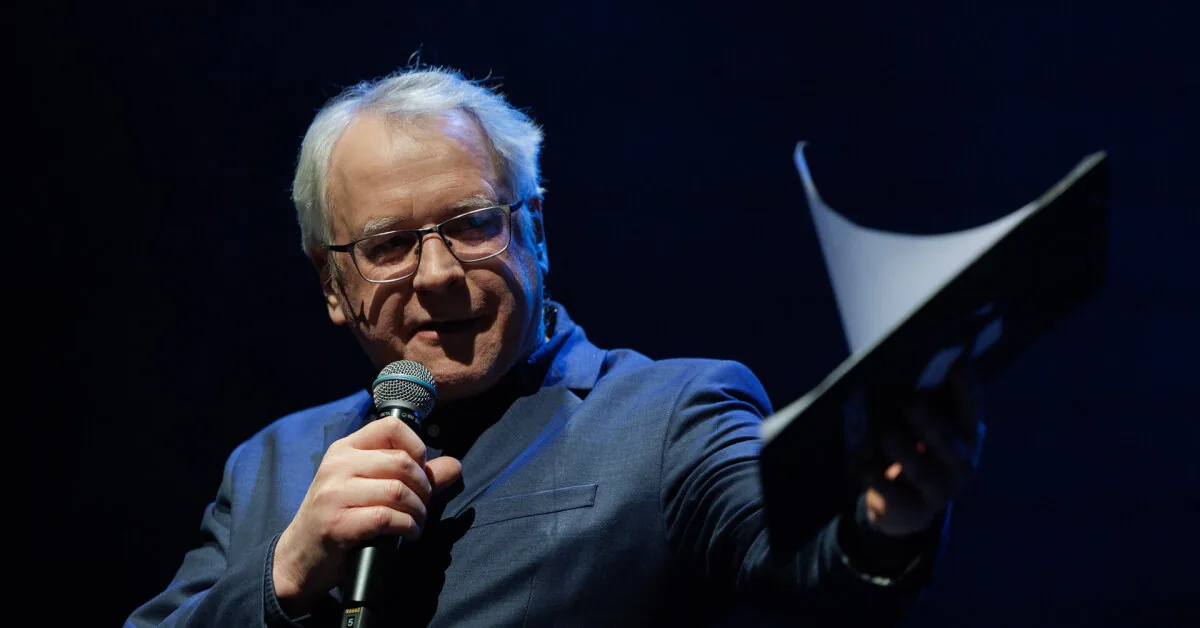
One of such meetings with A. Šlepikas is being prepared by the 19th cultural festival “Purple Evening,” which will take place in Anykščiai from August 13 to 15. The conversation with the poet will be held on August 14 at the L. and S. Didžiuliai Public Library.
Read more The EU and UK have imposed joint sanctions on Russia for cyberattacks
There will be more poetry events at the festival. At midnight, entering August 15, traditional poetry readings will take place in the Anykščiai chapel, where actress Rasa Samuolytė will read the works of Daiva Čepauskaitė.
At noon, at the A. Baranauskas and A. Vienuolis-Žukauskas Memorial Museum on Writers’ Hill, a musical composition “Rhythmic Texts” is being prepared by writer and poet Rimantas Kmita and percussionist Gintautas Gascevičius.
Before the “Purple Evening” festival, Laisvė Radzevičienė spoke with A. Šlepikas.
– At the “Purple Evening” festival, you will meet your fans. There have been many such meetings during your career. What do you see when you leave the Vilnius bubble?
– Mostly women librarians who are interested in literature and love poetry. They care, they invite. I see people for whom such meetings become entertainment; they come to listen to what someone coming from afar will say.
– Do you think literature is capable of bringing people together?
– Anything can bring people together – a cake-baking evening, poetry. But going to a town or village library and expecting to meet connoisseurs with whom you can discuss poetry is probably not realistic. People who come to meetings have their own idea of poetry. Usually, it is written in classical quatrains and talks about beautiful things. Lyrical, melodic – that is what they expect and hope for. But not every poet brings that. And then we hear: we don’t understand new poetry. It’s impossible to understand if you don’t constantly take an interest, don’t see how it changes, if you are stuck in the first half of the 20th century or in Romanticism.
Wanting people to know poetry well and understand it perfectly is also nonsense. Poetry is not a universal product, not pop music; it is still more a matter for eccentrics and freaks. Few people are interested in contemporary poetry or write it. So, expecting to be greeted like Maironis in every village is unrealistic.
When you come to present your work, you not only read the text but also talk with people, explain how the text came about, what inspired it. Look, it becomes a bit clearer. To be honest, a written text is easier to understand; when reading, you see what connects with what, what rhymes. The appearance of a poem is also part of poetry.
– But poetry has the right to be misunderstood? Or understood differently? After all, a poem is influenced by our personal experiences…
– The phrase “to understand poetry” is not entirely accurate. Poetry needs not only to be understood but also felt and experienced. There are more words describing the reader’s or listener’s relationship with the text. When we listen to music, we don’t think to say that I understand this music. If we like it, it doesn’t have to be understood; it can just be beautiful. There aren’t many things in poetry that you can describe rationally; sometimes we don’t even understand why we like one text and not another. Maybe it’s the feeling of the words or the combination?
Poetry needs not only to be understood but also felt and experienced.
It is easier to understand poster poetry, love lyrics; you can understand a poem about partisans or the Holocaust – poetry is diverse.
For people who work in the fields from morning till evening, it may not be necessary to delve into the subtleties of poetry. Such meetings, by the way, are always interesting – they bring poets down to earth, showing that maybe other kinds of texts are needed, not just those that concern you personally.
Read more Last words of Lindsey Graham: «I can’t die now»
Poets have always tried to describe the hard-to-describe reality, what we all think about – what is death, silence, eternity, an end, flow, the beginning and end of love, what is God, what is emptiness… Very often these truths or beauty are unspoken; poetry only tries to touch them.
– Are there fashionable themes in poetry?
– Fashionable themes are eternal – death, love, time. Young poets often write about death. It seems as if they know a lot about it. Later, the theme of death begins to disappear from poems. Maybe it becomes scary? Or maybe they begin to understand that it is serious.
– Recently, much has been said about poetry and death – we said goodbye to Aidas Marčėnas…
– Aidas was and will remain a great poet very important to Lithuanian literature and culture in general. Books and articles have already been written about him; his poetry sounds and will continue to sound. But now it is more important to me – my friend, a very good person, died, and I feel a huge emptiness opened up. It is hard to talk about it…
– We hear a lot of Ukrainian poetry, where the theme of death is also very prominent. Don’t Lithuanian poets share the premonition of war?
– The lines of current Ukrainian poets are very moving; they have experienced what war is. In critical times, a lot of such poetry is written – let’s remember Bronius Krivickas, the Žemininkai generation. If not for war after war, maybe they would have become great poets like Henrikas Nagys, Kazys Bradūnas, Viktoras Miliūnas. Or Holocaust poetry written while hiding in the ghetto… Different, but still poetry. And it moves.
War poetry is more direct; you can feel it. A text written in poetic language conveys meaninglessness, pain, despair of loss, injustice more vividly. And the writer often gets rid of the horror weighing on him in his poems. Poetry written in difficult times is definitely different, but there are poets who defend themselves from war by writing gentle verses. The great Lithuanian aesthete Henrikas Radauskas wrote a wonderful poem about the wind and a flower in a terrible, war-destroyed place. Around the same time, Česlovas Milošas and Jonas Mekas wrote beautiful things too.
The texts of current Ukrainian poets simply shock; it is good that we have more and more of them in Lithuania and that they are translated into Lithuanian.
– I wonder how much change artificial intelligence has brought to poetry?
– At least so far, I haven’t read a single text somewhat resembling poetry written with artificial intelligence. I haven’t tried it myself, but friends’ attempts are disappointing – simply uninteresting. Artificial intelligence arranges its blocks, while poets do not follow rules; the human mind is unpredictable.
– Maybe you will announce a new book at the “Purple Evening” festival?
– There are texts, but I don’t have news about a book yet. I just finished writing the libretto for Zita Bružaitė’s oratorio “Votai,” which should premiere in October. The theme is quite complex; it is a work about human disability and strength.
Read more Lithuanian tennis champions revealed
The cultural festival “Purple Evening” in Anykščiai – August 13–15.