







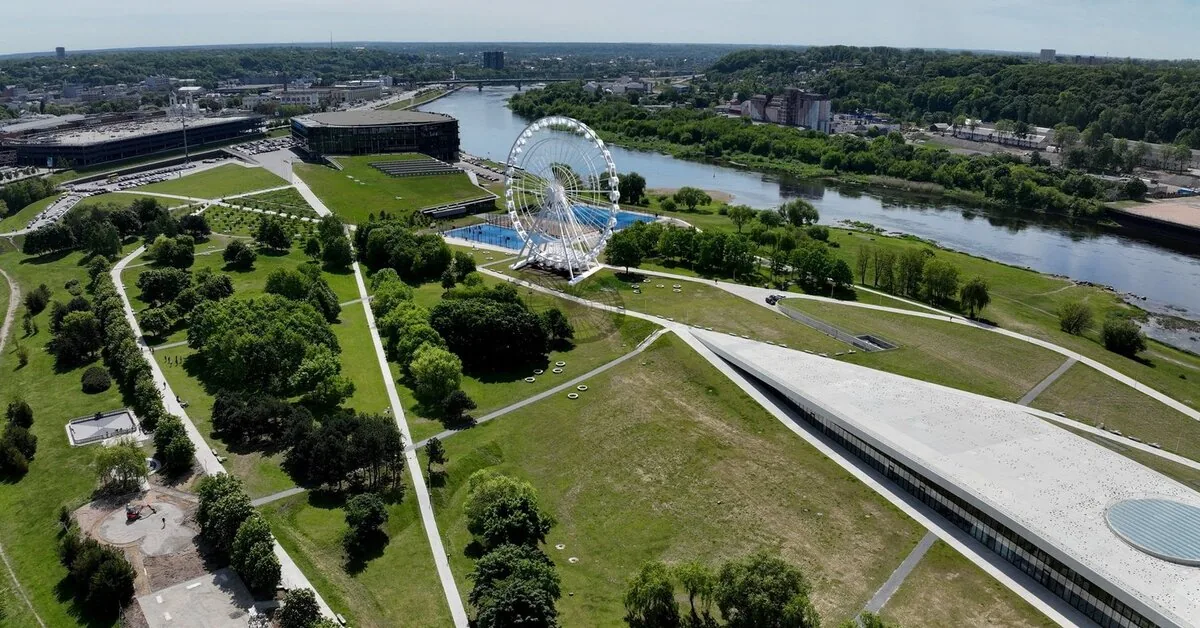
Answers obtained by the portal “Kas vyksta Kaune” show that questions about who ordered, who performed, and who will pay for the foundations installed under the observation wheel did not get into the inspection. And, according to the inspection, they could not get in because it is not within their competence. The latest response from the inspection, received on Wednesday evening after its repeated visit to the island, revealed more – the wheel near those foundations is not even fixed, and the maintenance of the wheel as a device generally belongs to a fourth institution.
Read more Volodymyr Zelensky: Ukraine is arranging meetings in the USA
What the inspection checked and what it did not
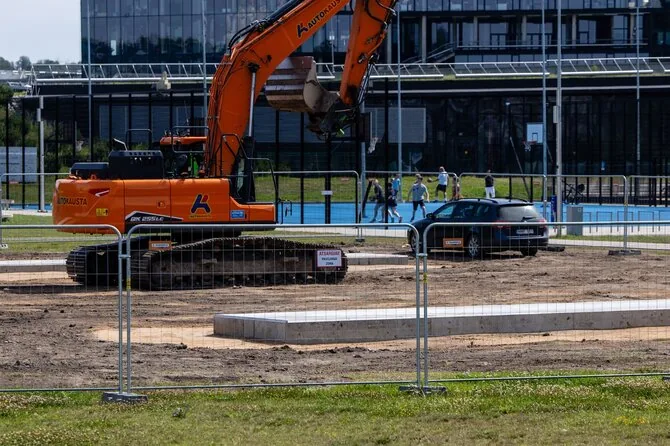
Let’s remind the situation simply. Since the end of July, 52 deep piles have been drilled and concrete foundations poured on Nemunas Island – on which a 4.6 million euro observation wheel funded by the city budget is now being completed. In the only public contract for the construction works of this object, signed by the municipal company “Kauno švara” and the construction company “Autokausta,” there are no piles or foundations – its scope covers only path surfaces, bases, and lawn sowing for 17.4 thousand euros.
The contract itself, concluded by an unpublished survey on the day work started, was signed with physical signatures and stamps, although its own rules stipulate that the contract is signed with qualified electronic signatures, and physical ones are only allowed when electronic signing is impossible due to technical reasons. Unlike an electronic signature, a physical one does not leave a verifiable timestamp, and the contract was published in the public procurement system only on August 10 – when the media and the Construction Inspection were already interested in the object.
The municipality itself has already explained its position on the piles and foundations in writing to the portal during the works, and it is worth recalling.
“The Kaunas City Municipality Administration (KMSA) did not design or install the foundations on Nemunas Island. KMSA ordered the installation of paths on Nemunas Island from the contractor ‘Kauno švara’ according to the path project prepared by ‘Urban line.’ Currently, the paths on Nemunas Island are fully designed and installed, the object has been handed over and registered. We do not have construction contracts between the contractor ‘Kauno švara’ and its subcontractors” – Paulius Pachomovas, Head of the Construction Management Department of Kaunas City Municipality.
The price ratio is also telling. The path design services contract, signed on May 13, when the location of the wheel was still publicly called unchosen, cost 34.2 thousand euros. At the end of July, while drilling piles, two subcontractors were added – geological survey and architectural part preparers. Meanwhile, the surface works under the only public construction contract cost 17.4 thousand euros – twice less than their design. Simple gravel paths do not explain such a ratio.
Already on June 22 – a month before any works on Nemunas Island – the municipality concluded a separate contract for the electrical network restructuring project at the same address for 18.6 thousand euros. It provided for a power increase up to 160 kilowatts. Such power, equivalent to the needs of a small apartment building, would be too much for lighting pedestrian paths. For the observation wheel – with bright decorative lighting, heated and cooled gondolas, and motor drive – it should definitely be enough.
Let’s put together what these sentences mean along with the contract content. The municipality did not order the foundations. The ordering chain named by it – through “Kauno švara” – ends with a contract that does not include foundations. No other contracts, in the municipality’s own words, have been signed. But the foundations exist on the object – they were recorded by the Construction Inspection in an act, and photos of the works carried out were published on the portal. Who built them is practically clear, but who paid for them? No one has answered this question so far.
The portal asked the Construction Inspection as well – after all, it was the one that inspected the construction and issued the conclusion. The answer was straightforward. “Questions regarding the composition and scope of construction contracts, the basis for ordering specific works, and civil legal relations between the builder (client), designer, and contractor do not fall within the competence of VTPSI,” the inspection stated.
Translated into simple language – the inspection checked whether the structures comply with construction rules but did not and will not check on what basis the works were carried out, who ordered them, and from what funds. Formally, the inspection is right; this is its statutory function. However, the “no violations found” announced to the public in August did not have this explanation – and sounded like an inspection covering everything.
Foundations were important before, now they are not
Interestingly, the inspection’s own position on the foundations changed fundamentally within a month.
As early as July 31, when asked by the portal about the works on the island, the inspection quoted the Construction Law definition – a structure is an object with load-bearing structures installed at the construction site – and indicated the limit from which a permit is mandatory: a site up to 100 sq. meters is a Group I simple structure that does not require a permit, while a larger one in the city requires a permit.
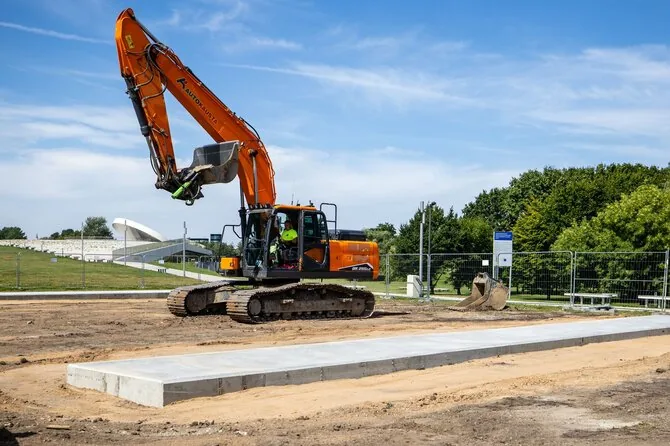
At the beginning of August, when asked by the portal how that area is calculated, the inspection clarified even more – according to the vertical projection of the structure’s outer contour onto the ground surface. Combining both inspection answers, the conclusion is clear and simple. Foundation slabs are load-bearing structures, thus part of the structure, and the structure’s contour is the contour of its widest construction – like a house with a basement, the area is not counted only by the roof. According to this methodology provided by the inspection itself, the portal calculated from aerial photos that the area of just the concreted foundation structures reaches about 300 sq. meters – several times more than the 100 square meter limit, and the two “paths” version becomes incompatible with their own rules.
However, at the end of August, the conclusion drawn by the inspection stated that no violations were found – the areas were assessed not according to the structure contours but according to the project and cadastral files, which recorded only the visible surface strips of 61.69 and 75.71 square meters. The project itself, on which the assessment was based, as we wrote on Wednesday, was seen differently by heritage protectors – the Cultural Heritage Department confirmed it only approved the cable without piles, and the department, in its own words, is unaware of the solutions of the version assessed by the inspection. The underground structures, which the inspection itself recorded in an act – 52 piles and slabs up to five meters wide – were not included in the structure’s area.
And in September, when the portal submitted new questions, the inspection went even further with the legal explanation – since such structures do not require a permit, allegedly the project itself is not mandatory either, so neither the project version nor its completeness changes the assessment.
Read more Denim jacket stolen from store: police ask for public assistance
Putting these answers side by side, the sequence of explanations looks like this. At first, foundations, according to the inspection, are included in the structure’s dimensions. Then the conclusion is written according to documents that do not include foundation dimensions. And finally, it is explained that the documents relied upon were not mandatory at all, so their content does not matter. Each answer separately sounds logical. All three together leave the question the inspection did not answer – if foundations are included in the structure’s size, and their slabs alone occupy more than all declared paths, why is the object still considered two structures that require neither a permit nor a project?
Repeated inspection – the wheel near the foundations is not fixed
After the portal’s questions about the paths turning into the wheel’s supporting base, the inspection visited the object again – and the factual circumstances it recorded deserve special attention.
“It was found that steel containers rest on the Pedestrian paths. The steel containers are not anchored and not fixed to the base. There are filling hatches on top of the steel containers, and discharge fittings (taps) at the bottom,” the inspection stated.
In simple terms – the observation wheel stands on a ballast system that will be filled with weight and is not fixed in any way to the 52 drilled piles under the paths. This confirms what the wheel purchase contract showed, describing the device as stabilized by ballast and not requiring a permanent foundation. In other words, the deep foundations, whose origin and payment no one can explain, according to the facts recorded by the inspection itself, are not used to secure the device – the wheel is simply placed on them as it would be on any flat site.
The inspection also provided the first quantitative assessment throughout the investigation – according to it, during the inspection, it was found that “the area of irregularly shaped concreted pile zones was up to 100 m2.” The number, just below the limit from which permit requirements begin, raises questions – according to editorial measurements from aerial photos, the total area of just the reinforced concrete foundation slabs, which are up to five meters wide, approaches 300 sq. meters, but they are already buried underground.
The Labor Inspectorate is now responsible for the wheel’s maintenance control, and maintenance belongs to the municipality
The latest response from the Construction Inspection also clarified how the wheel itself is legally classified. According to the inspection’s explanation, the observation wheel is classified under the legal acts for the maintenance of potentially dangerous devices as an amusement device with a motor drive, so it does not require a construction permit, and the installation, maintenance, and use control is carried out by the State Labor Inspectorate. The question of whether the paths turning into the device’s supporting base changes their assessment was answered similarly – after construction is completed, the supervision of the use of structures by law belongs to the Kaunas City Municipality Administration.
The last detail in this distribution of responsibilities deserves special attention. The supervision of the use of structures – whether the paths are used according to the registered purpose, whether they are safe, or whether their purpose can be changed – by law belongs to the municipality. This means that whether the Nemunas Island paths, which currently serve as the observation wheel’s supporting base, are used according to their purpose will be assessed by the same institution that ordered them, accepted them, built the wheel on them, and now refuses to even show the project.
So the legality of the construction was assessed by the Construction Inspection, but contracts and work orders are not its competence. Purchases are assessed by the Public Procurement Office. The maintenance of the wheel as a device is the concern of the State Labor Inspectorate. And the supervision of the use of the paths is the municipality’s own. Each institution is responsible for its narrow area, and none has the competence to answer the simple question from which it all started – whose funds built the pile foundations. According to construction experts, the cost of such works does not fit into the “Kauno švara” and “Autokausta” construction contracts.
The secret foundations ball – in the hands of the Public Procurement Office
The question of who and with whose funds built the foundations is currently being examined by the Public Procurement Office – it confirmed to the portal that it is conducting an assessment and awaiting documents from the municipality and “Kauno švara,” and its conclusions are expected in the coming weeks. The circumstance named by heritage protectors that such structures require an impact analysis on the heritage site is, in the Construction Inspection’s opinion, not significant for the conclusion. According to the portal “Kas vyksta Kaune,” the analysis is currently being prepared, and its content should indicate that the only publicly named suitable location for the observation wheel is precisely Nemunas Island.
Other links in the process also continue to choose silence instead of clear answers. The company “URBAN LINE,” which prepared the project, has not responded to the portal’s questions – including when and on whose order the project version with piles appeared – for more than a month, although the questions were sent repeatedly and publicly reminded. The company “Ekspertika,” which performed a non-mandatory project expertise during the construction peak – which project version it examined remains unknown. And the portal “Kas vyksta Kaune” appealed the municipality’s refusal to provide project-related documents – the Lithuanian Administrative Disputes Commission accepted the complaint regarding refusal and non-response to seven of eight request points.
After appealing the Kaunas City Municipality’s refusal, the Disputes Commission decided to clarify the complaint. And here began another absurdity: it is impossible to determine who prepared the “Word” file sent by the municipality – there is no date, number, signature, or preparer. Therefore, journalists have now provided the commission with evidence that the response sent by the Kaunas municipality was indeed prepared by the municipal administration.
We remind that the observation wheel costing 4.6 million euros was purchased by the municipal institution “Kaunas IN,” its location was not publicly announced until the start of construction, and the story began with a reader’s message about unexpectedly started pile foundations drilling on Nemunas Island. The municipality only confirmed a month later that the new observation wheel would be built in this location, although the started works clearly showed that these were not simple pedestrian paths.
Read more A motorcyclist was injured in Trakai district: police are looking for witnesses of the accident