










However, rest alone is not always enough, and if treatment and rehabilitation are not started in time, the risk of chronic ankle instability, recurrent injuries, prolonged pain, and poorer joint function increases. Vilnius Diagnostic and Surgery Clinic “Meliva” (formerly “Kardiolita Clinics”) Orthopedics-Traumatology Center orthopedic traumatologist Indrė Kuropatkinaitė-Vaitekūnė talks in more detail about foot and ankle injuries and their treatment.
Read more «Šilelis» expands production in Europe: signed a contract with a second factory

According to I. Kuropatkinaitė-Vaitekūnė, patients most often seek help for ankle sprains, fractures, various foot pains, deformities, as well as wounds and infections. Foot and ankle injuries occur during sports or travel when a lot of walking is required. Both very active people and those who usually move less but suddenly experience a heavy physical load after a longer passive period encounter them. The risk of repeated injuries remains higher for those who have previously sprained their ankle.
“After a minor injury, mild pain may persist for several weeks, but it is important that it gradually decreases. If the pain is severe and does not decrease after three or four days, it is not worth delaying. A serious injury may also be indicated by significant swelling, subcutaneous bruising, visible deformity, or inability to put weight on the foot and support the body weight. In such cases, it is worth consulting a doctor,” says the orthopedic traumatologist.
It is important to properly assess the injury
In cases of severe pain, significant swelling, and difficulty bearing weight on the foot, it may be appropriate to immobilize it even if no fracture is visible on the X-ray. Immobilization helps reduce pain and swelling and provides stability to the injured ligaments. In milder cases, a removable brace may suffice.
“After the injury, an X-ray examination is first performed to assess whether there is a fracture. If the pain persists for six to eight weeks, joint locking is felt, or injuries recur, magnetic resonance imaging may be appropriate. If done too early, it does not always provide a clear answer because tissues are swollen after the injury, there may be leaked blood around, making it harder to assess the injury and its extent,” explains I. Kuropatkinaitė-Vaitekūnė.
Complete rest is not always the best solution
The orthopedic traumatologist draws attention to one of the most common misconceptions that a soft brace or elastic bandage is always enough to stabilize the joint after an injury. Another common mistake is complete cessation of physical activity for a longer period. This reduces muscle tone, slows blood circulation, and worsens ankle joint balance.
Read more Spanish company Indra will upgrade the railway traffic management system
“If the injury is not severe, it is worth limiting physical load during the first week and then gradually starting light exercises. Rehabilitation is important before returning to more intense sports. Daily exercises that strengthen the ankle and improve its balance help reduce the risk of injuries, and after the injury, the first goal is to restore joint mobility and only then move on to strengthening. Working with a physiotherapist can help with this,” says I. Kuropatkinaitė-Vaitekūnė.
Diabetic foot: how to avoid serious complications?
Special attention should be paid to foot condition in diabetes mellitus because this disease is associated with various complications. One of them is diabetic foot. Due to vascular and nerve damage, ulcers may appear on the feet, deep tissues or even bones may be affected. An untreated callus can turn into an ulcer, and an accompanying infection can, in severe cases, lead to limb amputation or even life-threatening conditions such as blood poisoning.
“This problem often develops unnoticed because patients do not feel pain and do not always pay attention to small wounds, blisters, or abrasions. To avoid complications, it is worth inspecting the feet daily in a well-lit place and using a mirror if necessary when having diabetes. If redness, swelling, fluid starts to flow from a wound, or an unpleasant odor is felt, it is important to immediately inform your family doctor,” emphasizes Vilnius Diagnostic and Surgery Clinic orthopedic traumatologist I. Kuropatkinaitė-Vaitiekūnė.
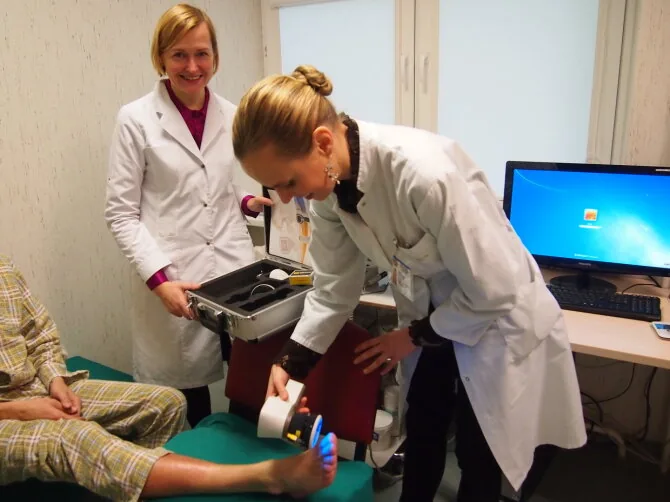
It is also useful to regularly check the inside of footwear and make sure there are no foreign objects, sharp edges, or seams that could rub the skin. When having diabetes, it is important to avoid walking barefoot, change socks daily, and care for the skin between the toes. Physical medicine and rehabilitation are also important, helping to maintain physical activity, improve blood circulation, and control blood glucose levels.
Read more Released Elizabeth Buchanan’s book «Do You Want to Have Greenland? Viking Lessons for Donald Trump»