Contemporary architecture and urban planning pay a lot of attention to the “human scale,” humane spaces, empathy, or simply a quality everyday life for people. The creator of spaces, founder of the studio “Aform,” Aurelija Jurkonė also says that as a professional, the most important thing for her is not the apartment area, but the owner’s life scenario.
However, the architect herself, who raises an animal and has created several interiors taking four-legged friends into account, notes that sometimes the fact that the daily life and leisure of many people are inseparable from their four-legged companions can be lost in this equation.
“Good architecture starts with the question: how will people live here every day? And that everyday life for many families today is unimaginable without a four-legged friend. When we create an environment where it is comfortable to walk with a dog, we almost always create a better environment for people as well,” says A. Jurkonė.
What does not work
In the architect’s opinion, today a larger part of home buyers still prioritize human needs and tastes, or at least do not consider the impact these can have on a pet. She points out several common situations here.
“First of all – too much attention to the apartment interior and too little to the environment. People devote a lot of energy to a very beautiful, functional home, but if the nearest park is a couple of kilometers away, it becomes a daily problem. Also, the floor level is often underestimated. While the dog is young and healthy, everything is fine, but as it ages or gets sick, every trip, even by elevator, becomes more difficult,” explains A. Jurkonė.
She draws attention to the fact that people setting up apartments often do not think about acoustics. For example, if the neighbor’s footsteps or elevator sounds are heard at home, more sensitive dogs may start reacting by barking. So good sound insulation creates comfort not only for people.
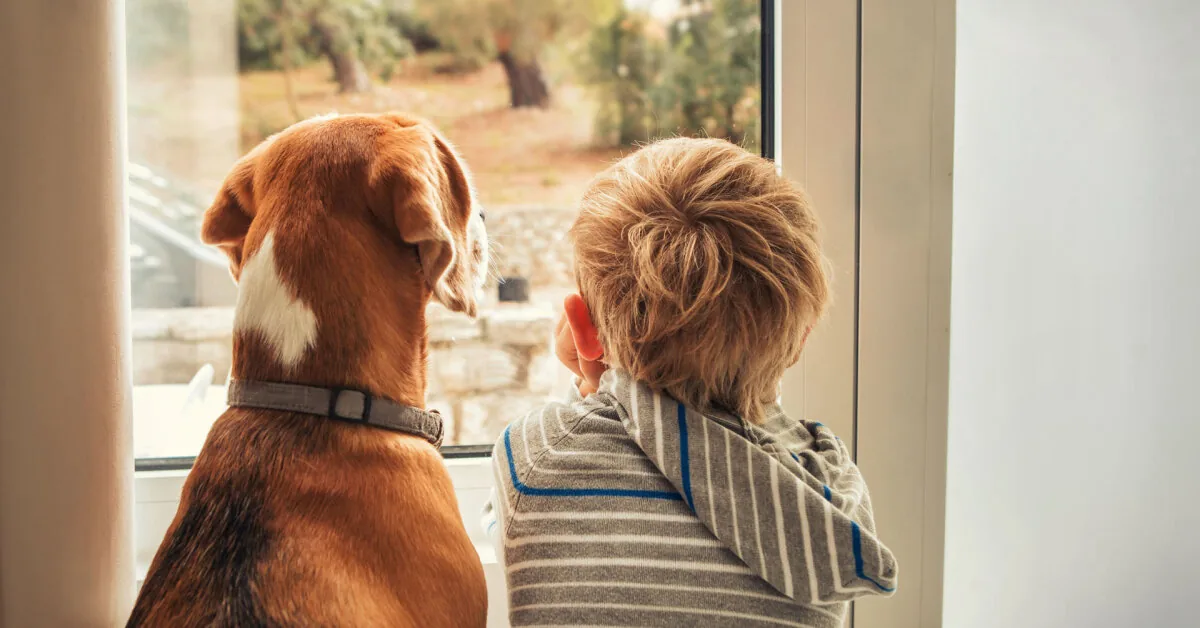
“Another interesting paradox – people now dream of panoramic windows from floor to door, but for a dog, this can sometimes become a constant television. So a passing cyclist, a cat, or a courier becomes a daily event, and sometimes a constant cause for barking. This is a good example when an architectural advantage for one family member becomes a challenge for another,” the architect points out.
Among other such cases, she mentions a completely white, minimalist interior with glossy floors she has seen herself. Only after moving in did the family realize that the dog was afraid to walk on them. So in this case, carpets had to be laid not for aesthetics but for the animal’s confidence.
What she would advise
In the architect’s opinion, the quality of a four-legged friend’s life is more often determined not by square meters or the type of housing, but by the owner’s lifestyle. If the owner is active, spends a lot of time outdoors, and the home is designed so that it is comfortable for all family members to live in, the apartment can definitely be a great place for a dog.
Speaking about an environment attractive to pets and owners, A. Jurkonė advises looking for apartment projects with clear, attractive zones for pets that are somewhat set back from the living room windows.
Wisely designed spaces of this kind will be convenient for everyone – both four-legged friends and their owners, as well as neighbors. On a neighborhood scale, she would look not only for a dog park but also, more importantly, a continuous network of pedestrian paths, parks, trees, lighting, the possibility to walk safely early in the morning or evening, and well-planned public spaces.
“When choosing a specific apartment, I would evaluate how easily one can go outside. If you have to go up and down from the tenth floor four or five times a day, wait for the elevator, go through closed corridors, it becomes inconvenient for both the person and the animal,” says A. Jurkonė.
Read more Book Anatomy: «Catch the Wind»
Inside the home itself, she advises paying attention to floor materials. For example, cynologists recommend quality vinyl for pets because tiles are not a small matter for a dog’s joints. It is also important that the materials are moisture-resistant and easy to clean – in this aspect, wooden flooring will be neither liquid-resistant nor practical.
“I always pay attention to natural light and the view through the windows. Many dogs like to observe the surroundings, but windows facing a very noisy street can become a constant stimulus to bark. Sometimes a calmer view of trees is a much greater value than a panoramic cityscape. The place near the entrance is also important – where the leash, towel after rain, bowls, or dog supplies will be kept. These seem like small things, but they greatly affect everyday comfort,” says the space creator.
Overall, according to her, a good home is one where all family members, regardless of whether they have two or four legs, feel equally welcome.
Although A. Jurkonė mentioned that overall priority is still felt for human needs in the market, she also sees a positive trend – younger buyers increasingly choose neighborhoods based on quality of life rather than just housing size. Also, the dog is more and more becoming a full-fledged family member, so its needs appear in the decision-making process.
She also sees changes among developers: in new real estate projects, dog parks, waste bins, water stations, special places for leashes near cafes or commercial spaces can be found more and more often. This shows that pets are becoming part of city life.
What they see
Developers also hear the needs of pets and their owners. Eglė Krengauskė, head of marketing at the real estate development company “Homa Group,” agrees that the needs of four-legged friends and people often coincide: they all value green, natural, calm, nearby environments that offer opportunities to move, as well as well-thought-out internal spaces of the neighborhood.
She also notices that dog-friendly drinking fountains, trash bins, or other infrastructure are gradually becoming market standards. Especially since, according to various estimates, at least half a million dogs and no fewer cats may live in Lithuania.
“This alone should encourage the market to care more about the needs of four-legged family members. Although they are often compatible with human priorities, some solutions can become consciously chosen distinctions. For example, I am proud of colleagues who, instead of additional storage rooms in the underground garage of our NIRO quarter under construction in Vilnius near Buivydiškės ponds, decided to design a special room for washing bicycle wheels and puppy paws,” says E. Krengauskė.
She also agrees with the idea that today’s homes should be designed starting from the life scenarios of individuals or families, in which the role of the animal is statistically undeniable.
“I believe that solutions for pets will eventually be perceived not as a separate infrastructure category but simply as part of a more comfortable everyday life,” says E. Krengauskė.
Read more Four people died in nightly Russian attacks in Ukraine