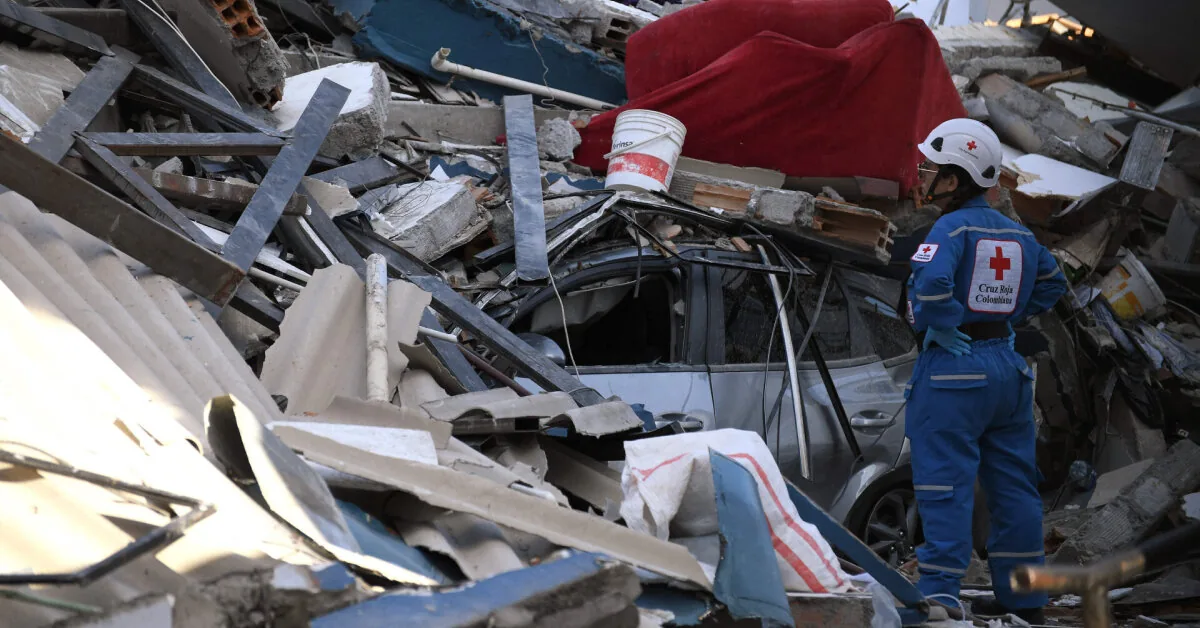
As the chief seismologist of the Deep and Oil Geology Department of the Lithuanian Geological Survey, Andrius Pačėsa, says, the numbers look similar – they differ by only 0.3 magnitude, but a 7.7 magnitude earthquake releases about 2.8 times more energy than a 7.4 magnitude earthquake.
What does magnitude mean and why is even a small difference so significant?
Scientists use specific scales to determine the strength of an earthquake, where the units of measurement are magnitudes. Essentially, it is a way to measure how much energy is released during an earthquake. Seismic waves are recorded by seismographs and the amplitudes of these waves are measured. Depending on the distance from the earthquake’s epicenter to the measuring station, a correction is added in the calculations.
“The Richter scale, more precisely the Richter-Gutenberg scale, is most often mentioned in the public space. It is reliably applied only to smaller earthquakes – up to about 5 magnitudes, i.e., those that can be felt but usually do not cause significant damage. Other scales – body wave, surface wave, or moment magnitude scales – are used to calculate stronger earthquakes, but they all rely on the same principles and roughly coincide up to 5 magnitudes,” explains the seismologist.
Moreover, he adds, it is important to know that earthquake scales are logarithmic. This means that even a one magnitude difference is enormous. For example, a 6 magnitude earthquake releases 31 times more energy than a 5 magnitude one. And a 7 magnitude earthquake releases 961 times more energy than a 5 magnitude one.
To make it easier to imagine:
A 5 magnitude earthquake can strongly shake a small town but usually does not cause major damage.
A 6 magnitude earthquake is dangerous – poorer buildings collapse, landslides occur, and people are harmed.
A 7 magnitude earthquake becomes a regional disaster, capable of destroying entire cities.
A 9 magnitude earthquake is a global event, capable of causing tsunamis and changing coastlines.
Read more Surprising and delightful: creamy green orzotto with burrata
These examples describe situations in the epicenter area when the earthquake is shallow – its focal depth reaches up to about 30 km. If the focus is very deep, for example, a 7 magnitude earthquake occurs at a depth of 700 km, it may not be felt as strongly on the surface and may not cause significant damage.
Therefore, the consequences of an earthquake are determined not only by its magnitude. The depth of the focus, distance to residential areas, local geological conditions, and building resistance are also important.
“It is also important not to confuse magnitude and intensity. Magnitude describes the strength of the earthquake itself – one magnitude is assigned to one event. Intensity shows how strongly the earthquake was felt and what effects it caused in a specific location. Therefore, the intensity of the same earthquake can vary greatly in different cities or regions,” says A. Pačėsa.
Earthquake scales have neither lower nor upper limits. The most powerful known earthquake was recorded in Chile in 1960. Its magnitude was 9.5. Meanwhile, very weak tremors, for example, the explosion of a few hundred grams of TNT, can even have a negative magnitude – say, –1.
Strong earthquakes are recorded even thousands of kilometers from their epicenters. The seismic monitoring system operating in Lithuania records almost all earthquakes stronger than 5 magnitudes occurring worldwide, except for events in so-called seismic shadow zones.
Currently, specialists of the Lithuanian Geological Survey focus mainly on seismic events in Lithuania and the surrounding region. They register about a thousand weak local events per year (mostly explosions, as well as weak earthquakes) and several dozen strong distant earthquakes.
Read more Holidays are over – „Žalgiris“ held the first training session: „We need to feel the system“