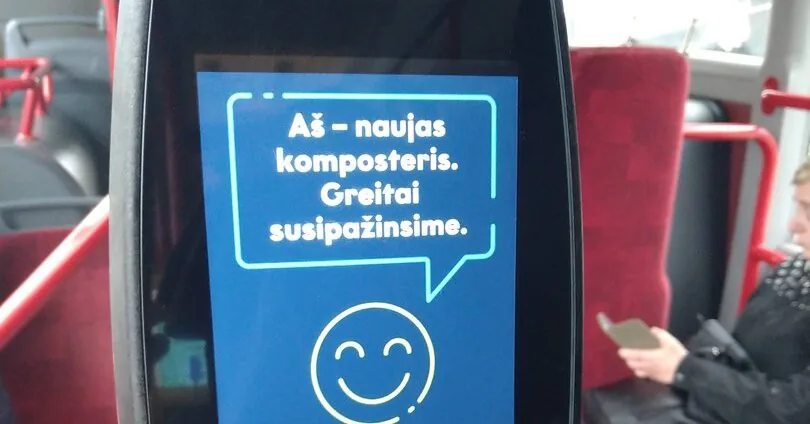
Practice shows that situations where passengers have to pay a fine for a trip often arise not because of an attempt to avoid purchasing a ticket, but because they do not know or misunderstand the applicable regulations – which moment is considered the start of control, whether a new ticket must be purchased when transferring to another vehicle, and how the situation is assessed when a 30-minute ticket is not enough to complete the trip due to traffic jams or other circumstances beyond the passenger’s control.
Read more Published relationship plan by Oksana Pikul and Dominykas Dirksys
“The public transport ticket system may seem very simple to the passenger at first glance – you buy a ticket and travel. However, from a legal point of view, not only the fact of purchasing the ticket is important. It also matters whether the ticket is properly and timely activated, whether it is still valid at the moment of control, and when using a concession – whether the passenger can justify the right to it. These circumstances in practice can determine whether the passenger’s trip is considered legal,” says Sandra Mickienė, senior lawyer at the AVOCAD law firm.

Where should passengers look for relevant information?
All persons using public transport in Vilnius city should first familiarize themselves with the rules of using public transport to properly understand their rights and obligations and be able to comply with them during the trip.
Relevant legal acts and other documents regulating passenger transport and passenger control are available to the public in the “Legal Acts” section of the JUDU website. There you can find, for example, the Rules for the Transport of Passengers and Luggage by Public Transport of Vilnius City Municipality, the rules for using the “m.Ticket” app, the description of the procedure for purchasing and/or using and refunding funds in the JUDU (Vilnius resident) card, electronic and paper tickets in the e-wallet, and other documents.
Besides legal acts, it is useful for passengers to familiarize themselves with the JUDU frequently asked questions (FAQ) section, which provides answers to many specific questions about ticket purchase, activation, validity, transfers, concessions, and passenger control.
Although the FAQ is not a legal act, this information helps better understand the practical application of the current rules. “It is certainly not necessary for the passenger to know all legal acts by heart, but before using a specific ticket type, it is worth knowing its main conditions of use. This is especially relevant when using a mobile app, concession tickets, or planning a longer trip with transfers. The rules and practical explanations published by JUDU allow you to check in advance how to act in a specific situation,” notes S. Mickienė.
Ticket activation and the start of passenger control
One of the situations that may cause disputes between passengers and control officers is improper or late ticket activation.
According to the rules of Vilnius city public transport, the start of passenger control is not associated with the moment when the controller boards the vehicle or approaches a specific passenger to check their ticket. Passenger control begins when the vehicle approaches the stop where control is carried out, or a stop without an entrance, and the driver or another authorized person blocks the validators installed in the vehicle.
Therefore, every passenger, immediately after boarding the vehicle and before reaching another stop where control actions may be performed, if they do not have a valid ticket, must purchase and properly activate it without delay. The ticket must be activated before the start of passenger control so that at this moment the passenger is considered to have a valid ticket.
“It is important to understand that the start of control is not the moment when the passenger sees the controller or when the controller approaches to check a specific ticket. The rules define this moment differently – it is associated with the vehicle approaching the stop where control is carried out and the blocking of the validators. Therefore, activating the ticket only upon seeing the controller may be too late,” emphasizes the senior lawyer at AVOCAD.
The method of ticket activation depends on how it was purchased.
When using the JUDU / Vilnius resident card, it must be tapped on the validator, the desired ticket to activate selected, and then the card tapped again to confirm the selection. If the card contains different types of tickets, the validator allows choosing which ticket to activate.
An electronic ticket purchased via the mobile app is activated within the app itself by performing the activation action. The activation process takes 15 seconds, so the ticket is not considered valid until the activation process is completed and the app confirms that the ticket is activated.
“These 15 seconds may seem like an insignificant technical detail, but in case of control, they can become very important. A passenger who has chosen the mobile app should start the activation action immediately upon boarding the vehicle. The ticket is considered activated only after the activation process is completed, so one should not wait for the next stop or the appearance of controllers,” explains S. Mickienė.
A separate method is a contactless bank card. In Vilnius public transport, it is possible to purchase a 60-minute ticket with it, for which concessions currently do not apply. The ticket is purchased by holding the physical bank card to the validator or using a phone or watch with the appropriate payment method installed.
A successful purchase is confirmed by a confirmation displayed on the validator screen and an audible signal.
In practice, there are cases when a passenger, after boarding public transport, forgets to activate the ticket and does so only, for example, after noticing a controller boarding. In such a case, the mere fact that the ticket is already activated when the controller checks the passenger does not mean that the passenger had a valid ticket at the start of control.
It is assessed when the ticket was actually activated and whether this happened before the start of passenger control, i.e., before the vehicle approached the stop where controllers carry out passenger control and the driver or another authorized person blocked the validators.
If it is determined that the ticket was activated after the start of control, it is considered that the passenger did not have a valid ticket at the start of control. In such a case, the later activation of the ticket does not change this circumstance. “In other words, during control, not only what the controller sees on the passenger’s phone at the moment of checking is evaluated, but also when the ticket actually became valid. If it was activated after control began, the later activation does not negate the fact that at the start of control there was no valid ticket,” emphasizes the lawyer.
Control ticket
However, if it is found that the passenger did not properly activate the ticket at the start of control, they may be given the opportunity to avoid administrative liability by purchasing a control ticket during the control. The control ticket is intended for cases when it is found during control that the passenger is traveling without a properly marked or activated ticket.
The control ticket costs 15 EUR and can only be paid by non-cash means – bank card. The purchased ticket is valid for two hours from the moment of purchase, and the passenger is not required to leave the vehicle.
If the passenger cannot pay for the control ticket by non-cash means, the controller has the right to expel such a passenger from the vehicle and draw up an administrative offense report for traveling without a ticket in accordance with the legal acts.
In such a case, the passenger is subject to administrative liability under Article 446, Part 4 of the Code of Administrative Offenses of the Republic of Lithuania (ANK) – a fine from 16 to 30 euros.
Concession ticket: having the right to a concession alone is not enough
The Law on Transport Concessions of the Republic of Lithuania establishes categories of persons entitled to use public transport under concessionary conditions and purchase tickets with a set discount. Among such persons are pupils and students, persons with disabilities, persons of a certain age, their accompanying persons, and other groups specified in the law.
Read more London received a warning from Moscow: «You will pay»
However, belonging to one of these categories alone is not enough. A passenger can use the transport concession only if they have a valid document confirming their right to the respective concession and present it to the controller upon request.
“It is important here to distinguish two things – the actual right of a person to a concession and the ability to prove it during control. For example, a passenger may indeed be a student and have the right to a concession ticket, but during control, they must be able to prove this right with the prescribed document. Simply explaining that the document was left at home is not enough,” says S. Mickienė.
If the passenger does not have such a document, for example, forgot it at home, they cannot properly justify their right to use a concession ticket during control. In such a case, administrative liability under Article 446 of the ANK may apply. When a passenger actually has an objective right to a concession and has purchased the corresponding ticket but does not present the proof during inspection, their action is qualified under Part 2 of Article 446 of the ANK, which provides for a milder fine – from 10 to 14 euros.
When a person has no right to any concession but travels with a concession ticket, their action is equated to traveling without a ticket under Part 4 of Article 446 of the ANK. A stricter monetary fine is provided for this – from 16 to 30 euros. “These situations should not be confused. One thing is to have the right to a concession but not present the confirming document during control, and quite another is to consciously use a concession ticket without any right to a concession. Accordingly, the liability provided for in the legal acts differs,” explains the AVOCAD lawyer.
Concession ticket for students: what is important to know?
Students who meet the conditions set out in the Law on Transport Concessions of the Republic of Lithuania are entitled to an 80% discount on single and time-limited tickets in Vilnius public transport.
The right to this concession is granted to higher education students studying in a full-time study program if they are citizens of the Republic of Lithuania, other European Union member states, or European Economic Area countries or their family members and study in higher education institutions of European Union member states or European Economic Area countries in a full-time study program.
However, having the right to a transport concession alone is not sufficient grounds to use a concession ticket during the trip. A passenger who has purchased and activated a concession ticket must have a valid document confirming their right to the respective transport concession and present it to the controller upon request during passenger control.
Students can confirm their right to a concession with a student ID issued by the school or university or a valid ISIC card if the respective educational institution is located in the European Union.
In practice, the case of newly enrolled students is also relevant, when the student ID has not yet been issued. The mere fact that the student does not yet have a student ID does not prevent them from using the transport concession for students. Usually, until October 1, it is enough to have a certificate issued by the educational institution confirming the student status and present it during passenger control.
“This is especially relevant at the beginning of the new academic year. A first-year student may be legally admitted to study but not yet have a student ID made. In such a case, it is important to take care in advance of a certificate from the educational institution that would allow confirming the student status during control. So, not only the student status itself is important but also the ability to properly prove it,” draws attention S. Mickienė.
If a student actually has the right to a transport concession but does not present the document confirming this right during control, they may be subject to a fine from 10 to 14 euros under Part 2 of Article 446 of the ANK.
Ticket validity period – not the duration of the trip
Another common misconception is that a timely purchased and activated ticket is valid until the end of the trip, even if the trip itself lasts longer than the ticket validity period. However, the ticket validity time is not related to the duration of the passenger’s trip. It is counted from the moment of ticket activation and depends on the type of ticket chosen. For example, a 30-minute ticket is valid for 30 minutes from the moment of activation, and a 60-minute ticket for 60 minutes.
“Passengers sometimes naturally expect that if they boarded the vehicle with a valid ticket, they will be able to travel to the final stop with it. However, the rules work differently – the ticket is valid for a specifically set time. Therefore, even when the trip is prolonged due to traffic jams or other circumstances beyond the passenger’s control, after the ticket validity period expires, a new ticket must be purchased and activated,” explains S. Mickienė.
So, if the trip is prolonged due to traffic jams or other reasons and the ticket validity period ends before the passenger reaches the final stop, the mere fact that the ticket was purchased and activated on time does not give the right to continue traveling. In such a case, the passenger must purchase and properly activate a new ticket to continue the trip. On the other hand, the ticket validity period is not linked to a specific vehicle.
For example, a passenger who activated a 60-minute ticket can transfer from one bus or trolleybus to another within this time and continue using the same ticket if its validity period has not expired.
“A transfer itself does not mean that a new ticket must be purchased. If the 30 or 60-minute ticket is still valid, the passenger can transfer to another bus or trolleybus during its validity period. The essential criterion is not the number of vehicles but whether the ticket validity period has not expired,” emphasizes the lawyer.
What is most important for the passenger to remember?
In summary, S. Mickienė highlights several practically important rules that passengers should remember:
1. The ticket must not only be purchased but also properly activated. This is especially important when using a mobile app because ticket activation is not instantaneous – 15 seconds must pass after activation confirmation. Only then is the ticket considered activated, and the person has a valid travel ticket.
2. The start of control is not the moment when the controller approaches the passenger. The start of control is associated with the vehicle approaching the respective stop and blocking the validators, not with the moment when the controller physically boards the vehicle or approaches the specific passenger being checked. Therefore, the ticket must be purchased and activated before the vehicle approaches the stop where the inspection will be carried out and the validators are blocked.
3. When using a concession ticket, it is necessary to have a document confirming the right to the concession. A passenger entitled to a specific concession must present this document to the controller upon request during control. Failure to have or present such a document may result in a fine.
4. When transferring to another vehicle, it is not necessary to buy a new ticket if the existing ticket is still valid. 30 and 60-minute tickets allow unlimited transfers to another bus or trolleybus during their validity, so transferring to another vehicle does not by itself mean a new ticket must be purchased.
5. The ticket validity period is not related to the actual duration of the trip. The passenger must consider the ticket validity period – no tolerance period is applied. After the set validity period expires, the passenger cannot rely on the same ticket just because the trip objectively took longer not due to the passenger’s fault or reasons dependent on them. In such a case, a new ticket must be purchased and activated.
“Most of these situations arise not because of passengers’ conscious attempts to travel without a ticket but due to a lack of knowledge of practical rules. Therefore, the simplest way to avoid an unpleasant dispute during control is to activate the ticket immediately upon boarding, monitor its validity period, and always have a document confirming the concession when using one,” concludes AVOCAD senior lawyer Sandra Mickienė.
Read more Aidas Jurkšas: «Klaipėda Lighthouse Becomes a Hostage of Biocrats»