Interested in birds since childhood
– Ingrida, you are a biologist, but you focus most on ornithology. How did you become interested in it?
Read more 10 companies punished for bringing dangerous goods: among them – well-known traders
– I became interested back in school. From the fifth grade, when subject profiling began, I attended a nature club led by biology teacher Tomas Baravykas. There were many older students in it, and they invited me to join.
After the death of the head of the Žuvintas Biosphere Reserve, ornithologist Vytautas Nedzinskas, the club was renamed in his honor as the Dr. Vytautas Nedzinskas Ornithologists Club. In short, I was fascinated by the teacher – inspired by him, I chose the profession of biology teacher. While still in the club, I met many Lithuanian ornithologists, so when I entered university, I already knew many lecturers and felt confident.
Soon, in the first year, I was offered to lead the zoologists’ club. I agreed. Although the club had 45 members and most were older than me, I organized activities based on the teacher’s experience: we traveled around Lithuania, studied protected areas.
It was easy because I knew the people working there almost everywhere, so they gladly welcomed us. At that time, it was not common to pay for educational activities, so in exchange, our club did useful work for the place, and in return, they organized a hike for us and allowed us to camp in tents.
After my bachelor’s studies, I continued with a master’s degree. I studied the first semester in Lithuania, spent the second in Italy, and after returning that summer, I went on a four-month internship at Umea University in northern Sweden to ring birds.
– At what stage of your studies did you become interested specifically in birds?
– From the very beginning. In the third year, I defended a course paper on the diet of little owls and barn owls, and I dedicated my bachelor’s and master’s theses to the ringing of whooper swans and their migration studies. Birds accompanied me throughout my studies.
– Do you have an answer to the question why birds, and not, for example, hedgehogs?
– Because I received knowledge about birds from my teacher and felt strong in that field. Plants never interested me. At university, lecturers used to say: “Ingrida, don’t look at the sky, you still have to collect a herbarium.” It was a mandatory part of the studies, so I collected them through gritted teeth, but my true passion was birds.
By the way, the hardest part was learning to recognize bird calls. When children were born in the family, my hearing probably sharpened – now I definitely recognize many more species. I can’t say I know them all. Also, you can’t say that once you learn a bird’s call, you will recognize it for life. For example, if I see birds flying by the sea – I don’t know them all.
To recognize a bird in flight, different methods are needed, constant practice is necessary, you need to have a trained eye. Still, I am strongest in bird ringing because I devote most of my time to it.
– In other words, ornithology has many directions.
– Yes, for example, colleagues study cormorant diets, others record bird calls, photograph, install nests, or specialize only in owl research. It is a very broad field.
Ornithology cannot be studied as a separate discipline – there is no such study direction. You can start to be interested in it, but deeper studies are only in doctoral studies, focusing on a specific bird species or group.
For both parents and children
– When traveling to another country, we admire unusual fauna, but often do not recognize what lives very close by. Is there anything to see in Lithuania?
– Definitely. My goal is to introduce people to our nature. People come to educational activities in Utena from Vilnius, Panevėžys, Biržai, and other cities, but I want to “unlock” this beauty for the people of Utena themselves. Some local residents are surprised: “Are there really such birds here?”
We get caught up in the routine of everyday life and do not notice the environment. Each regional park has prepared books in PDF format about the values of protected areas and the most visited sites. If a family is too lazy to look for information, they can simply read and choose a route – even artificial intelligence can help arrange it, as those publications list all the park’s values and even tasks for families.
– You are a guide, event and educational organizer. What activities do you offer in Utena?
– My activity is not limited to Utena – I travel all over Lithuania, but I really want to create something permanent in Utena so that people from all over Lithuania come to us. I have ideas, I believe the municipality will hear me and help. I am convinced: Utena really needs a visited natural site.
For now, I lead tours, educational activities for children and adults, organize events for the public and camps for families. Their theme is nature.
You can’t bring a person to nature for three days and talk only about birds, so I always have naturalists from various fields with me. I organize camps specifically for families because if I worked only with children – I would motivate them, they would return to their parents, but if parents don’t care about nature, there will be no next stage.
I emphasize parents: I want to show what treasures we have in nature and how to present them to children. At the same time, parents rest – activities are organized both together and separately.
I think a motivated father or mother will look for ways to interest the child in nature in the future. I believe that the more we introduce a child to the environment and living nature, the more they will protect it.
– You are from Marijampolė but now live in Utena. How did you end up here?
– My husband is from the Utena region. For me, this is the most beautiful nature in Lithuania: hills, lakes, we knew that we would live here someday, and when favorable circumstances arose, we came and settled.
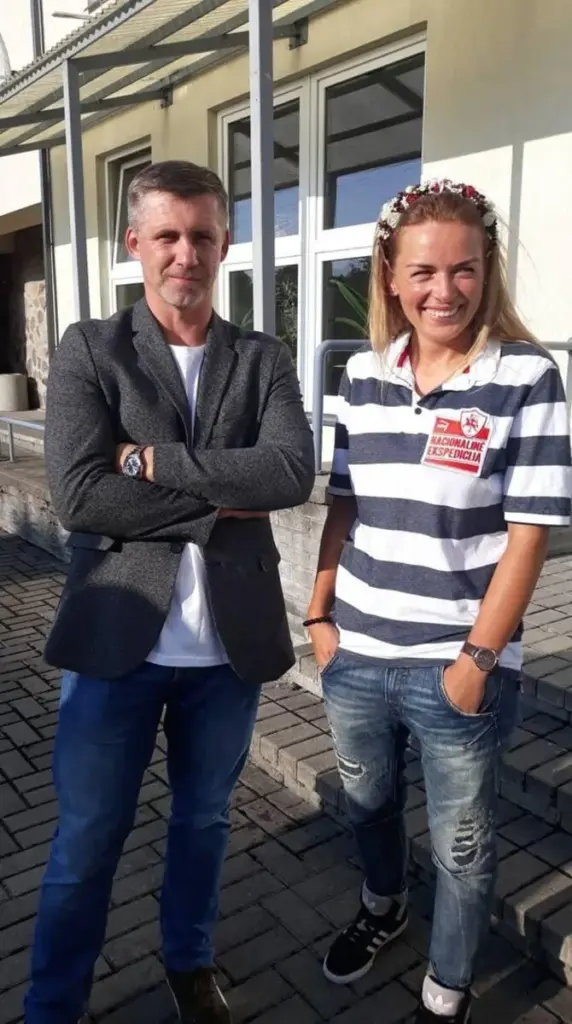
We had to rent a house, and there are not many such offers in Utena. Still, I believe that nothing happens by chance in life. I participated in the National Expedition “Dnieper through Ukraine” together with Salemonas Paltanavičius and Edmundas Jakilaitis. The head of the travel agency “Kur toliau,” Simonas, who later offered me to become a guide and accompany a tourist group to Chile and Argentina, also sailed with us. I agreed, and during that trip, I met a couple from Utena – it turned out they had a house in Utena that they could rent out. That’s how we agreed.
Fears of nature: from ticks to bears
– How would you answer the question: why does a person need nature?
– In big cities, people live in constant rush, so they seek nature as an oasis of peace and relaxation. But we don’t know how to disconnect from phones, many are afraid to go into nature because they don’t know what to do there.
Or they fear ticks. Everything comes from ignorance. I think nature is primarily an opportunity to stop for a rushing society. When people come and experience it, they understand what they were missing.
– You mentioned that people fear ticks, but there are bigger fears: bears, wolves.
– Speaking of bears, my husband is a beekeeper – bears have overturned our hives several times. At his parents’ place, living in a homestead, a bear has visited the terrace several times and damaged old empty hives.
Still, it is important to understand: all animals fear humans. But if you meet a female with cubs, she will defend her offspring, so behavior can be unpredictable.
If you meet a bear, you must not run – it may chase. You need to stay calm and slowly retreat. One mushroom picker said he saw a bear, slowly retreated from it, but out of fear, he doesn’t even remember how he got home. Bears that boldly approach humans should be avoided. They, like other animals, are scared off by sound signals.
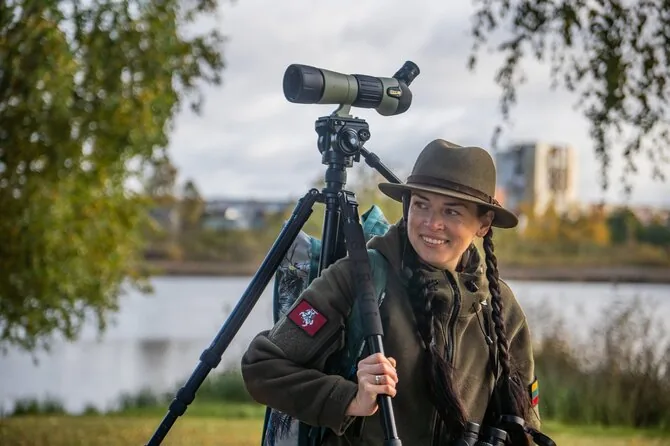
I like to photograph, so I travel a lot around Lithuania. Naturalists hint where to hide to see one or another animal. Then you sit still because if your clothes rustle accidentally, the animal will hear and not come. Naturalists use special noiseless clothes. When you have experience, you understand what noise means to an animal – they avoid humans.
Bears that boldly approach humans should be avoided. They, like other animals, are scared off by sound signals.
The same goes for wolves. One of my teachers, Tomas Baravykas, has been studying wolves for twelve years and wrote a book “Heralds of Twilight.” It interestingly reveals their life, explains why a wolf runs to a sheep and that it definitely won’t suddenly attack a human.
By the way, Sweden offers a unique experience – spending a day in a tent near wolves. Naturalists are nearby. It seems unreal to me; I would really like to try. I have seen a wolf in the wild only once, and our whole family has met a lynx with three cubs. The point is that it is very difficult to see some wild animals.
A person’s relationship with wild animals is peculiar: we love all animals until they settle in our yard. They are all cute, but if a ferret or a weasel comes into the yard – they start to bother.
– What would you say as a naturalist about the fear of ticks?
– More and more people organize children’s birthdays in nature. Recently, I had four seven-year-olds – we spent six hours in the forest: ringing birds, an educational session about owls and orientation in the environment took place.
Watching children who perhaps try for the first time to tie a tent knot or help build a twelve-meter bird trap is a pleasure. When you motivate children and trust them, they can do a lot.
A tick does not attach in a minute. After leaving the forest – shake off, check if there are any on your body.
But it is clear that the fear is brought from parents – city children were very afraid of ticks. As soon as they got out of the car, they started spraying repellents.
Read more Firefighters who helped extinguish forest fires in Southern France welcomed in Vilnius
I never do that myself. A tick does not attach in a minute. After leaving the forest – shake off, check if there are any on your body. But if you don’t check after leaving the forest and walk all day in the same clothes – of course, some may remain. People also fear mosquitoes, but there is a solution for them – thermacells.
– What are they?
– They are wireless devices to repel mosquitoes. Nowadays, all city families who go to nature have them (laughs).
The world of owls
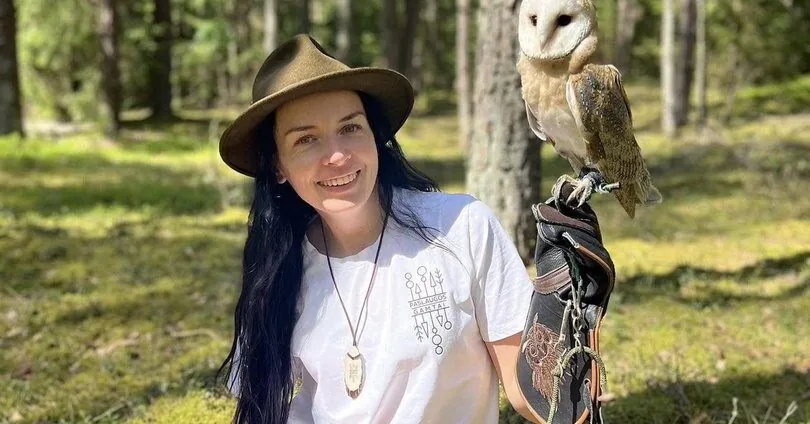
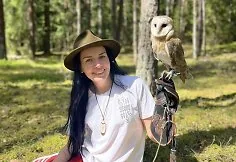
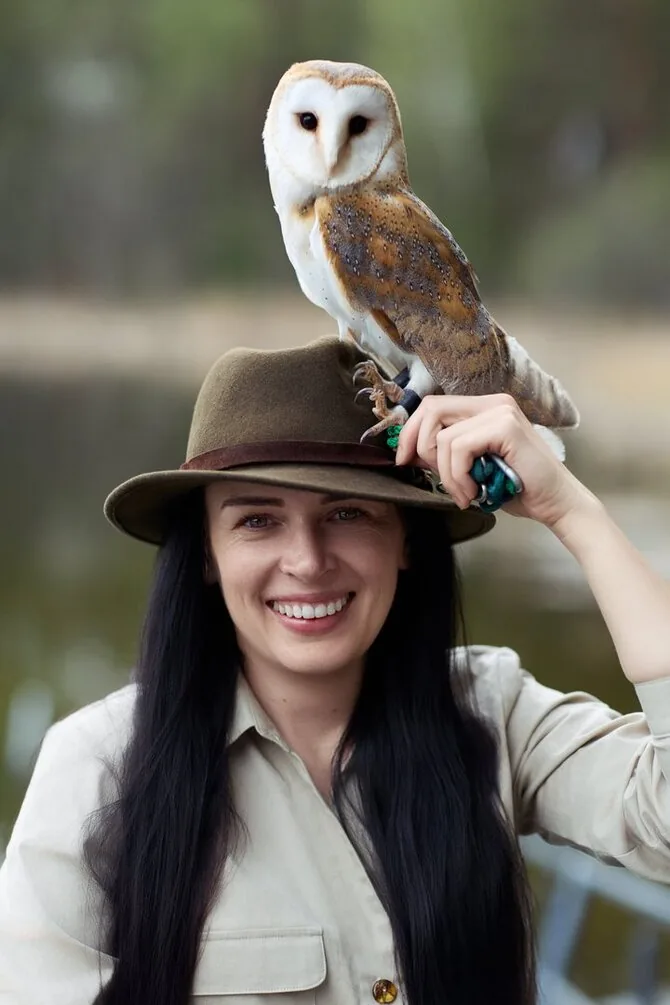
– You raise three owls in aviaries in your home yard. How did they end up with you?
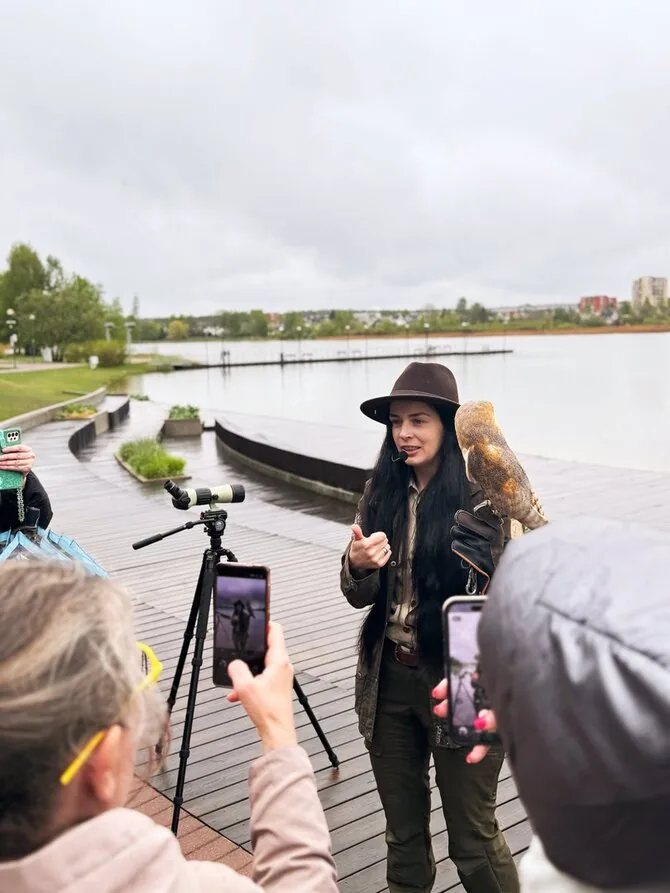
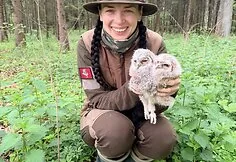
– There was a stage in my life when I was offered to work in Rudamina, Owl Park. I agreed. It was an intense time; on weekends, thirty people visited every hour. I liked observing their reactions, joy. It’s easy to talk when you rely on your experience ringing birds, not dry theory – probably that’s what people liked. Those owls were less afraid of people, cozy like cats.
At that time, it was not yet forbidden to give owls into hands. I didn’t like it, but that was the rule – people wanted to take pictures and often came just for that. Eventually, it was prohibited by law due to the stress birds experienced, and also, we could bring diseases to them. And it’s very good that it was banned.
It’s easy to talk when you rely on your experience ringing birds, not dry theory.
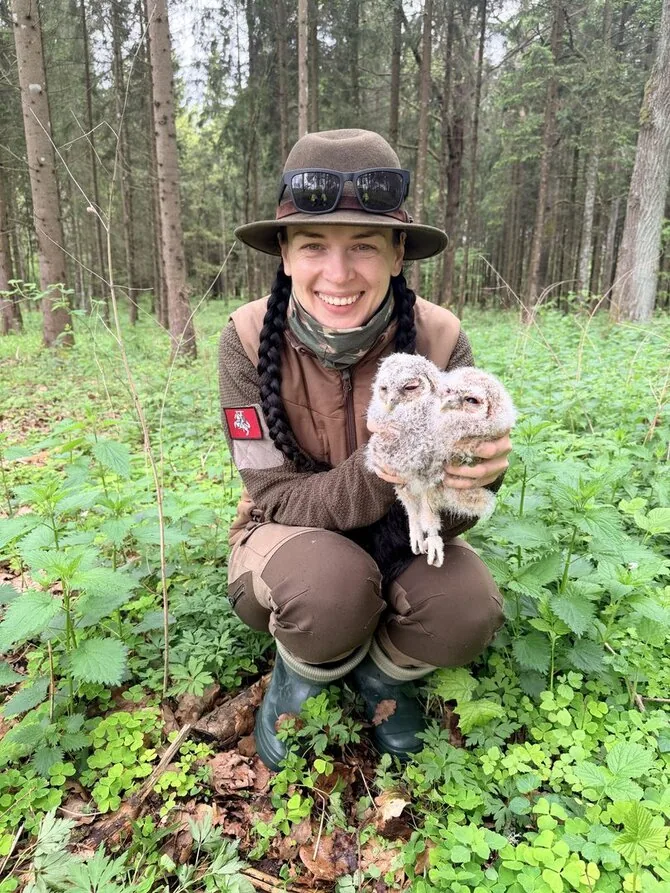
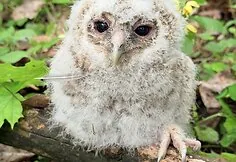
I liked this activity; I saw great meaning in educating people. One of my main messages is not to take owlets from the wild and not to “rescue” them. People who find an owlet in spring often think it is injured. You don’t need to do anything – just put it in a tree and leave it alone. Only by educating society can we contribute to nature by “not rescuing” it.
Then the pandemic started, tours stopped. At that time, my husband and I lived in an apartment in Klaipėda. I remembered that I knew the owner of HBH, wrote her a letter, introduced myself, and offered to set up owl aviaries in their game park. There is a forest there, a beautiful place for aviaries.
I was inexperienced, so I promised to build aviaries with my own money, buy birds, take care of permits – I only asked for a plot of land. It would have been an attraction for restaurant customers and a workplace for me. By the way, wherever I settle, I create workplaces for myself.
The HBH owner agreed, and so the aviaries appeared – beautiful and… very expensive. They didn’t pay off for me, but what wouldn’t you do for a dream. I bought birds from Belgium and the Netherlands, and when we moved to Utena, I brought them too.
– What is special about these birds?
– Owls are surrounded by many myths – they are mystical, mysterious birds. If we talk about the wild, they are very hard to see. By the way, not all owls are nocturnal: for example, the sparrow owl can be active during the day, while the tawny owl only at night.
– I’ve never seen them in nature.
– It’s really hard to notice because in their natural resting pose they stiffen like sticks. Near a tree trunk, the bird looks like a branch, so you wouldn’t even notice. But you have definitely heard their calls, just probably didn’t recognize them.
– Is it always hooting?
– Not necessarily. Owl calls vary. People often think they only hoot, but, for example, the tawny owl’s call sounds completely different. Domestic owls make other sounds, and female and male calls differ. And the calls of little owl chicks are very memorable.
– Owls are associated with wisdom. Is there truth in that?
– Yes, the roots of owls as a symbol of wisdom go back to ancient Greek mythology. But in reality, these birds are big lazybones: owls do not build nests themselves.
If you put up a nest box – they won’t lay eggs on bare boards, and if there is no convenient approach, they won’t settle there either. Their “cleverness” is shown by the fact that they simply use other birds’ nests. For example, crows or jackdaws are many times smarter than owls.
When you think about how many schools in Lithuania have an owl in their logo. I always joke with children in schools: if teachers give an owl as a gift – and gifts with this bird are very popular – then think about whether you really want to emphasize that the teacher is lazy?
The only real “superpower” they have is exceptional hearing, not wisdom.
How do birds find their way?
– What other birds living in Lithuania are interesting to you?
– Each species is unique. For example, storks form pairs for life and even mourn their partner. The courtship of shorebirds or the call of the woodpecker is distinctive.
Together with PhD Julius Morkūnas and a large team of ornithologists, we studied swans for a long time. We found cases where the family splits: the male flies to winter with the young to one German island, and the female to another, but in spring they return to the same nest. Such knowledge can only be obtained by ringing birds.
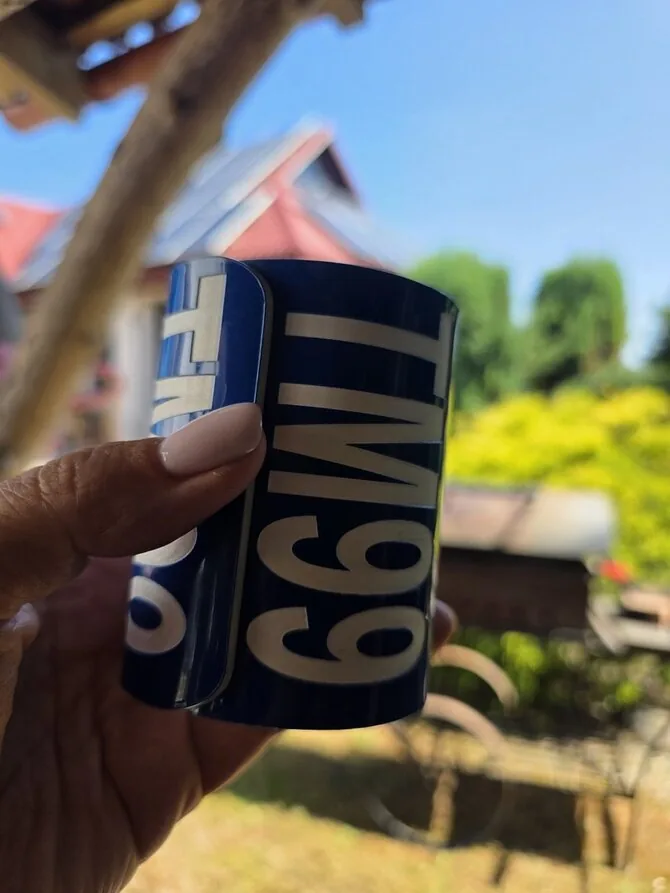
There were also curiosities with swan ringing. They are ringed with a large ring on the neck, not on the leg, so people sometimes call the police or nature protection. There were even reports that a beer can was put on a bird’s neck. Swans are ringed this way in other countries too; only the ring colors differ: blue in Lithuania, yellow in Poland, etc.
– Why are swans ringed on the neck?
– Previously, we only ringed on the legs, but they are almost always in the water. When we started ringing on the neck too – it provided a lot of valuable data about bird behavior.
Different birds are ringed with different rings, whose data allow finding out when and where the bird was ringed. It is an important contribution to science: ringing helps determine how breeding sites change, whether migration routes change, and whether climate change affects them.
People often say: “The same stork has been nesting at my place for twenty years.” But after putting a ring on, it turns out that a completely different bird returned the next year.
Birds are also fitted with geolocators. We worked with ornithologists from Japan ringing little terns. When a bird returns from Africa, we look for where they start breeding, then with binoculars look for which individual has something white on the leg. After finding the bird, you need to watch the nest, then catch it with a special trap, remove the geolocator, and connect it to a computer: extract data and watch how a migration map is drawn in a few minutes.
In Europe, we already have data that migration routes have changed and are no longer as described in old books. There are also GPS transmitters costing thousands – then every day you receive a message on your mobile device about where the bird is. Ringing becomes smart, but funds are needed. It’s nice that entrepreneurs appear who want to contribute to purchasing GPS transmitters.
– How do birds “navigate,” how do they find their way?
– Some say by stars, others – by rivers.
– What do you say?
– There are birds that fly only over land, others migrate over the sea. You can say that birds find their way by orienting according to the Sun, stars, Earth’s magnetic field, landscape. There is no single answer to how birds find their way.
There is a very interesting scientist Sacha Dench, called the “human swan,” who flew a paraglider following a little swan – rising and landing with it. In 2016, she flew about seven thousand kilometers by motorized paraglider through 11 countries, following the migration route of little swans (Cygnus columbianus bewickii) from the Russian Arctic to the United Kingdom.
The expedition’s goal was to find out and show the public what dangers swans face during migration – habitat loss, power lines, illegal hunting, and other human-caused threats.
We are guests in nature
– Ingrida, what should be a healthy and respectful human relationship with nature?
– It is often said that nature is our home, but I think we are only guests in it. We must realize that humans have already left a deep footprint on Earth that we cannot erase. So if we can still do something good, let’s respect and protect nature. Usually, nothing special needs to be done: when kayaking – don’t interfere with animals’ lives, don’t disturb swans, don’t climb slopes where terns breed. This is basic respect.
Sometimes I hear complaints that “a swan attacked.” But why did it attack? What did you do and why did you get close to it? Usually, the answer is: “I tried to save a cygnet.” But who asked you? A swan has strength – it can hit hard with its wings and scratch with its claws.
We naturalists know how to work with birds so they are not injured and experience as little stress as possible. There is even a photo where I am in a boat with about twenty swans – we caught them and brought them to shore for ringing. By the way, an interesting moment: swans often have many leeches in their eyes, so after catching them, we also cleaned the birds’ eyes.
– You have tried various forms of work in life, even worked at the Ministry of Education, Science and Sports.
– Yes. I think all people are equal, but there I noticed that some employees, for example, those doing audits, like to “strut like peacocks,” so everyone is afraid of them (laughs). Sometimes I notice this at a lower level when it becomes important not what you know but who you know. But I believe these are passing things.
– How long did you work at the ministry?
– One and a half years.
– Why did you leave? From our conversation, it seems that enthusiasts and professionals like you should work in such institutions.
– Too much bureaucracy. I stayed those one and a half years only out of respect for our department head. I have never met another person in life who allowed me to grow so much and believed in me so much. She entrusted me with interesting areas to supervise, such as non-formal education – it was really interesting work.
But, waiting for the right moment, I dared to talk to the head and say that I intend to leave. I think I can give more to Lithuania by doing what I do now – educating people.
Read more Donald Tusk: Poland will soon have the largest army in Europe