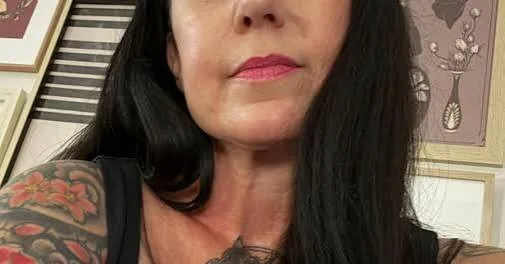
It all started with a feeling that something was wrong. Rebecca Luna was 46 when she noticed that she suddenly could no longer perform simple tasks at work. At first, she thought it was a result of stress. She certainly had enough of it as a single mother of two daughters.
However, after about two years of visits to doctors, a diagnosis was made that changed her life forever: early-onset Alzheimer’s disease – a rare form of dementia.
The neurologist who diagnosed the disease told the Canadian woman that her expected lifespan was between five and seven years.
Spoke openly about early dementia
In April 2025, at the age of 48, Luna spoke publicly about her diagnosis. On her TikTok account “wheredidbecsgo,” she began sharing what many people with Alzheimer’s experience silently: fear of forgetting, sadness, dark humor, and small moments of normalcy. One of her videos, for example, was titled: “Dates when you’re dying.” Recently, she was followed by more than 99,000 people.
Thus, Luna became a voice for people living with a disease that is almost always associated in public consciousness only with old age. But this is only partly true. If the first symptoms appear before the age of 65, specialists speak of early dementia. About 370,000 new cases of this type are diagnosed worldwide each year.
According to the German Alzheimer’s Association, about 1.84 million people in Germany suffer from dementia. Almost 6% of them, about 106,000 people, are younger than 65 years old.
Symptoms, as in older age, can vary. Among them are:
memory impairments;
speech and comprehension difficulties;
orientation problems;
personality changes.
Many patients also suffer from delusions, depression, and sleep disorders. Since dementia is rarely considered at a young age, the diagnosis is often made late.
There are Alzheimer’s drugs in early stages
In one of her TikTok videos in early 2026, Luna openly explained why she refused drug treatment. Although she did not mention the name in the video, she most likely referred to “Leqembi,” whose active ingredient is lecanemab. It was the first approved drug to truly slow the progression of Alzheimer’s disease.
“Leqembi” works by breaking down amyloid beta plaques in the brain – protein deposits that play an important role in the development of Alzheimer’s disease.
However, the drug is not without risks. The most common and serious side effect is so-called ARIA changes – amyloid-related abnormalities visible in imaging studies, such as brain swelling and microbleeds. Such changes occur in about one in five patients taking “Leqembi.”
Moreover, treatment requires strict monitoring: the U.S. Food and Drug Administration recommends MRI scans before the 3rd, 5th, 7th, and 14th infusions to detect brain bleeding or swelling early. The infusions themselves are administered every two weeks.
“For me, it’s a clear no”
It was precisely this combination of risk and intensive monitoring that deterred Luna. In her video, she said:
“My neurologist basically said: there is a high risk of brain bleeding, a high risk of brain swelling, and you will have to regularly get MRIs. And I don’t want to spend my time traveling from one hospital to another, getting infusions, having MRIs. The time I am still conscious and thinking clearly is limited, and I don’t want to spend it on that.”
And I don’t want to spend my time traveling from one hospital to another, getting infusions, having MRIs. The time I am still conscious and thinking clearly is limited, and I don’t want to spend it on that.
Luna also refused other available Alzheimer’s drugs. According to her, the neurologist explained that these medications might slightly delay deterioration but do not stop it.
Read more Israel wants «more serious» negotiations with Lebanon, says prime minister’s spokesperson
“They don’t slow anything down, they just temporarily lift you up one step while you still move down. Not worth it,” she said.
In addition, possible interactions with medications she was already taking contributed to her decision. Luna had been taking a chemotherapy drug for psoriasis and a proton pump inhibitor for reflux disease for several years. A third complex therapy would have been simply too much of a burden both physically and psychologically.
Luna’s conclusion was categorical: “For me, it’s a clear no.”
The drug is also viewed controversially in Germany
Skepticism about “Leqembi” is not accidental – in Germany, this drug is also viewed controversially. As in Canada, it has been on the market in Germany since autumn 2025. However, in February 2026, the Joint Federal Committee concluded that there is no proven additional benefit compared to the current standard of care.
The study on which this conclusion was based showed that after 18 months of treatment, lecanemab did not demonstrate significant advantages in symptom deterioration or quality of life compared to older drugs that only relieve symptoms.
Currently, only a few hundred patients are treated with “Leqembi” in Germany. The treatment requires half-day infusions every two weeks, mandatory MRI checks, and neuropsychological tests. Many clinics and outpatient doctors already do not offer this therapy because reimbursement does not cover the actual costs.
Nevertheless, the chairman of the Joint Federal Committee, Josef Hecken, emphasized: “The absence of additional benefit does not mean that the active substance is worthless.” New research data could change the assessment in the future.
The decision to choose assisted dying
On social media, Luna also spoke about supporting MAID – Medical Assistance in Dying, a legally regulated assisted dying program in Canada for people with severe and incurable diseases. Under this program, a doctor or qualified nurse can administer a lethal drug at the patient’s request or, in rarer cases, prescribe a medication that the patient takes themselves.
On July 22, 2026, Luna posted her last video. In it, she explained that she had moved up the date of her MAID procedure – from early August to July 25.
“I live in a body that no longer feels safe, no longer feels well. It’s a terrible feeling. And the thought of waiting another two weeks just seemed too much,” she said.
I live in a body that no longer feels safe, no longer feels well. It’s a terrible feeling.
Luna emphasized that she did not choose this disease, so she does not feel as if she “chose” MAID. Rather, according to her, this reality was imposed on her.
“I didn’t wake up one morning thinking: wow, how I wish to have early Alzheimer’s at 46 and have two children. No, that’s not what I wanted. I want relief. I want the suffering to end,” the woman shared.
On July 25, 2026, at 1:15 p.m., Rebecca Luna died. Her eldest daughter, Maya Findlay, confirmed the death on social media and on the “GoFundMe” page that Luna herself had created so that the family would not be burdened financially after her passing.