
„Such a gap is not only determined by employee productivity,“ says Saulius Žilinskas, director of the international company credit rating agency „Creditreform Lietuva“. „In some places, one or a few people can manage trade flows, assets, or energy projects worth tens of millions of euros, while elsewhere, as the number of clients grows, the need for employees also increases. Company data reveals how strongly turnover per employee depends on the sector or chosen business model.“
For the analysis, analysts at „Creditreform Lietuva“ selected legal entities whose turnover in 2024 was at least 1 million euros and which were profitable in 2025. The turnover per employee in 2025 was calculated by dividing the annual turnover by the average number of employees in 2025.
In each of the 19 NACE activity sectors, five companies with the highest turnover per employee in 2025 were highlighted. When comparing different sectors, the median turnover per employee of all legal entities in the specific activity included in the analysis was calculated.
At the top of the records – companies with one employee
Of the 95 companies that made it to the TOP 5 in their activity, the average number of employees in 53 did not exceed two, and 38 had only one employee.
The most impressive figures were recorded in trade. In „Convenity“ registered in Kaunas (activity – retail trade of furniture, lighting equipment, and other household goods), turnover per employee in 2025 was 98.1 million euros, in the Vilnius company „Bewell EU“ (mail order sales) – 62.9 million, in the Kaunas company „Aniras“ (wholesale trade of chemical products) – 50.9 million euros. All three companies had one employee last year.
A somewhat different example is „Fleet union“ registered in Vilnius district, which ranked fourth (wholesale trade of fuel). The company’s turnover was almost 337 million euros, the average number of employees was 11.5, so turnover per employee was 29.3 million euros.
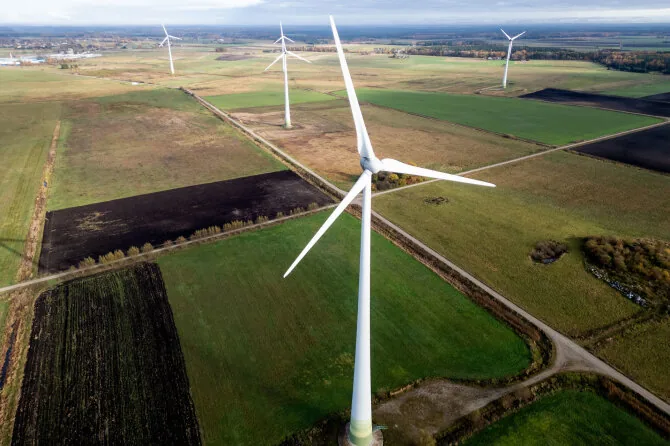
In the energy sector, the leader was „Interstic“ registered in Vilnius (sale of gas and gas equipment) with 42.6 million euros turnover per employee. Next were „Potentia industriae“ engaged in electricity production with 18.8 million, „Vėjo parkai“ with 17.6 million, „Vėjas LT“ with 12.6 million, and „Idex Paneriškių“, which also supplies steam and hot water, with 11.1 million euros per employee. Four of these five companies employed one employee each last year.
A similar picture is seen in the real estate sector. „Ozo turto“ registered in Vilnius had a turnover per employee of 38.8 million euros, „Taikos turto“ – 26.8 million, „Kauno audinių projekto“ registered in Kaunas – 26.7 million, „Ozo biurų“ – 26.5 million, „Ozantis“ – 21.5 million euros. The average staff of all five companies last year was 1.
Super productivity, clever business model, or sector specificity?
Million-euro turnover per employee does not necessarily mean that one person directly creates turnover of tens of millions of euros through their work.
A project-based, investment, asset management, or holding-type company can manage high-value assets or financial flows and does not need a large permanent team. A trading company can resell high-value goods while outsourcing logistics, warehousing, accounting, IT, or other functions to external providers.
In corporate groups, some employees may also be concentrated in other legal entities, and part of the activity may be performed by subcontractors or other external service providers. Therefore, high turnover and only one or two employees primarily signal a specific business structure.
Restaurants and hotels do not generate millions per employee
A very different picture is seen in activities that require many staff to provide services.
In the accommodation and food service sector, the median turnover per employee was about 58 thousand euros. For comparison, in trade it was almost six times higher – about 332 thousand euros, in energy – 239 thousand, and in real estate activities – 611 thousand euros. Even lower median turnover per employee was in healthcare and social work – about 46 thousand, and education – about 39 thousand euros.
Read more Kaunas officers are investigating who decided to «get treated for free»
The difference is well illustrated by companies with larger staff. „Neringa Hotel“ registered in Vilnius, with an average of 30.5 employees, had turnover per employee of about 136 thousand euros. „Lietuva, viešbutis“ registered in Vilnius, with an average of 137 employees, had about 135 thousand, and „CNC catering“ registered in Kretinga district, with an average of 107.5 employees, had about 116 thousand euros. Similar differences are seen in other labor-intensive activities.
More clients in a hotel or restaurant usually means a greater need for receptionists, cooks, waiters, room cleaners, and other staff. Healthcare or education services also cannot be increased indefinitely without increasing the number of specialists.
„ORLEN Lietuva“ – a different example of million-euro turnover
The result of „ORLEN Lietuva“ in Mažeikiai shows that a company with many employees can also achieve a high figure.
Its turnover in 2025 was almost 5.37 billion euros, the average number of employees was 1539, and turnover per employee was 3.49 million euros. By this indicator, the company ranked third among manufacturing companies.
In the future, turnover per employee may increase further due to the development of artificial intelligence (AI). AI is already taking over some routine programming, analysis, customer service, marketing, and administrative tasks, so companies can achieve the same or greater operational volume with a smaller team. This is especially relevant for IT and other knowledge-intensive activities, where one employee using AI tools can perform much more work. Therefore, it is likely that in the future, higher turnovers per employee will also be seen in activities that currently require many employees.
Million-euro turnover – minimal wages
Another contrast is revealed by wage data. Comparing companies, the median of the monthly average gross wages „before taxes“ for 2025 was calculated for each. Unfortunately, it is not possible to compare the companies that declared the highest turnover per employee because „Sodra“ publishes wages only for economic entities with an average listed number of employees greater than three.
In the already mentioned „Fleet union“, turnover per employee was 29.3 million euros, while the median average wage in 2025 was about 3.0 thousand euros. Meanwhile, „Elenger“ registered in Vilnius, also engaged in fuel trade, had turnover per employee of 11.3 million euros, but last year’s median wage was about 5.2 thousand euros.
In the transport sector, „Lion Auto Auction“ registered in Klaipėda had turnover per employee of 4.9 million euros, and the median wage was about 1.6 thousand euros. „Global Ocean Link Lithuania“ (Vilnius), which achieved almost the same turnover of 4.7 million euros, had a median wage almost three times higher – about 4.6 thousand euros. „Girteka cargo“ had turnover per employee of about 3.9 million euros, and the median wage was about 2.7 thousand euros.
The contrast is even more striking in agriculture. „SAgra“ registered in Vilkaviškis district had turnover per employee of 2.07 million euros, but the median wage was about 930 euros. Meanwhile, the agricultural cooperative „Vilkaviškio grūdai“ had turnover per employee about 18% lower – 1.71 million euros, but the median wage was almost 2 thousand euros – more than twice as much as in „SAgra“.
Profit per employee record holders
An additional perspective is profit per employee. In this category, investment and controlling companies, which usually consolidate all profits earned in the group or holding companies, can boast very high figures.
In the financial and insurance activities group, profit per employee in „Skinarta“ registered in Kaunas was almost 32.0 million euros in 2025, in „J investicijos“ registered in Vilnius – 16.0 million, and in „SBA furniture group“ – 12.2 million euros. In the professional, scientific, and technical activities group, „tesonet fhc“ (formerly „Tesonet Global“) established in Vilnius had a figure of about 27.0 million euros.
Read more In the «Rokiškio Grand Rally» qualification, the pace was set by Vaidotas Žala