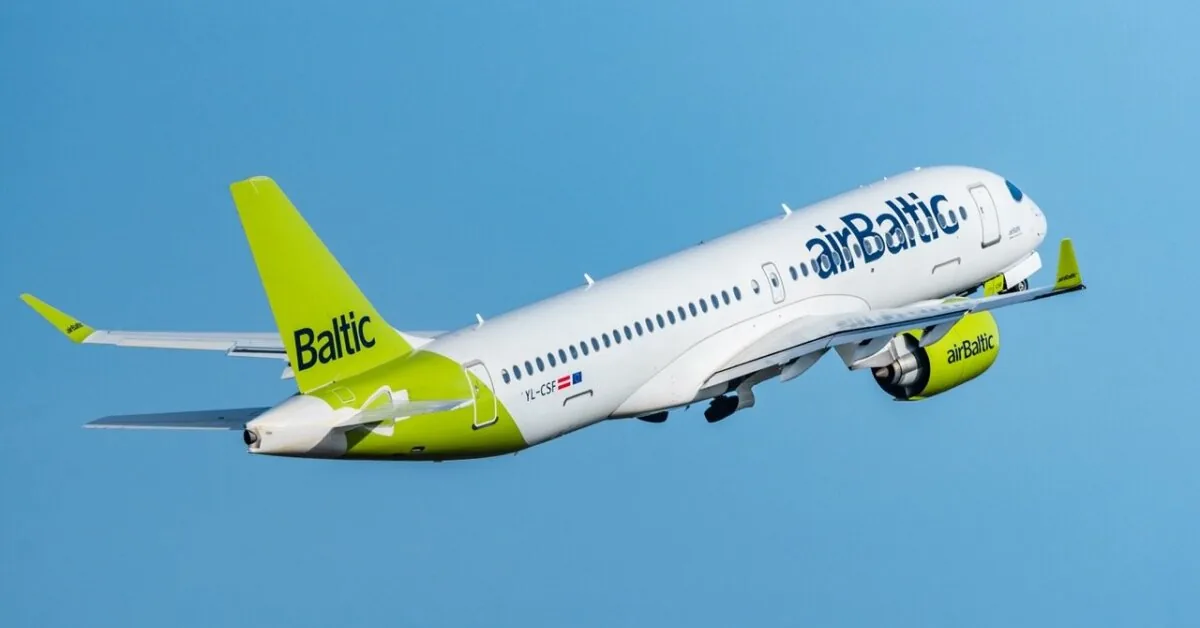
The plan envisions a more concentrated flight network structure centered around Riga, a smaller fleet consisting solely of Airbus A220-300 aircraft, stronger year-round ACMI partnerships, and greater operational efficiency. The goal is to create a more resilient business and improve its financial sustainability.
Read more Southern Europe is on fire: tourists no longer know what to do
This announcement is made during airBaltic’s discussions with key stakeholders and potential interim financing providers. During this process, certain financial and operational information from the updated business plan was shared with selected parties under confidentiality agreements and is now being disclosed through an information release statement (“cleansing statement”) published by Euronext Dublin. The proposed interim financing and broader recapitalization have not yet been agreed or finalized and remain subject to agreements with stakeholders, necessary bondholder approvals, and other confirmations.
In light of the proposed recapitalization and new business plan, holders of airBaltic’s 2029 redeemable secured senior bonds are encouraged to participate in upcoming voting processes. A re-vote on the necessary resolutions will take place on August 17, 2026, with further voting stages planned thereafter.
Updated plan for a fundamentally changed operating environment
The previous business plan, prepared in anticipation of a planned initial public offering (IPO), envisaged long-term growth in passenger traffic and ticket revenue in the Baltic region and broader European markets, which would have allowed expanding the fleet to 100 aircraft.
Since then, the operating environment has fundamentally changed. Demand and revenue growth have slowed, geopolitical developments in Ukraine and the Middle East have increased uncertainty and operating costs, and prolonged Pratt & Whitney engine availability restrictions have affected the airline’s ability to utilize its entire fleet.
The updated business plan responds to these changes by consciously shifting priorities: first, financial stability; second, growth. airBaltic’s flight network, fleet, cost base, and capital structure are adapted to current market conditions while maintaining the airline’s core role in providing connectivity for Latvia and the wider Baltic region. Future growth will be moderate and focused on opportunities that ensure sustainable profitability, cash generation, and a stronger balance sheet.
“Every successful airline must continuously adapt to a changing market. Therefore, this business plan is about disciplined decisions that strengthen airBaltic’s long-term competitiveness while preserving what matters most – reliable connectivity, operations, and financial sustainability. It provides the company with a stronger foundation for the future and enables us to create long-term value for customers, partners, and Latvia,” said Erno Hildén, airBaltic President and CEO.
Commitment to maintaining connectivity for Latvia and the wider region
In the new business plan, airBaltic is positioned as a strong national airline with a demand-driven flight network, efficient operations, and a solid foundation for long-term financial results.
The business plan outlines a flight network strategy centered on Riga, Latvia. Rather than pursuing large-scale expansion, airBaltic will focus primarily on strengthening its positions in existing markets by increasing flight offerings and frequencies where demand and profitability are highest. The company’s bases will continue to complement the network with selected point-to-point city services, while tactical and seasonal flights will help optimize fleet utilization year-round.
airBaltic expects to operate approximately 36 Airbus A220-300 aircraft by the end of 2026 (currently 54), with the fleet gradually increasing to about 40 aircraft by 2031. Despite a smaller fleet, regular flight capacity is expected to remain broadly stable due to better aircraft utilization. Additionally, closer commercial partnerships with ACMI partners will enable more efficient year-round aircraft use and reduce seasonal business fluctuations.
Available seat kilometers (ASK) for scheduled flights are forecasted to decrease from about 9.6 billion in 2026 to 8.7 billion in 2027, then gradually increase to approximately 10.5 billion by 2031. This reflects a more concentrated, profit-oriented flight network strategy.
Greater resilience through ACMI partnerships and structurally lower cost base
Strengthening commercial partnerships with ACMI clients will help airBaltic return to profitability under the new model. More balanced capacity allocation across both summer and winter seasons will help increase margins by significantly reducing the company’s fixed cost burden during the winter season, while also reducing the seasonality of the flight network business, diversifying the revenue base, and providing greater flexibility in allocating aircraft according to market demand.
Read more «Azov» soldiers showed how they burned a Russian military convoy: «Run away, occupiers»
By implementing joint fleet, flight network, and operational initiatives, airBaltic aims to achieve approximately €45 million in recurring annual benefits, mainly through operating cost reductions as well as leveraging revenue growth opportunities. In the updated plan, strict cost control is a priority alongside revenue growth to restore financial capacity: improved margins and increased cash generation are expected to be achieved through both more disciplined capacity utilization and a structurally lower cost base.
Recapitalization to create a sustainable capital structure
To meet near-term liquidity needs and support the implementation of the updated business plan, airBaltic seeks to obtain €225 million in interim financing. The interim financing is intended to provide the company with a financial bridge until a permanent financing solution is secured and remains subject to necessary bondholder approvals and other confirmations.
The proposed permanent financing package consists of up to €225 million in new debt financing and €100 million in new equity. The proposed recapitalization also includes a partial conversion of the 2029 redeemable secured senior bonds into equity, with the remaining portion replaced by new, smaller debt of up to €125 million, as well as a partial conversion of certain other balance sheet liabilities into equity. Some elements of the proposed recapitalization still require relevant approvals.
Financial outlook
According to the updated business plan, airBaltic expects revenues to reach approximately €0.8 billion in 2027, increase to €0.9 billion in 2029, and €1.0 billion in 2031.
EBITDAR is forecasted to increase to about €192 million in 2027, €243 million in 2029, and €300 million in 2031, with EBITDAR margins of approximately 25–29%.
The business plan also anticipates a gradual strengthening of the company’s financial position, driven by both improved operational results and the implementation of the proposed recapitalization. This is reflected in the net financial leverage ratio, calculated as net debt / EBITDAR. This ratio indicates how many times the company’s net debt exceeds its annual earnings capacity; the lower the ratio, the stronger the company’s financial position.
Net financial leverage is expected to be approximately 4.8 times at the end of 2026 after recapitalization completion, decreasing to about 2.4 times by the end of 2029, and further reducing to around 1.6 times by the end of 2031.
The above financial information is based on current airBaltic expectations and assumptions and is not a guarantee of future performance. Actual results may differ significantly due to various factors, including fuel prices, exchange rates, inflation, demand trends, supply chain disruptions, and successful implementation of the company’s business plan.
The company continues to implement the business plan by undertaking interrelated actions and will provide additional information through the stock exchange in the future as required.
airBaltic continues to operate as usual, and all scheduled flights are operating as planned. The implementation of the business plan will not affect the airline’s daily operations or services provided to passengers.
It is recalled that amid financial difficulties, Air Baltic announced it will suspend flights from Vilnius Airport to Berlin and Dubai for the upcoming winter season, from Palanga to Tenerife, and reduce frequencies between Vilnius and Tallinn, the company told BNS.
Read more Trump spoke briefly about his relationship with Benjamin Netanyahu