However, the problem is not only illegal trade: products that do not meet requirements are still sold in regular retail outlets – retail chains, gas stations, and elsewhere. According to experts, this indicates not only gaps in control but also a lack of responsibility on the part of traders. This is discussed in the podcast “Lietuva sveiksta” (Lithuania is recovering), hosted by Laura Dabulytė, according to a press release.
Doctors: sometimes we cannot say what a person was poisoned by
“Standard tests only allow us to identify a part of classic narcotic substances, but today more and more synthetic compounds are appearing on the market that they do not detect. A person arrives clearly intoxicated, but the tests may be negative because standard tests simply do not detect it,” says Julius Jaramavičius, head of Santaros Clinics Emergency Medicine Center, emergency medicine doctor.
According to the doctor, patients admitted to emergency departments often complain of severe anxiety, hallucinations, heart rhythm disorders, and in more severe cases, impaired consciousness, seizures, or respiratory problems.
“If you see a person who is not responding to questions, speaking incoherently, or losing consciousness, do not wait – it is essential to call an ambulance as soon as possible. In such situations, time can be crucial,” emphasizes the doctor.
According to J. Jaramavičius, the biggest concern is that young people often do not even know what they are actually vaping.
“Poisonings from legal products are extremely rare. If there are signs of poisoning, it is likely that there is more than just simple nicotine in that electronic cigarette. Illegal products can contain practically anything – from synthetic cannabinoids to opioids or other psychoactive substances and other dangerous chemical compounds. This means that children or young people can inhale substances whose composition is unknown to themselves, doctors, or sellers,” states J. Jaramavičius.
Professor Čaplinskas: we cannot wait until all consequences become clear
Member of the Seimas of the Republic of Lithuania, Doctor of Medical Sciences Professor Saulius Čaplinskas says that today we already have enough arguments to take more decisive action.
“If a product is clearly aimed at children, is attractive in terms of colors, flavors, shape, and poses a health risk, we should not wait another fifteen or twenty years until all evidence of long-term consequences is collected. We are already seeing short-term harm now,” says the professor.
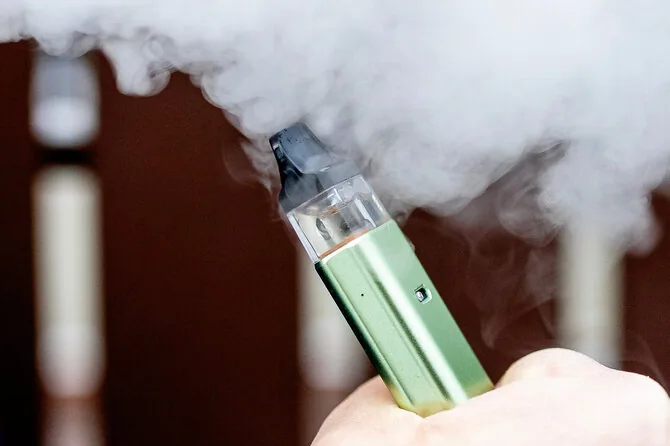
According to him, disposable electronic cigarettes become a gateway to addiction.
“We must clearly state – such products must not be accessible to children. Just as today we can no longer imagine smoking on planes or in restaurants, in the future we should not tolerate colorful disposable electronic cigarettes intended for children,” says S. Čaplinskas.
Read more Were huge sums of money really found in Zelensky’s parents’ account?
The professor emphasizes that the most important thing is not just prohibitions, but also a clear message sent by society.
“Children learn from their environment. If they see that smoking or vaping is a common phenomenon, they accept it as the norm. Therefore, prevention begins not in the Seimas, but in the family, school, and society as a whole,” says S. Čaplinskas.
The problem is not a lack of laws, but their non-compliance
Liudas Zakarevičius, External Affairs Director for the Baltic States at “Philip Morris”, points out that the trade in electronic cigarettes in Lithuania is already strictly regulated, but in practice, a significant part of the products on the market still do not meet the valid requirements.
“The biggest problem today is not a lack of laws. The problem is that they are not complied with. Inspections by the State Consumer Rights Protection Authority show that a large proportion of electronic cigarettes do not meet the valid requirements, but this does not prevent such products from continuing to be sold,” he says.
According to L. Zakarevičius, fines today often become merely business costs.
“If the fines imposed for violations are less than the profit earned, they do not serve their purpose. Therefore, it is necessary to strengthen control and provide for significantly stricter liability for those who deliberately violate the laws,” explains L. Zakarevičius.
He emphasizes that when it comes to minors, there can be no compromises.
“Tolerance towards children must be zero. Minors must neither consume nor have the opportunity to acquire nicotine products. This requires not only state control but also responsible business behavior,” asserts L. Zakarevičius.
The discussion participants agree that the problems caused by electronic cigarettes cannot be solved by prohibitions alone. To protect children and adolescents, it is necessary to strengthen market supervision, more effectively combat illegal trade, increase responsibility for violations, invest in prevention, and ensure that existing laws are actually implemented.
Read more Dubai is turning things around: it has come up with a new way to get tourists back