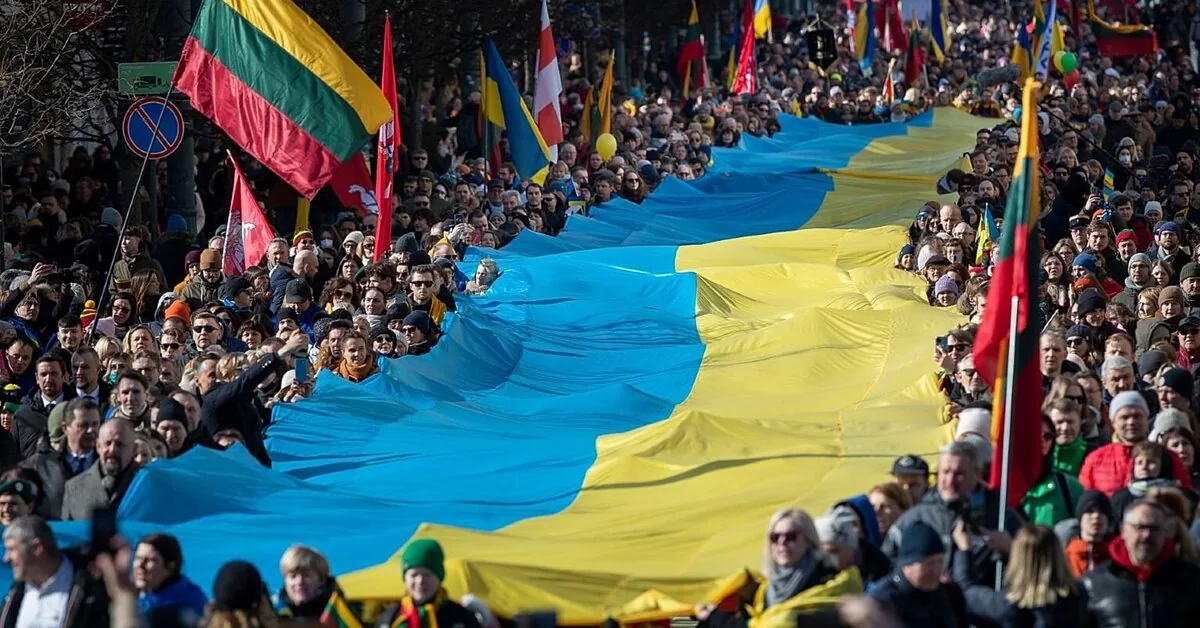
Since the beginning of the war in Ukraine in 2022 and the repressions of the Lukashenko regime in Belarus, Lithuania has become one of the most involved European countries in accepting refugee students. The country’s universities, supported by European institutions and civil society, have created specific measures that allow young people to continue their studies despite exile.
Read more At the seaside, officers worked tirelessly: they checked 1186 drivers, 10 have serious troubles
Significant share of foreign students
Ukrainian and Belarusian students today make up the two largest foreign nationalities in Lithuanian universities, surpassing India. Of the 10,579 foreign students registered in the 2022/23 academic year, Ukrainians account for about 16.7% of all foreign students — more than 1,700 students. Belarusians, although their exact share is not published separately, consistently rank among the top three nationalities — a trend driven by geographic and cultural proximity and an active admission policy in Vilnius. For comparison, in the total foreign population living in Lithuania, Ukrainians make up 35%, and Belarusians 26%, indicating the scale of migration flow from these two countries.
Significant financial commitment
Lithuania has allocated nearly 32 million euros to support the education of Ukrainian refugees, including 4.2 million for university tuition fees, scholarships, and other benefits. Although in September 2024 the Lithuanian government decided to no longer reimburse tuition fees for newly arrived Ukrainians — who now have to compete for state-funded places through the general admission procedure alongside Lithuanian students — several universities have decided to independently maintain this funding. This is especially true for Vilnius College, Vilnius Gediminas Technical University, and Vytautas Magnus University — a strong signal of academic commitment that goes beyond political decisions.
Gradual but real integration
The integration of refugee students into the environment of Lithuanian universities is gradually taking place. Lecturers emphasize that Ukrainian and Belarusian students adapt relatively well, partly due to cultural and linguistic proximity. Learning the Lithuanian language demonstrates a visible integration effort: the share of Ukrainian refugees able to communicate effectively in Lithuanian increased from 26% in 2024 to 34% in 2025 — an eight percentage point growth in one year, a positive sign towards long-term integration.
For many of these students, the opportunity to study at university means much more than a diploma: it is an establishment, a continuation of life in the face of a break imposed by war and repression.
Vilnius — the academic crossroads of Eastern Europe
By accepting both Ukrainian students fleeing bombs and Belarusian students fleeing an authoritarian regime, Vilnius is establishing itself as a true academic crossroads of Eastern Europe. Lithuanian universities not only open doors — they build bridges between wounded societies and a shared European future, concretely embodying the values of solidarity and academic freedom that Europe proclaims to defend.
Read more EK leader calls to restrict access to social networks based on users’ age